Kitchen Sage (Salvia officinalis)
Formerly Salvia lavandulifolia, Salvia clusii, Salvia crispa
Kitchen sage does well in full sun, and it also takes part shade. It prefers well-drained soil that runs from medium to dry. The ASPCA lists it as non-toxic to cats and to dogs. Hardy in zones 4a to 8b, it is an evergreen shrub that reaches 1–2 ft (0.3–0.6 m) tall.
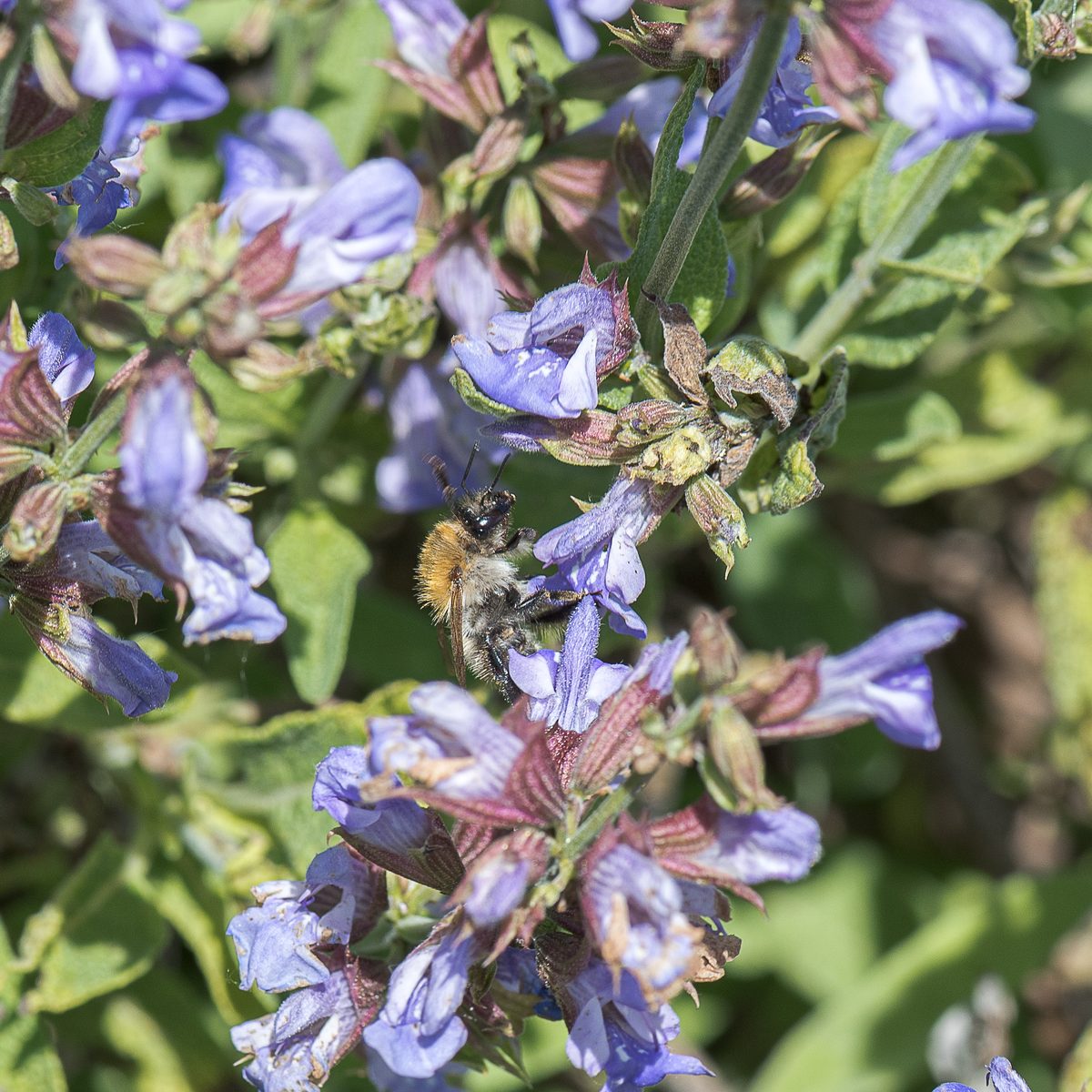
Photo: Flocci Nivis, CC BY 4.0 via Wikimedia Commons

Quick facts
| Light: | Full sun and part shade (full sun preferred)11 source |
|---|---|
| Water: | Dry to medium112 |
| Soil: | Well drained and occasionally dry; pH 6–811 source |
| Hardiness: | Zones 4a–8b11 source |
| Size: | 1–2 ft (0.3–0.6 m) × 2–3 ft (0.61–0.91 m)11 source |
| Growth rate: | Moderate11 source |
| Bloom: | Blue, pink and purple11 source |
| Cats: | Non-toxic to cats 14 |
| Dogs: | Non-toxic to dogs 14 |
| Native range: | ALB, FRA, GER, GRC, ITA, SPA, SWI, YUG5 |
| Family: | Lamiaceae |
How much light does a Kitchen Sage need?
Full sun, meaning 6 or more hours of direct sunlight a day, is the preferred exposure for kitchen sage. Part shade is also listed among its accepted conditions. Choose full sun where you can, and treat part shade as the second choice. These are the two outdoor light levels recorded for this plant.
- Light: Full sun and part shade (full sun preferred)1
How often to water a Kitchen Sage
Dry to medium soil moisture suits kitchen sage. It prefers well-drained soil, and the soils it prefers mimic those of its Mediterranean homeland. Good drainage is listed for it as well. The plants are described as very tolerant of drought. Medium is the wettest end of its listed moisture range.
Best soil for a Kitchen Sage
Well-drained soil that is occasionally dry is the listed match for kitchen sage. Good drainage is the feature to look for in a planting site. Soil moisture from medium to dry is preferred. The recorded pH range is neutral, from 6.0 to 8.0. The plants are described as very tolerant of poor soil as well as drought. Drainage and pH are the two soil conditions recorded for this plant.
Hardiness and temperature
Zones 4a to 8b are listed for kitchen sage. The full list runs through 4a, 4b, 5a, 5b, 6a, 6b, 7a, 7b, 8a and 8b. Zones 4a and 8b are the cold and warm limits of that list. Kitchen sage is an evergreen shrub. Its native range is recorded as Albania, France, Germany, Greece, Italy, Spain, Switzerland and Yugoslavia.
- Hardiness: Zones 4a–8b1
Fertilizing a Kitchen Sage
Feeding is not needed for kitchen sage, and the recorded fertilizer frequency is none. The plants are very tolerant of drought and poor soil, so little is required regarding irrigation and fertility. Irrigation and fertility both ask little of you. Poor soil is among the conditions it tolerates.
- Fertilizer: Not needed2
Pruning a Kitchen Sage
The pruning on record for kitchen sage is to remove dead growth only. The guidance is to cut the plant back in spring, taking out any dead portions. Nothing beyond dead growth is called for in that entry. Maintenance effort is rated medium. Growth rate is moderate.
- Pruning: Remove dead growth only3
How to plant a Kitchen Sage
Choose a planting site in USDA zones 4a through 8b. Space plants with room for a mature spread of 2–3 ft (0.61–0.91 m). Leave room above for a height of 1–2 ft (0.3–0.6 m). Pick a spot in full sun with well-drained soil. A soil pH of 6 to 8 suits it.
- Hardiness: Zones 4a–8b1
Winter care
Kitchen sage is described as an evergreen shrub. It is listed for zones 4a through 8b, from the colder to the warmer end of that span. Dead portions are cut back in spring, and that is the only pruning listed. Good drainage is listed for it, along with soil that is occasionally dry. Feeding is not needed.
- Hardiness: Zones 4a–8b1
How to propagate a Kitchen Sage
Three propagation methods are listed for kitchen sage: layering, seed and stem cuttings. Layering is one route, seed is another, and stem cuttings are the third. Each is recorded as a way to make new plants of this species. Plan for each new plant to reach 1–2 ft (0.3–0.6 m) tall and 2–3 ft (0.61–0.91 m) wide.
- Propagation: Layering, seed and stem cuttings1
Common problems
Leaf hoppers, slugs, spider mites and spittlebugs are the pests listed as possible on kitchen sage. Root rot, powdery mildew and verticillium wilt can occur as diseases. Four pests and three diseases are on that list. Deer resistance is reported for this plant.
| Problem | Kind |
|---|---|
| Leaf hoppers | Pest |
| Slugs and snails | Pest |
| Spider mites | Pest |
| Spittlebugs | Pest |
| Root rot | Disease |
| Powdery mildew | Disease |
| Verticillium wilt | Disease |
Is Kitchen Sage toxic to cats and dogs?
For cats, kitchen sage is listed as non-toxic. For dogs, the listing is the same: non-toxic. The ASPCA Animal Poison Control Center records the entry as Non-Toxic to Dogs and Non-Toxic to Cats. The NC State Extension Gardener Plant Toolbox lists it as non-toxic for cats and non-toxic for dogs. Non-toxic is the status recorded for each of the two animals on this page.
Recommended supplies
- Soil: a free-draining mix, and a pot with a drainage hole.
Questions and answers
- Is kitchen sage toxic to cats or dogs?
- It is listed as non-toxic to cats and non-toxic to dogs by the ASPCA Animal Poison Control Center. NC State Extension also lists it as non-toxic for each animal.
- How much sun does kitchen sage need?
- Full sun is preferred, which means 6 or more hours of direct sunlight a day. Part shade is also listed as suitable. Choose full sun where you can.
- Does kitchen sage need fertilizer?
- Fertilizer is listed as not needed. The plants are very tolerant of drought and poor soil, so little is required regarding irrigation and fertility. Dry to medium soil that drains well is preferred.
Sources
- NC State Extension Gardener Plant Toolbox. https://plants.ces.ncsu.edu/plants/salvia-officinalis/. Accessed 14 October 2026.
- Clemson Cooperative Extension Home & Garden Information Center. https://hgic.clemson.edu/sage-the-wisest-herb/. Accessed 14 October 2026.
- Penn State Extension. https://extension.psu.edu/edible-landscapes-herbs-and-flowers. Accessed 14 October 2026.
- ASPCA Animal Poison Control Center. https://www.aspca.org/pet-care/aspca-poison-control/toxic-and-non-toxic-plants/sage. Accessed 14 October 2026.
- Royal Botanic Gardens, Kew (World Checklist of Vascular Plants). https://sftp.kew.org/pub/data-repositories/WCVP/wcvp.zip. Accessed 4 June 2026.
How this page was made
- Written with AI assistance from the sources listed on this page. AI is never the source of a fact.