Tiger Lily (Lilium lancifolium)
Formerly Lilium tigrinum, Lilium leopoldii, Lilium lishmannii
Tiger lily, Lilium lancifolium, does best in full sun and tolerates part shade, with a medium water need. It is a bulb, and its stems stand about 4 ft (1.22 m) tall. The ASPCA lists it as toxic to cats. The ASPCA lists it as non-toxic to dogs.
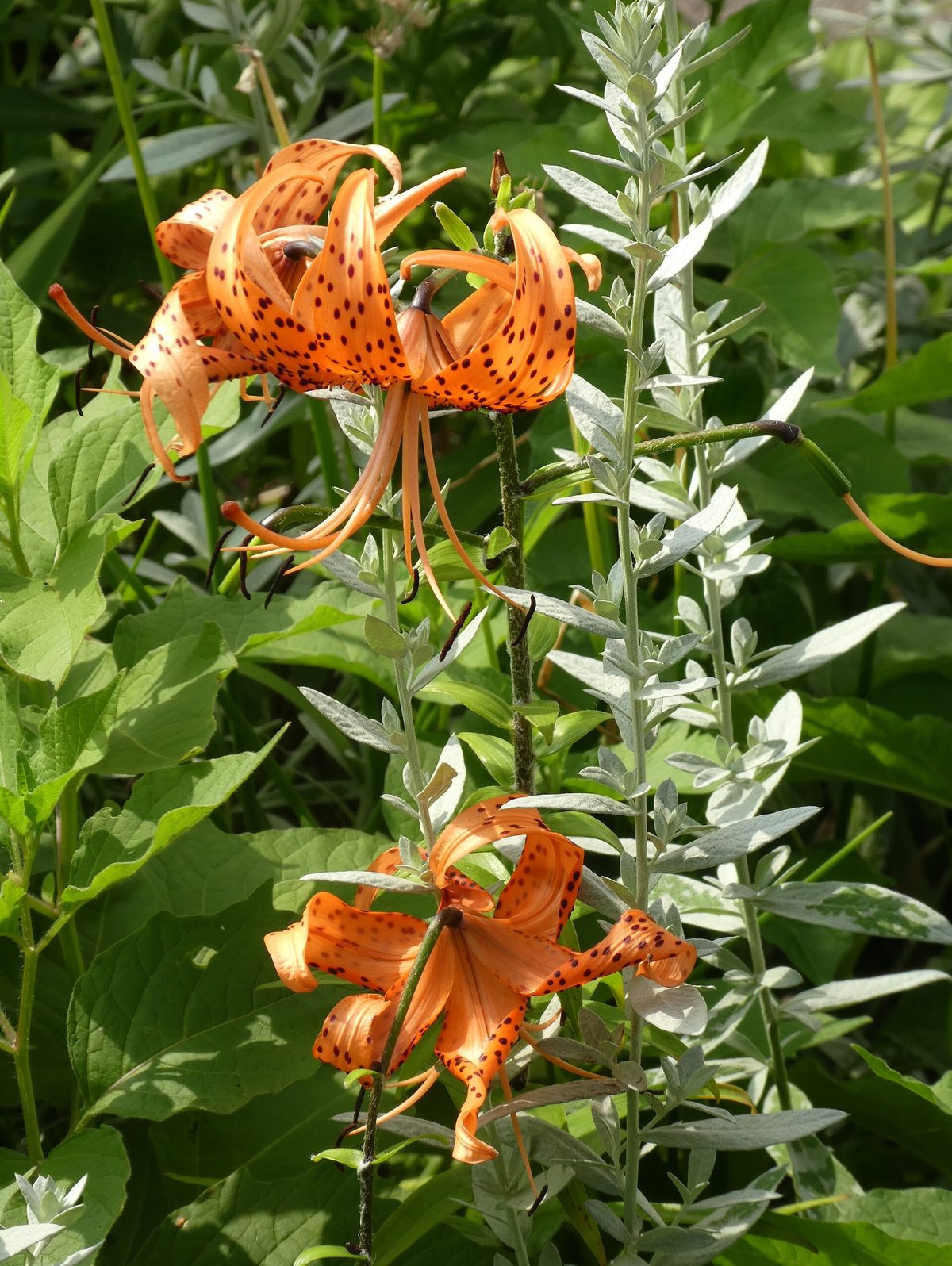
Photo: Екатерина Борисова, CC BY-SA 4.0 via Wikimedia Commons

Quick facts
| Light: | Full sun and part shade (full sun preferred)12 |
|---|---|
| Water: | Medium32 |
| Soil: | Well drained and moist; pH 6–7123 |
| Hardiness: | Zones 5a–8b11 source |
| Size: | 4 ft (1.22 m) × 1–2 ft (0.3–0.61 m)611 source |
| Growth rate: | Rapid111 source |
| Bloom: | Jul–Aug, White, yellow, orange and red6211 source |
| Cats: | Toxic to cats 415 |
| Dogs: | Non-toxic to dogs 41 |
| Native range: | CHC, CHM, CHN, CHQ, CHS, CHT, JAP, KOR, KUR, PRM, SAK7 |
| Family: | Liliaceae |
How much light does a Tiger Lily need?
Tiger lily prefers full sun, and part shade is also listed for it. A good site receives sun or part shade and has well-drained soil. In shadier conditions the plant will survive, but flower production will be poor. Full sun is the exposure to choose if flowers matter to you.
How often to water a Tiger Lily
Tiger lily has a medium water need. Medium is both the lowest and the highest water level listed for this plant. One extension source puts that at about one inch (2.5 cm) of water per week. Another says lilies need to be kept moist. The soil it grows in is listed as both well drained and moist.
Best soil for a Tiger Lily
Tiger lily grows in soil that is well drained and moist. One source lists good drainage for it, and another says lilies need well-drained soil. Moist is listed alongside well drained, not in place of it. The preferred pH range is 6–7. Iowa State describes lilies as preferring slightly acidic soils high in organic matter, with a pH of 6.0 to 7.0.
Hardiness and temperature
Tiger lily is listed for USDA zones 5a to 8b. That range covers eight zone steps: 5a, 5b, 6a, 6b, 7a, 7b, 8a and 8b. Zone 4 and colder fall outside that range. No cited source records a minimum temperature for it. Humidity needs are not documented either.
- Hardiness: Zones 5a–8b1
Fertilizing a Tiger Lily
Feed tiger lily every two weeks in the growing season. Iowa State describes water-soluble fertilizers applied regularly through the growing season, every 2 to 3 weeks. Water-soluble types are the kind that source names. A fertilizer ratio and an amount per feeding are not documented for this plant.
- Fertilizer: Every two weeks in the growing season3
Pruning a Tiger Lily
Deadhead tiger lily by removing spent blooms promptly. According to Iowa State, this prevents seed production and redirects energy back into bulb development. Deadheading is the only pruning type listed for this plant. Cutting back stems, shaping and other pruning methods are not documented here.
How to plant a Tiger Lily
Plant tiger lily in USDA zones 5a to 8b. Choose a site with full sun and well-drained, moist soil. Leave room for a plant about 4 ft (1.22 m) tall and 1–2 ft (0.3–0.61 m) wide. It is a bulb. In the lower 48 US states it is listed as introduced. Planting depth and spacing between bulbs are not documented here.
- Hardiness: Zones 5a–8b1
Winter care
Tiger lily is listed for USDA zones 5a to 8b, and zone 5a is the coldest of them. Gardeners in zone 4 or colder are outside the listed range. No cited source records a minimum temperature for the plant. Winter mulching, lifting and storage are not documented either.
- Hardiness: Zones 5a–8b1
Common problems
The pests listed for tiger lily are bulb mites, aphids, slugs and snails, potato aphid, narcissus bulb fly and white-tailed deer. Aphids appear twice on that list, as aphids and as potato aphid. Common diseases are not documented for this plant. Treatment methods for these pests are not documented either.
- Common pests: bulb mites, aphids, slugs and snails, potato aphid, narcissus bulb fly and white tailed deer1
| Problem | Kind |
|---|---|
| Bulb mites | Pest |
| Aphids | Pest |
| Slugs and snails | Pest |
| Potato aphid | Pest |
| Narcissus bulb fly | Pest |
| White tailed deer | Pest |
Is Tiger Lily toxic to cats and dogs?
The ASPCA lists tiger lily as toxic to cats. NC State Extension's Plant Toolbox also marks it as a problem for cats. For dogs, the ASPCA lists it as non-toxic. NC State Extension likewise describes it as non-toxic for dogs. The toxic parts, signs and severity are not documented in the facts for this page. Cats and dogs are the two animals this site covers.
Pet-safe alternatives
Recommended supplies
- Soil: a free-draining mix, and a pot with a drainage hole.
Questions and answers
- Is tiger lily toxic to cats and dogs?
- The ASPCA lists tiger lily as toxic to cats, and NC State Extension marks it as a problem for cats. The ASPCA lists it as non-toxic to dogs. Cats and dogs are the two animals this site covers.
- Where should I plant tiger lily?
- Full sun is preferred, and part shade is also listed. In shadier conditions it will survive, but flower production will be poor. Pick well-drained, moist soil in USDA zones 5a to 8b.
- How tall does tiger lily grow, and what colors are the flowers?
- The stems stand about 4 ft (1.22 m) tall. Flowers come in white, yellow, orange and red. The plant spreads 1–2 ft (0.3–0.61 m) wide.
Sources
- NC State Extension. https://plants.ces.ncsu.edu/plants/lilium-lancifolium/. Accessed 14 October 2026.
- Clemson Cooperative Extension HGIC. https://hgic.clemson.edu/factsheet/summer-and-fall-flowering-bulbs/. Accessed 14 October 2026.
- Iowa State University Extension and Outreach. https://yardandgarden.extension.iastate.edu/how-to/growing-lilies-iowa. Accessed 14 October 2026.
- ASPCA Animal Poison Control Center. https://www.aspca.org/pet-care/aspca-poison-control/toxic-and-non-toxic-plants/tiger-lily. Accessed 14 October 2026.
- Pet Poison Helpline. https://www.petpoisonhelpline.com/poison/tiger-lily/. Accessed 14 October 2026.
- Chicago Botanic Garden. https://www.chicagobotanic.org/plant-information/plant-finder/lilium-lancifolium-tiger-lily. Accessed 14 October 2026.
- Royal Botanic Gardens, Kew (World Checklist of Vascular Plants). https://sftp.kew.org/pub/data-repositories/WCVP/wcvp.zip. Accessed 4 June 2026.
How this page was made
- Written with AI assistance from the sources listed on this page. AI is never the source of a fact.