Common St. Johnswort (Hypericum perforatum)
Formerly Hypericum assurgens, Hypericum komarovii, Hypericum lineolatum
Give common St. Johnswort full sun, with part shade as the other listed option. It is hardy in USDA zones 3a to 8b. The ASPCA lists Hypericum perforatum as toxic to both cats and dogs. Plants grow 1 to 3.3 ft (0.3 to 1 m) tall.
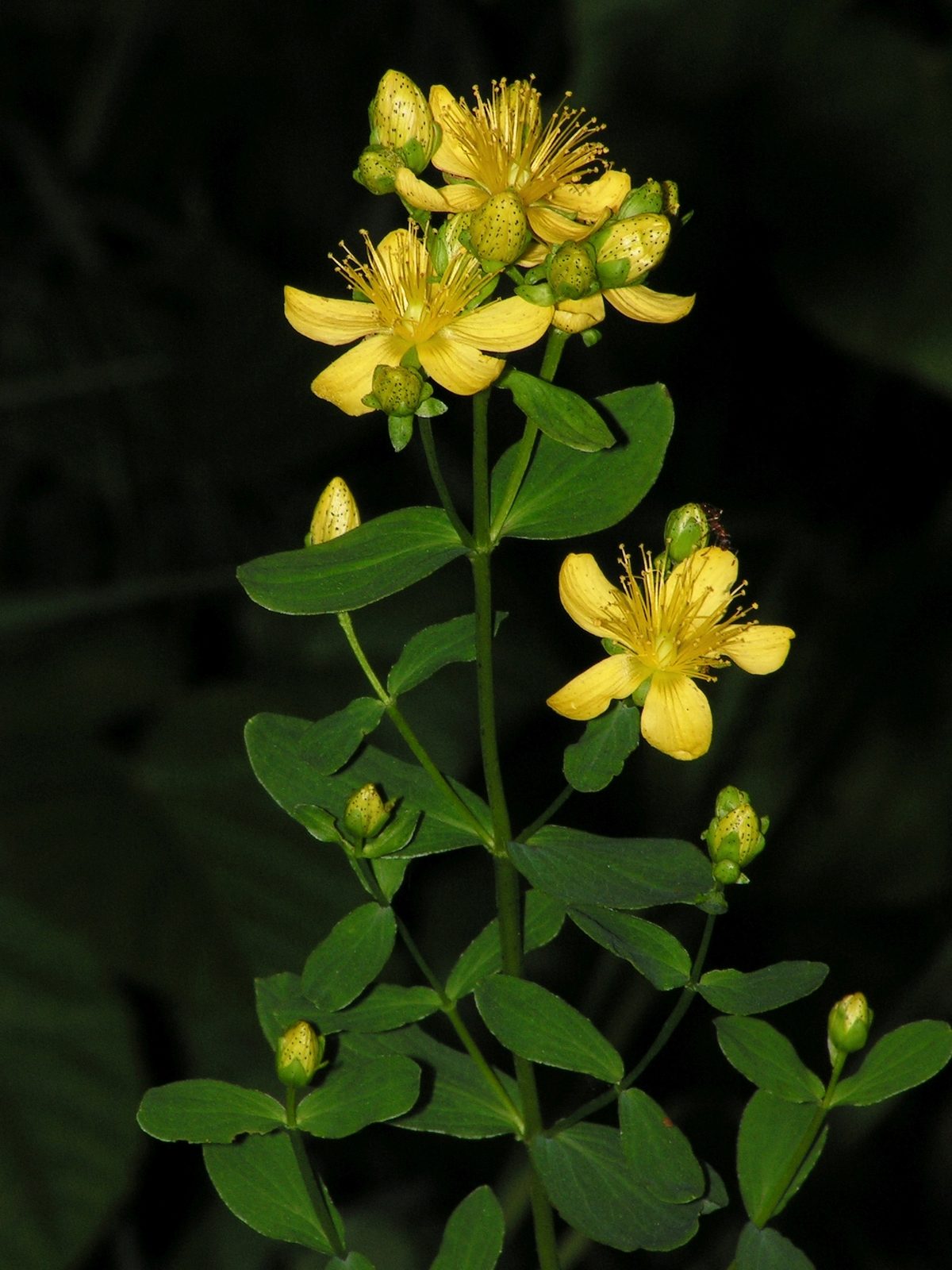
Photo: Bff, CC BY-SA 4.0 via Wikimedia Commons

Quick facts
| Light: | Full sun and part shade (full sun preferred)11 source |
|---|---|
| Soil: | Well drained and moist11 source |
| Hardiness: | Zones 3a–8b11 source |
| Size: | 1–3.3 ft (0.3–1 m) × 0.7–2 ft (0.23–0.61 m)21 |
| Growth rate: | Moderate11 source |
| Bloom: | May–Aug, Yellow15 |
| Cats: | Toxic to cats 41 |
| Dogs: | Toxic to dogs 41 |
| Native range: | ALB, ALT, AUT, BGM, BLR, BLT, BUL, CHC, CHN, CHQ, CHS, CHX, CYP, CZE, DEN, EAI, FIN, FRA, GER, GRB, GRC, IRE, ITA, KAZ, KGZ, KRA, KRY, LBS, MOR, NCS, NET, NOR, POL, POR, ROM, RUC, RUE, RUS, RUW, SPA, SWE, SWI, TUR, UKR, WSB, YUG6 |
| Family: | Hypericaceae |
How much light does a Common St. Johnswort need?
Common St. Johnswort grows best in full sun, which the source defines as 6 or more hours of direct sunlight a day. Part shade is also listed as a suitable exposure for this plant. Of the two, full sun is the preferred exposure, so choose it when your site offers both.
- Light: Full sun and part shade (full sun preferred)1
Best soil for a Common St. Johnswort
Plant common St. Johnswort in soil that is well drained. Moist soil is also listed for this species, so both drainage descriptions apply to it. The drainage listing gives these two conditions and no others. Soil is one part of a good site, and the plant is also listed for USDA zones 3a to 8b. It grows at a moderate rate and reaches 1 to 3.3 ft (0.3 to 1 m) tall.
- Soil drainage: Well drained and moist1
Hardiness and temperature
Common St. Johnswort is listed for USDA hardiness zones 3a to 8b. The cold end of that range matches a minimum temperature of -40 °F (-40 °C). The warm end of the range is zone 8b. That range covers zones 3a, 3b, 4a, 4b, 5a, 5b, 6a, 6b, 7a, 7b, 8a and 8b. Within those zones, the plant grows at a moderate rate.
How to plant a Common St. Johnswort
Common St. Johnswort suits gardens in USDA zones 3a to 8b. Mature plants stand 1 to 3.3 ft (0.3 to 1 m) tall and 0.7 to 2 ft (0.23 to 0.61 m) wide, so leave room for that width when you set plants out. Choose a spot with full sun, since part shade is also listed but full sun is preferred. The soil should be well drained, and moist soil is also listed. Plants grow at a moderate rate.
- Hardiness: Zones 3a–8b1
Winter care
In zones 3a to 8b the plant is listed as hardy, with a minimum temperature of -40 °F (-40 °C). The source describes it as a herbaceous, perennial, deciduous or evergreen shrub. Gardeners in the coldest listed zone, 3a, are within the range of this plant. Zone 8b is the warmest zone on the list.
How to propagate a Common St. Johnswort
Division and seed are the two propagation methods listed for common St. Johnswort. The source says the plant reproduces by seed and by sprouting from lateral roots and root crowns. Seed is one route to new plants, and sprouting from the roots and crowns is the other. Mature plants measure 0.7 to 2 ft (0.23 to 0.61 m) wide.
- Propagation: Division and seed2
Common problems
Choristoneura parallela and Luperomorpha xanthodera are the pests listed for common St. Johnswort. The diseases listed are Candidatus Phytoplasma fraxini, Candidatus Phytoplasma solani and Xylella fastidiosa. In total, the record names two pests and three diseases for common St. Johnswort, Hypericum perforatum.
| Problem | Kind |
|---|---|
| Choristoneura parallela | Pest |
| Luperomorpha xanthodera | Pest |
| Candidatus phytoplasma fraxini | Disease |
| Candidatus phytoplasma solani | Disease |
| Xylella fastidiosa | Disease |
Is Common St. Johnswort toxic to cats and dogs?
The ASPCA lists common St. Johnswort as toxic to cats. It also lists the plant as toxic to dogs. Both animals carry the same toxic position in the ASPCA record. NC State Extension's Plant Toolbox flags the plant as a problem for cats. The same Plant Toolbox entry flags it as a problem for dogs. Cats and dogs are therefore both covered by the toxic listing for Hypericum perforatum.
Pet-safe alternatives
Recommended supplies
- Soil: a free-draining mix, and a pot with a drainage hole.
Questions and answers
- Is common St. Johnswort toxic to cats and dogs?
- The ASPCA lists Hypericum perforatum as toxic to both cats and dogs. NC State's Plant Toolbox also flags it as a problem for each of those animals.
- How cold can common St. Johnswort get?
- It is listed for USDA zones 3a to 8b, with a minimum temperature of -40 °F (-40 °C). That range runs from zone 3a at the cold end to zone 8b at the warm end.
- How big does common St. Johnswort grow?
- Plants reach 1 to 3.3 ft (0.3 to 1 m) tall and 0.7 to 2 ft (0.23 to 0.61 m) wide. The growth rate is moderate, and full sun is the preferred light.
Sources
- NC State Extension Gardener Plant Toolbox. https://plants.ces.ncsu.edu/plants/hypericum-perforatum/. Accessed 24 September 2026.
- USDA Forest Service Fire Effects Information System. https://www.fs.usda.gov/database/feis/plants/forb/hypper/all.html. Accessed 24 September 2026.
- EPPO Global Database. https://gd.eppo.int/taxon/HYPPE/pests. Accessed 24 September 2026.
- ASPCA Animal Poison Control Center. https://www.aspca.org/pet-care/aspca-poison-control/toxic-and-non-toxic-plants/st-johns-wort. Accessed 23 September 2026.
- Chicago Botanic Garden. https://www.chicagobotanic.org/plant-information/plant-finder/hypericum-perforatum-common-st-johnswort. Accessed 31 October 2026.
- Royal Botanic Gardens, Kew (World Checklist of Vascular Plants). https://sftp.kew.org/pub/data-repositories/WCVP/wcvp.zip. Accessed 4 June 2026.
How this page was made
- Written with AI assistance from the sources listed on this page. AI is never the source of a fact.