Poinsettia (Euphorbia pulcherrima)
Formerly Poinsettia pulcherrima, Euphorbia fastuosa, Pleuradena coccinea
A poinsettia stays healthy with bright, indirect light and medium water. The ASPCA lists it as toxic to cats and toxic to dogs. Pet Poison Helpline describes the toxicity as mild for both animals. The sections below cover soil, feeding, pruning and common problems.
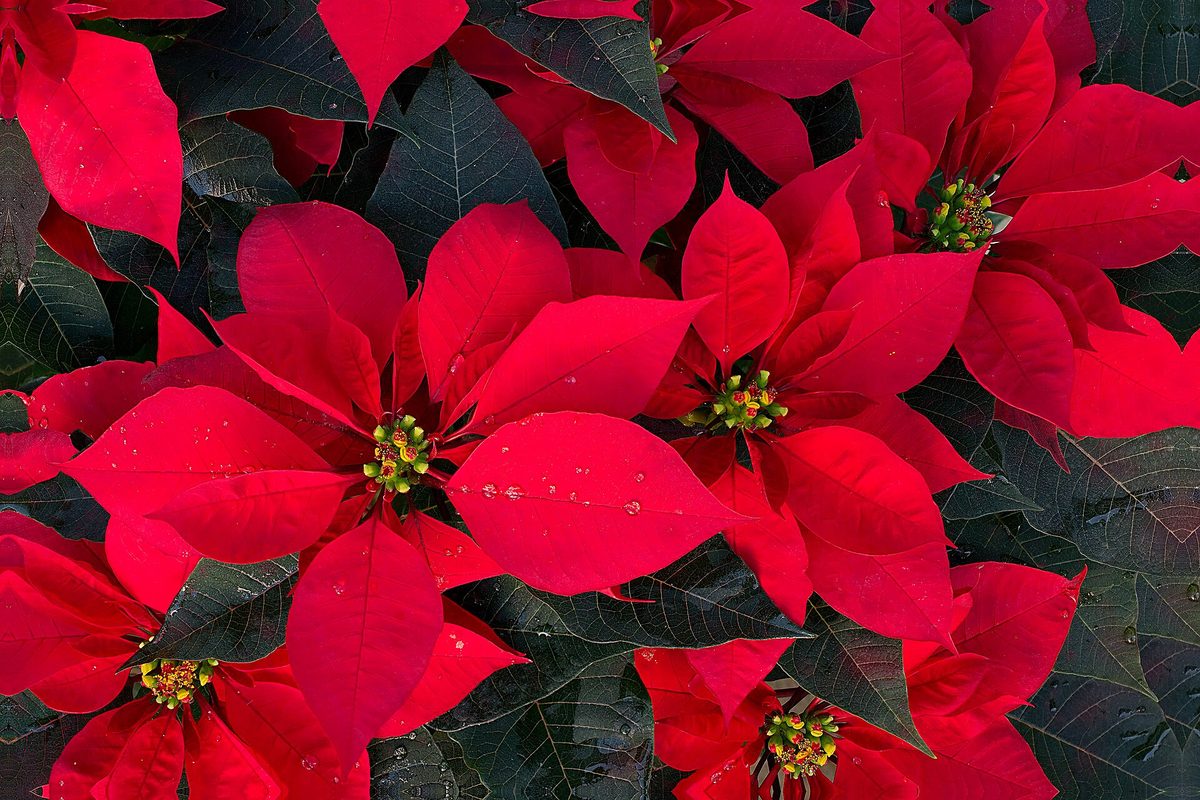
Photo: Carlos Valenzuela, CC BY-SA 4.0 via Wikimedia Commons

Quick facts
| Light: | Bright, indirect light11 source |
|---|---|
| Water: | Medium12 |
| Soil: | Well drained and moist; pH 5.5–6.53456 |
| Minimum temperature: | 50 °F (10 °C)11 source |
| Size: | 3–12 ft (0.91–3.66 m) × 3–8 ft (0.91–2.44 m)41 source |
| Bloom: | Dec–May, Red, pink, white and orange41 source |
| Cats: | Toxic to cats 1011 |
| Dogs: | Toxic to dogs 1011 |
| Family: | Euphorbiaceae |
How much light does a Poinsettia need?
Bright, indirect light suits a poinsettia kept inside the house. The plant should receive at least 6 hours of bright, indirect sunlight each day. Outdoors, it prefers part shade, which means direct sunlight for only part of the day, around 2 to 6 hours. Another extension guide describes the same outdoor preference as part sun, 4 to 6 hours daily.
- Light: Bright, indirect light1
How often to water a Poinsettia
A poinsettia asks for a medium amount of water, at neither the driest nor the wettest end of the scale. The soil should stay moderately moist. Water the plant thoroughly when the soil surface feels dry to the touch. Extension guidance also says to keep soil moist, and poinsettias prefer well-drained soil.
Best soil for a Poinsettia
Poinsettias prefer moist, well-drained soil with a pH between 5.5 and 6.5. Moist and well drained are the two drainage traits listed for this plant. The water need is medium, and that sits alongside the moist, well-drained soil. The pH range runs from 5.5 up to 6.5. Good drainage is listed as a soil need for this plant. Left in the ground, it can reach 3–12 ft (0.91–3.66 m) tall and 3–8 ft (0.91–2.44 m) wide.
Temperature and humidity
Chilling injury can cause premature leaf drop if the temperature falls below 50 °F (10 °C). The 50 °F (10 °C) figure is the minimum on file for this plant. Humidity needs are not documented for this page. Outdoors, the plant is listed for hardiness zones 9a to 11b. It is a deciduous to semi-evergreen shrub or small tree.
- Minimum temperature: 50 °F (10 °C)1
Fertilizing a Poinsettia
A dilute fertilizer solution every 2 weeks suits the growing season. Clemson's guidance is every two to three weeks during the spring, summer and fall. Biweekly feeding is the frequency recorded for the growing season. The fertilizer solution should be dilute. Feeding applies during the growing season, which covers spring, summer and fall here.
Pruning a Poinsettia
When the colorful bracts fade, prune the plant back to about 8 inches (20 cm) in height. That is the hard renewal pruning the record lists for this plant. Light shaping is also listed as a pruning type. The record places pruning in spring and again in summer. The plant blooms from winter through spring, with red, pink, white and orange bracts.
- Pruning: Hard renewal pruning and Light shaping (Mar–Apr, Jun–Aug)1
Repotting a Poinsettia
Transplant the poinsettia into a new container in early June. Choose a container 2 to 4 inches (5 to 10 cm) bigger than the original pot. June is the only repotting month on file. The pot should hold soil that is moist and well drained, with a pH between 5.5 and 6.5.
- Repotting: (Jun)1
Care calendar
| Task | Jan | Feb | Mar | Apr | May | Jun | Jul | Aug | Sep | Oct | Nov | Dec |
|---|---|---|---|---|---|---|---|---|---|---|---|---|
| Fertilize | Fertilize in Mar | Fertilize in Apr | Fertilize in May | Fertilize in Jun | Fertilize in Jul | Fertilize in Aug | Fertilize in Sep | Fertilize in Oct | Fertilize in Nov | |||
| Prune | Prune in Mar | Prune in Apr | Prune in Jun | Prune in Jul | Prune in Aug | |||||||
| Repot | Repot in Jun | |||||||||||
| Bloom | Bloom in Jan | Bloom in Feb | Bloom in Mar | Bloom in Apr | Bloom in May | Bloom in Dec |
How to propagate a Poinsettia
Propagate a poinsettia from stem cuttings. Take them in early summer and use rooting hormone. Stem cutting is the only propagation method on file for this plant. Rooting hormone is part of the method described. A cutting comes from a plant that can reach 3–12 ft (0.91–3.66 m) tall.
- Propagation: Stem cuttings4
Common problems
Mealybugs, spider mites, scale and whiteflies are the common pests of a poinsettia. Monitor the plant for those four pests. The diseases listed are powdery mildew, bacterial leaf spot, bacterial canker, bacterial stem rot, gray mold, root and stem rot, rust and mosaic virus. Four pests and eight diseases are on the list.
| Problem | Kind |
|---|---|
| Mealybugs | Pest |
| Spider mites | Pest |
| Scale insects | Pest |
| Whiteflies | Pest |
| Powdery mildew | Disease |
| Bacterial leaf spot | Disease |
| Bacterial canker | Disease |
| Bacterial stem rot | Disease |
| Gray mold | Disease |
| Root and stem rot | Disease |
| Rust | Disease |
| Mosaic virus | Disease |
Is Poinsettia toxic to cats and dogs?
The ASPCA lists the poinsettia as toxic to cats. The ASPCA also lists it as toxic to dogs. Pet Poison Helpline describes poinsettia plants as only mildly toxic to cats and dogs. For cats, the recorded position is toxic. For dogs, the recorded position is also toxic. Both the ASPCA and Pet Poison Helpline address cats and dogs. Neither listing gives a severity beyond the Pet Poison Helpline description of mild.
Pet-safe alternatives
Recommended supplies
- Light: bright, indirect light, such as near an east window; a full-spectrum grow light substitutes where no window does.
- Soil: a free-draining mix, and a pot with a drainage hole.
Questions and answers
- Is a poinsettia toxic to cats and dogs?
- The ASPCA lists the poinsettia as toxic to cats and toxic to dogs. Pet Poison Helpline describes it as only mildly toxic to both cats and dogs.
- How much light does a poinsettia need indoors?
- It should receive at least 6 hours of bright, indirect sunlight each day. Outdoors it prefers part shade, with direct sunlight for only part of the day.
- How often should I fertilize a poinsettia?
- Feed it every 2 weeks with a dilute fertilizer solution during the growing season. Another guide gives every two to three weeks during spring, summer and fall.
Sources
- Clemson Cooperative Extension HGIC. https://hgic.clemson.edu/factsheet/poinsettia/. Accessed 25 October 2026.
- University of Minnesota Extension. https://extension.umn.edu/houseplants/poinsettia. Accessed 25 October 2026.
- University of Florida IFAS Extension (EDIS). https://ask.ifas.ufl.edu/publication/EP349. Accessed 25 October 2026.
- NC State Extension Gardener Plant Toolbox. https://plants.ces.ncsu.edu/plants/euphorbia-pulcherrima/. Accessed 25 October 2026.
- University of Minnesota Extension. https://extension.umn.edu/garden-and-home/yard-and-garden/gardening-in-minnesota/poinsettia. Accessed 25 October 2026.
- University of Wisconsin-Madison Division of Extension (Wisconsin Horticulture). https://hort.extension.wisc.edu/2024/12/16/poinsettia-trivia-care/. Accessed 25 October 2026.
- Iowa State University Extension and Outreach. https://yardandgarden.extension.iastate.edu/how-to/guide-selection-and-care-poinsettias. Accessed 25 October 2026.
- UC Statewide Integrated Pest Management Program. https://ipm.ucanr.edu/agriculture/floriculture-and-ornamental-nurseries/poinsettia/. Accessed 25 October 2026.
- Penn State Extension. https://extension.psu.edu/trees-lawns-and-landscaping/ornamentals-and-floriculture/pests-and-diseases. Accessed 25 October 2026.
- ASPCA Animal Poison Control Center. https://www.aspca.org/pet-care/aspca-poison-control/toxic-and-non-toxic-plants/poinsettia. Accessed 25 October 2026.
- Pet Poison Helpline. https://www.petpoisonhelpline.com/poison/poinsettia/. Accessed 25 October 2026.
How this page was made
- Written with AI assistance from the sources listed on this page. AI is never the source of a fact.