Dutchman's Pipe Cactus (Epiphyllum oxypetalum)
Formerly Cereus latifrons, Cereus oxypetalus, Epiphyllum grande
To keep it alive, give it bright, indirect light indoors and medium water. Feed it monthly during the growing season. It is an epiphyte with a rapid growth rate. Its hardiness range is USDA zones 10a to 11b. Its flowers are white. Cuttings are the way to propagate it. Toxicity to cats and dogs is not documented here.
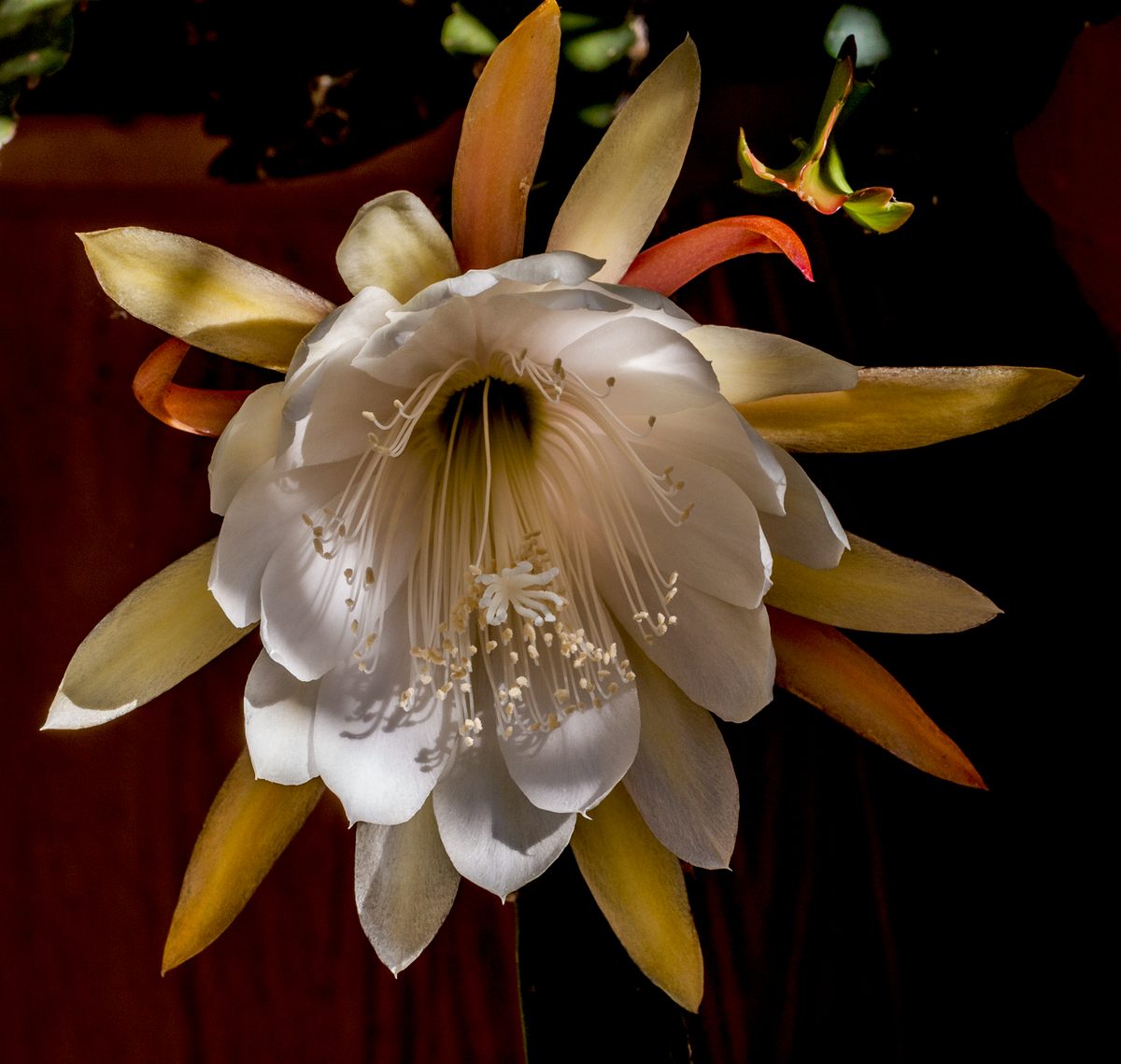
Photo: Fischer.H, CC BY-SA 4.0 via Wikimedia Commons

Quick facts
| Light: | Bright, indirect light11 source |
|---|---|
| Water: | Medium11 source |
| Soil: | Well drained and moist11 source |
| Minimum temperature: | 40 °F (4.4 °C)21 source |
| Size: | 10 ft (3.05 m) × 2–3 ft (0.61–0.91 m)11 source |
| Growth rate: | Rapid11 source |
| Bloom: | White11 source |
| Cats: | Not documented by major sources |
| Dogs: | Not documented by major sources |
| Native range: | BLZ, ELS, GUA, HON, MXC, MXG, MXS, MXT, NIC3 |
| Family: | Cactaceae |
How much light does a Dutchman's Pipe Cactus need?
Indoors, bright and indirect light is best, along with protection from the harsh afternoon sun. Outdoors the plant prefers part shade, meaning direct sunlight for only part of the day, about 2 to 6 hours. Outdoor growing is listed for USDA hardiness zones 10a through 11b.
- Light: Bright, indirect light1
How often to water a Dutchman's Pipe Cactus
During spring and summer, water regularly and soak the soil completely each time. Allow the top of the soil to dry out between waterings. The water need is rated medium, and that is both the lowest and the highest level listed. The plant is susceptible to root rot when it is overwatered or kept in poorly drained soil. Its soil is described as well drained and moist, and a cactus mix with sand or perlite is named for it.
- Water: Medium1
Best soil for a Dutchman's Pipe Cactus
A well-drained, average succulent or cactus potting mix with added sand or perlite suits this plant. The drainage conditions listed for the plant are well drained and moist. Poorly drained soil, like overwatering, leaves the plant open to root rot. As an epiphyte, it grows on other plants or trees as well as on rocks in its native habitat. In that habitat it may grow up to 10 ft (3.05 m) tall.
- Soil drainage: Well drained and moist1
Temperature and humidity
Give the plant a nighttime temperature of 40 to 50 °F (4.4 to 10 °C) during the winter. The minimum temperature recorded for it is 40 °F (4.4 °C). Winter nights are the period that the temperature advice covers. Humidity is rated high, and the plant prefers at least 50 percent humidity. It will tolerate air that is drier than that. Its listed hardiness range is USDA zones 10a to 11b.
Fertilizing a Dutchman's Pipe Cactus
From spring to fall, feed the plant a balanced fertilizer once a month. The listed frequency is monthly during the growing season. Spring through fall is the period that the monthly feeding covers. That monthly pattern is the only fertilizer schedule listed. The plant's growth rate is rapid.
- Fertilizer: Monthly in the growing season2
Repotting a Dutchman's Pipe Cactus
Plan to repot this plant every 2 to 3 years. That interval is given as a range, since repotting may be required every 2 or 3 years. Its mature spread is 2 to 3 ft (0.61–0.91 m), and its growth rate is listed as rapid. In its native habitat it may grow up to 10 ft (3.05 m) tall.
How to propagate a Dutchman's Pipe Cactus
Stem cuttings are the propagation method listed for Dutchman's pipe cactus, and it is described as easy. No other method is listed for it. Cuttings come from a plant with a rapid growth rate and a mature spread of 2 to 3 ft (0.61–0.91 m). The plant type is listed as epiphyte.
- Propagation: Stem cuttings1
Common problems
Mealybugs, scale insects and nematodes are the pests listed for this plant. Common insects include mealybugs, spider mites and scale. Root rot and powdery mildew are the diseases listed. Root rot is tied to overwatering and to poorly drained soil. Powdery mildew is the second disease on the list.
| Problem | Kind |
|---|---|
| Mealybugs | Pest |
| Scale insects | Pest |
| Nematodes | Pest |
| Root rot | Disease |
| Powdery mildew | Disease |
Is Dutchman's Pipe Cactus toxic to cats and dogs?
Recommended supplies
- Light: bright, indirect light, such as near an east window; a full-spectrum grow light substitutes where no window does.
- Soil: a free-draining mix, and a pot with a drainage hole.
- Humidity: it wants humid air; a pebble tray or a humidifier is the usual fix.
Questions and answers
- How much light does Dutchman's pipe cactus need?
- Indoors it needs bright, indirect light and protection from the harsh afternoon sun. Outdoors it prefers part shade, meaning direct sunlight for only part of the day, about 2 to 6 hours. The listed hardiness range is USDA zones 10a to 11b.
- What color are the flowers, and how big does the plant get?
- The flowers are white. In its native habitat the plant may grow up to 10 ft (3.05 m) tall. Its mature spread is 2 to 3 ft (0.61–0.91 m), and it grows at a rapid rate.
- How often should I feed, water and repot it?
- Feed it a balanced fertilizer once a month from spring to fall. Repotting may be required every 2 or 3 years. Water at a medium level, letting the top of the soil dry out between waterings.
Sources
- NC State Extension Gardener Plant Toolbox. https://plants.ces.ncsu.edu/plants/epiphyllum-oxypetalum/. Accessed 23 September 2026.
- Clemson Cooperative Extension Home & Garden Information Center. https://hgic.clemson.edu/factsheet/indoor-cacti/. Accessed 24 September 2026.
- Royal Botanic Gardens, Kew (World Checklist of Vascular Plants). https://sftp.kew.org/pub/data-repositories/WCVP/wcvp.zip. Accessed 4 June 2026.
How this page was made
- Written with AI assistance from the sources listed on this page. AI is never the source of a fact.