Garden Croton (Codiaeum variegatum)
Formerly Croton trilobus, Croton variegatus, Codiaeum triumphans
Keep your garden croton (Codiaeum variegatum) in bright light with some direct sun, and water it only when the top half-inch to an inch of soil dries out. It does best with warm temperatures and moderate to high humidity. It is listed as toxic to both cats and dogs.
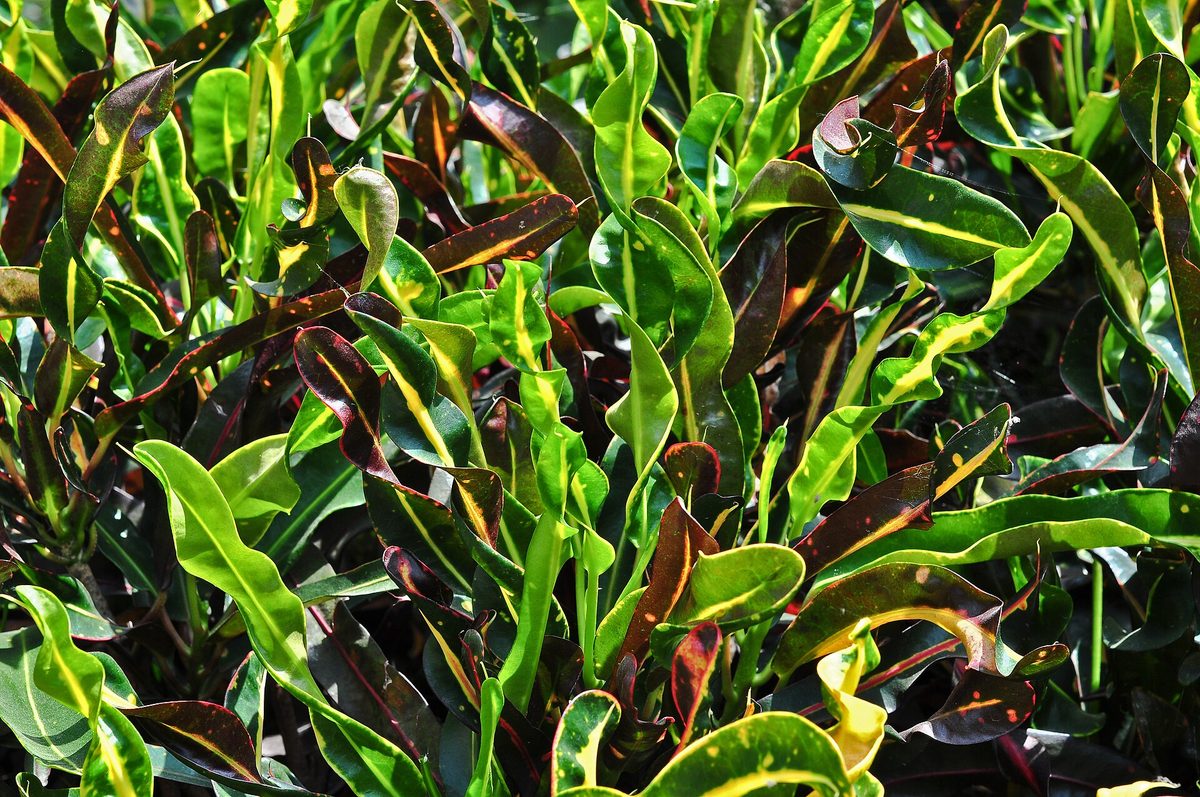
Photo: Joydeep, CC BY-SA 3.0 via Wikimedia Commons

Quick facts
| Light: | Bright, indirect light; tolerates direct sun11 source |
|---|---|
| Water: | Dry to wet21 source |
| Soil: | Well drained, moist and occasionally dry13 |
| Minimum temperature: | 50 °F (10 °C)11 source |
| Size: | 2–8 ft (0.61–2.44 m) × 2–6 ft (0.61–1.83 m)11 source |
| Bloom: | White and yellow31 |
| Cats: | Toxic to cats (1 source) 5 |
| Dogs: | Toxic to dogs (1 source) 5 |
| Native range: | BIS, BOR, FIJ, JAW, LSI, MOL, NWG, PHI, QLD, SCZ, SOL, SUL, VAN6 |
| Family: | Euphorbiaceae |
How much light does a Garden Croton need?
Croton needs bright light for the best leaf color, with some direct sun. In too much shade it may lose its lower leaves. Bright, indirect light suits it indoors, and it tolerates direct sun. Outdoors, crotons prefer full sun or partial shade. In cool climates a plant outdoors can take full sun if it is kept moist.
- Light: Bright, indirect light; tolerates direct sun1
How often to water a Garden Croton
Water your croton only when the top half-inch to an inch of soil dries out. Its recorded water needs run from dry to medium at the low end and up to medium wet at the high end. The soil it does best in is moist and well drained, and it can be occasionally dry. Outdoors in a cool climate, keep the plant moist if it gets full sun.
- Water: Dry to wet2
Best soil for a Garden Croton
Croton does best in fertile, well-drained, moist soil. Crotons also prefer humus-rich soil that drains well and is occasionally dry. The drainage record lists three conditions: well drained, moist and occasionally dry. Between waterings, the top half-inch to an inch of this soil should dry out. No cited source gives a preferred soil pH range for this plant, so that value is not documented here.
Temperature and humidity
Bring your croton indoors when temperatures reach 50 °F (10 °C). That 50 °F (10 °C) mark is the point at which a plant kept outdoors should come inside. It does best with moderate to high humidity and warm temperatures. Humidity is recorded as high for this species. It is hardy only in USDA zones 11 to 12, and the listed range is zones 11a to 12b. Outside those zones, the plant is not recorded as hardy.
Fertilizing a Garden Croton
Fertilize your croton once or twice during the growing season, or more often for faster growth. The fertilizer record for this plant is a light feeding, about once a year. The source allows more frequent feeding when you want faster growth. No cited source names a fertilizer ratio or type.
- Fertilizer: Light, once a year2
How to propagate a Garden Croton
You can propagate croton by seed, stem cuttings and layering. The plant is easily propagated by air layering or softwood cuttings. Air layering is done in spring, and softwood cuttings are taken in summer. Seed is possible, but the offspring won't resemble the parent. Stem cuttings are one of three recorded methods, along with seed and layering.
Common problems
Croton has few pest problems other than the usual insects that commonly infest houseplants. Mealybugs, spider mites and scale insects are among the pests recorded. Records also list spiraling whitefly, woolly whitefly and fall armyworm. Recorded diseases include cotton root rot, xanthomonas leaf spot and impatiens necrotic spot virus.
- Common pests: spiraling whitefly, woolly whitefly, texas citrus mite, oriental spider mite, white peach scale, chilli thrips, red banded thrips, fall armyworm, tetranychus mexicanus, glassy winged sharpshooter, green shield scale, mealybugs, spider mites and scale insects43
- Common diseases: alphanucleorhabdovirus melongenae, tomato chlorosis virus, impatiens necrotic spot virus, cotton root rot and xanthomonas leaf spot4
| Problem | Kind |
|---|---|
| Spiraling whitefly | Pest |
| Woolly whitefly | Pest |
| Texas citrus mite | Pest |
| Oriental spider mite | Pest |
| White peach scale | Pest |
| Chilli thrips | Pest |
| Red banded thrips | Pest |
| Fall armyworm | Pest |
| Tetranychus mexicanus | Pest |
| Glassy winged sharpshooter | Pest |
| Green shield scale | Pest |
| Mealybugs | Pest |
| Spider mites | Pest |
| Scale insects | Pest |
| Alphanucleorhabdovirus melongenae | Disease |
| Tomato chlorosis virus | Disease |
| Impatiens necrotic spot virus | Disease |
| Cotton root rot | Disease |
| Xanthomonas leaf spot | Disease |
Is Garden Croton toxic to cats and dogs?
Pet Poison Helpline lists croton as toxic to cats. For cats, ingestion may cause mild irritation of the mouth and digestive tract, with drooling, vomiting or diarrhea. The same source lists the plant as toxic to dogs. For dogs, ingestion may cause mild irritation of the mouth and digestive tract, with drooling, vomiting or diarrhea. No cited source in this record names which parts of the plant are toxic.
Pet-safe alternatives
Recommended supplies
- Light: bright, indirect light, such as near an east window; a full-spectrum grow light substitutes where no window does.
- Soil: a free-draining mix, and a pot with a drainage hole.
- Humidity: it wants humid air; a pebble tray or a humidifier is the usual fix.
Questions and answers
- Is garden croton toxic to cats and dogs?
- Pet Poison Helpline lists it as toxic to both cats and dogs. Ingestion may cause mild irritation of the mouth and digestive tract, with drooling, vomiting or diarrhea. Cats and dogs are recorded separately, and the entries say the same thing.
- How much light does a croton need indoors?
- It needs bright light for the best leaf color, with some direct sun. It may lose its lower leaves in too much shade. Bright, indirect light is the recorded indoor setting, and it tolerates direct sun.
- When should I water a croton?
- Water it only when the top half-inch to an inch of soil dries out. The soil should be well drained and moist. It also does best with moderate to high humidity and warm temperatures.
Sources
- NC State Extension Gardener Plant Toolbox. https://plants.ces.ncsu.edu/plants/codiaeum-variegatum/. Accessed 14 October 2026.
- University of Wisconsin-Madison Division of Extension. https://hort.extension.wisc.edu/articles/croton-codiaeum-variegatum. Accessed 14 October 2026.
- University of Wisconsin-Madison Division of Extension. https://hort.extension.wisc.edu/articles/croton-codiaeum-variegatum/. Accessed 14 October 2026.
- EPPO Global Database. https://gd.eppo.int/taxon/CDIVA/pests. Accessed 14 October 2026.
- Pet Poison Helpline. https://www.petpoisonhelpline.com/poison/croton/. Accessed 14 October 2026.
- Royal Botanic Gardens, Kew (World Checklist of Vascular Plants). https://sftp.kew.org/pub/data-repositories/WCVP/wcvp.zip. Accessed 4 June 2026.
How this page was made
- Written with AI assistance from the sources listed on this page. AI is never the source of a fact.