Christplant (Euphorbia milii)
Formerly Euphorbia bojeri, Tumalis bojeri, Euphorbia breonii
Crown of thorns grows best outdoors in full sun, though it also tolerates part shade. Water it from dry to medium, letting the soil dry between waterings. This plant is toxic to cats and dogs. In cats, it causes mild oral and stomach irritation.
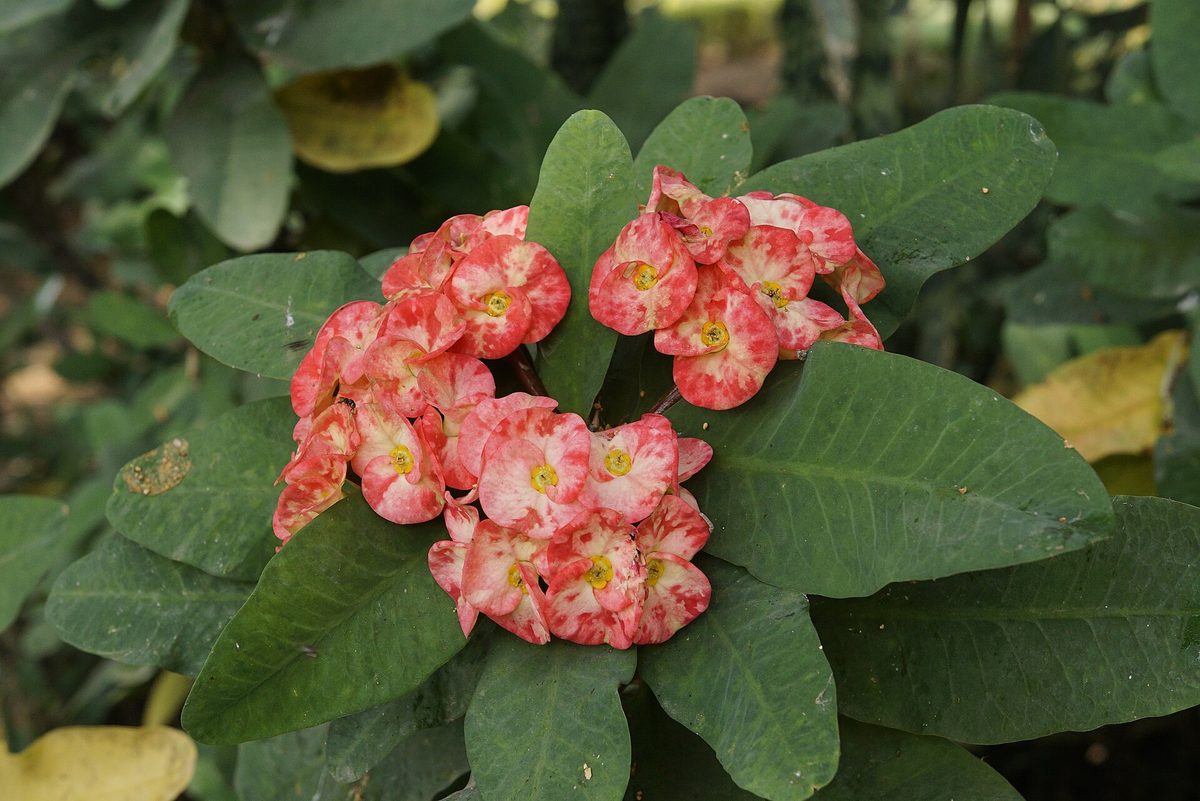
Photo: Vengolis, CC BY-SA 4.0 via Wikimedia Commons

Quick facts
| Light: | Full sun and part shade (full sun preferred)12 |
|---|---|
| Water: | Dry to medium21 source |
| Soil: | Well drained and occasionally dry21 source |
| Hardiness: | Zones 9a–11b11 source |
| Size: | 5 ft (1.52 m) × 3 ft (0.91 m)31 source |
| Bloom: | Red, pink, white, yellow and green12 |
| Cats: | Toxic to cats (1 source) Severity reported: Mild 1 |
| Dogs: | Toxic to dogs (1 source) 1 |
| Native range: | MDG4 |
| Family: | Euphorbiaceae |
How much light does a Christplant need?
Full sun outdoors is the best light for this plant, at least six hours of direct sun a day. It can also grow in part shade, though full sun is the preferred condition for this species. Both full sun and part shade are listed as suitable light levels for it outdoors.
How often to water a Christplant
Give this plant water that ranges from dry to medium, not a constant moisture level. Water deeply, then let the soil dry out before you water again. This dry-to-medium range suits a plant that does not want to stay wet all the time. Avoid letting it sit in soggy soil between waterings.
- Water: Dry to medium2
Best soil for a Christplant
This plant needs soil that drains well when grown outdoors. It also tolerates soil that is occasionally dry rather than evenly moist. Well-drained and occasionally dry are the two soil conditions recorded for this species. A constantly wet mix is not one of them. Choose a planting spot or pot that lets water drain through instead of pooling. This plant is not documented as needing consistently moist soil outdoors.
- Soil drainage: Well drained and occasionally dry2
Hardiness and temperature
USDA zones 9a through 11b mark this plant's outdoor hardiness range. It does not tolerate wet, cold soil, and it dislikes temperatures below 35.6°F (2°C). This plant does well in low humidity rather than high humidity. Zones below 9a fall outside its documented hardiness range. The coldest temperature it is documented to tolerate is 35.6°F (2°C). Humidity levels on the higher side are not what this plant is documented to prefer.
Fertilizing a Christplant
Spring and summer are when to fertilize this plant, lightly and just once a year. Use a balanced fertilizer rather than a strong or frequent feed. Outside of spring and summer, this plant is not documented as needing fertilizer. A light touch is enough, rather than a heavy feeding schedule.
- Fertilizer: Light, once a year (Mar–Aug)2
Pruning a Christplant
Prune this plant lightly to shape it. Light shaping also helps keep its size in check. At maturity, this plant can reach about 5 ft (1.52 m) tall and 3 ft (0.91 m) wide. Light pruning keeps its shape and size under control as it grows.
- Pruning: Light shaping2
How to plant a Christplant
Plant this species outdoors in USDA zones 9a through 11b. Space plants about 3 ft (0.91 m) apart, matching their mature spread. It can also grow up to about 5 ft (1.52 m) tall at maturity. This species is native to Madagascar. In the continental United States and Puerto Rico, it is classified as introduced rather than native. Replant it in spring or summer, when it is growing vigorously.
- Hardiness: Zones 9a–11b1
Winter care
In winter, protect this plant from temperatures below 35.6°F (2°C). Outdoors, that limit applies in zones cooler than its hardy range of 9a to 11b. Indoors for winter, it succeeds in heated homes, since it does well in low humidity. Below zone 9a, this species does not have a documented outdoor winter hardiness. Where winters dip below 35.6°F (2°C), bring the plant indoors or grow it in a container instead.
Care calendar
| Task | Jan | Feb | Mar | Apr | May | Jun | Jul | Aug | Sep | Oct | Nov | Dec |
|---|---|---|---|---|---|---|---|---|---|---|---|---|
| Fertilize | Fertilize in Mar | Fertilize in Apr | Fertilize in May | Fertilize in Jun | Fertilize in Jul | Fertilize in Aug | ||||||
| Repot | Repot in Mar | Repot in Apr | Repot in May | Repot in Jun | Repot in Jul | Repot in Aug |
How to propagate a Christplant
You can propagate this plant from seed, stem cuttings or grafting. Stem cuttings are one way to start a new plant. Growers can also use a technique called V cleft grafting to propagate it. Seed is a third documented method for growing new plants of this species. No single method is marked as the preferred one among the three documented here.
Common problems
Scale, mealybugs, thrips and spider mites are the insect pests recorded on this plant. Leaf spot, stem rot, root rot and botrytis blight are its documented diseases. In the Midwest, mealybugs are the most common of these pests, while spider mites, scale and thrips occur less often.
| Problem | Kind |
|---|---|
| Scale insects | Pest |
| Mealybugs | Pest |
| Thrips | Pest |
| Spider mites | Pest |
| Leaf spot | Disease |
| Stem rot | Disease |
| Root rot | Disease |
| Botrytis blight | Disease |
Is Christplant toxic to cats and dogs?
This plant is toxic to both cats and dogs. In cats, ingestion is documented to cause mild irritation to the mouth and stomach. No severity rating is documented for dogs here, only that the plant is listed as toxic to them. The cat listing includes a mild severity rating, while the dog listing does not specify one. Both animals are included in the toxic listing for this species.
Pet-safe alternatives
Recommended supplies
- Soil: a free-draining mix, and a pot with a drainage hole.
Questions and answers
- Is Euphorbia milii toxic to cats and dogs?
- Crown of thorns is toxic to both cats and dogs. In cats, it is documented to cause mild irritation to the mouth and stomach.
- What light does crown of thorns need outdoors?
- Give it full sun outdoors, with at least six hours of direct light a day. It also tolerates part shade, though full sun is preferred.
- How can you propagate Euphorbia milii?
- You can propagate this plant from seed, stem cuttings or grafting. Stem cuttings are one way to start a new plant. Grafting, specifically a technique called V cleft grafting, is another documented method.
Sources
- NC State Extension Gardener Plant Toolbox. https://plants.ces.ncsu.edu/plants/euphorbia-milii/. Accessed 12 October 2026.
- University of Wisconsin-Madison Division of Extension. https://hort.extension.wisc.edu/articles/crown-of-thorns-euphorbia-milii/. Accessed 12 October 2026.
- Chicago Botanic Garden. https://www.chicagobotanic.org/plant-information/plant-finder/euphorbia-milii-var-splendens-crown-thorns. Accessed 13 October 2026.
- Royal Botanic Gardens, Kew (World Checklist of Vascular Plants). https://sftp.kew.org/pub/data-repositories/WCVP/wcvp.zip. Accessed 4 June 2026.
How this page was made
- Written with AI assistance from the sources listed on this page. AI is never the source of a fact.