Madagascar Widow's-thrill (Kalanchoe blossfeldiana)
Formerly Kalanchoe globulifera var. coccinea
Keep Madagascar widow's-thrill in bright, indirect light indoors, and let the soil dry out between waterings. Its water need runs from dry to medium. It is a succulent. Its flowers come in red, orange, yellow, pink or white. The ASPCA lists the plant as toxic to cats and toxic to dogs.
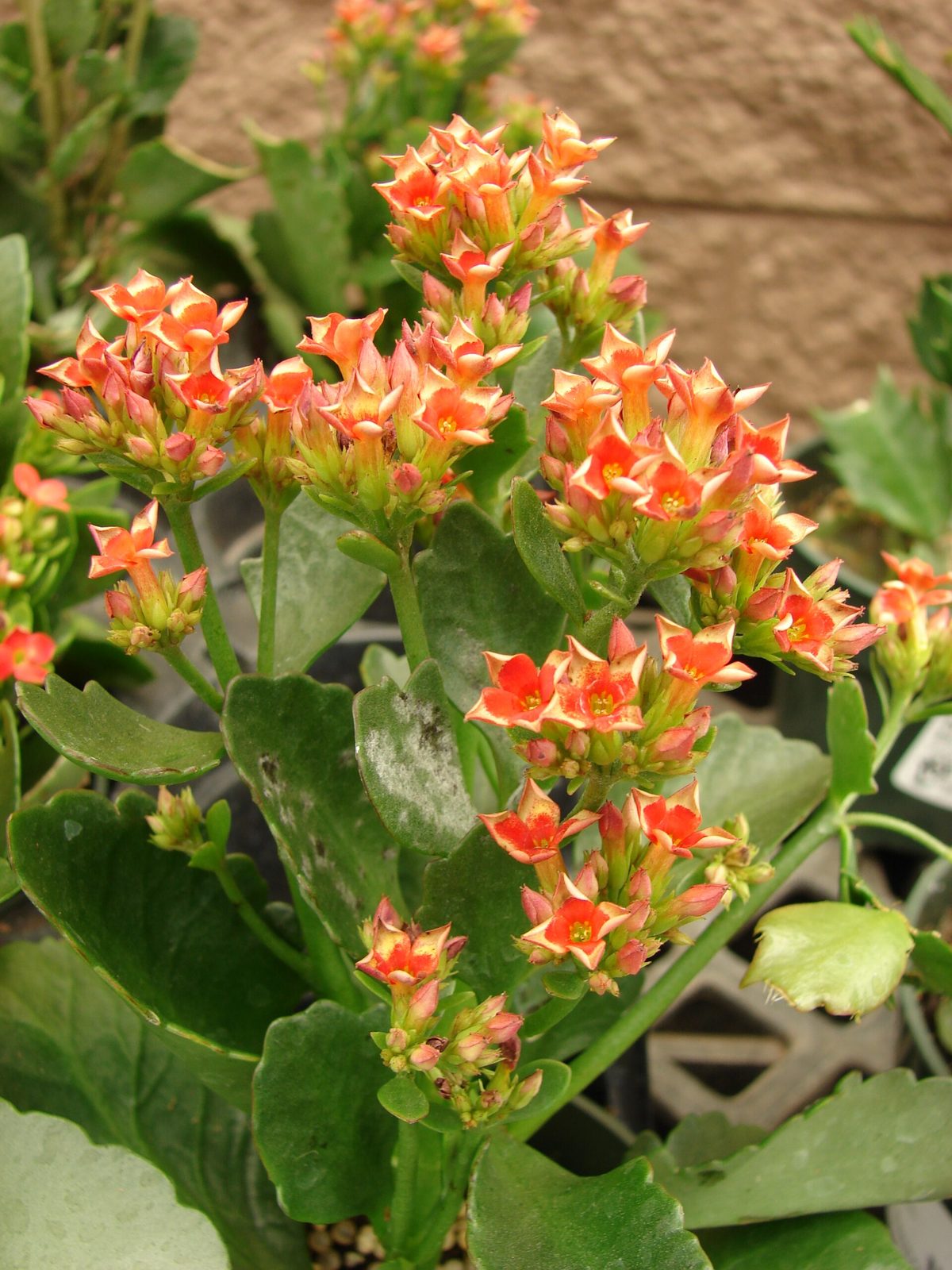
Photo: Forest & Kim Starr, CC BY 3.0 via Wikimedia Commons

Quick facts
| Light: | Bright, indirect light12 |
|---|---|
| Water: | Dry to medium12 |
| Soil: | Well drained13 |
| Minimum temperature: | 44.6 °F (7 °C)111 source |
| Size: | 0.5–1.5 ft (0.15–0.46 m) × 0.5–1 ft (0.15–0.3 m)13 |
| Growth rate: | Slow13 |
| Bloom: | Red, orange, yellow, pink and white11 source |
| Cats: | Toxic to cats Severity reported: Potentially fatal 45 |
| Dogs: | Toxic to dogs (1 source) 4 |
| Native range: | MDG6 |
| Family: | Crassulaceae |
How much light does a Madagascar Widow's-thrill need?
Madagascar widow's-thrill does best indoors in bright, indirect light. Partial shade is also described as suitable, and bright indoor light levels are tolerated well. Outdoors, it takes full sun to part shade, with full sun preferred. After the danger of frost has passed, you can move it to a bright, lightly shaded spot for the summer.
How often to water a Madagascar Widow's-thrill
Allow the soil to dry out between waterings, and then water deeply. The plant's water need is rated from dry to medium. Overwatering can cause root rot or stem rot. Check that the soil has dried slightly before each watering. The soil should also be well drained, in line with the plant's listed drainage need.
Best soil for a Madagascar Widow's-thrill
Give it light, sandy, open, well-drained soil. A well-drained potting mix suited to cactus or succulents fits the plant's listed drainage need. The plant is classed as a succulent. No cited source records a preferred soil pH for this plant, so that value is not documented here.
Temperature and humidity
Bring it indoors in cooler climates before temperatures fall to about 45 °F (7 °C). The recorded minimum temperature is 44.6 °F (7 °C). Outdoors, the plant is hardy in USDA zones 10a to 11b. No cited source records a humidity preference, so that value is not documented here.
Fertilizing a Madagascar Widow's-thrill
Fertilize actively growing plants with any houseplant fertilizer once a month. That monthly rhythm is the frequency recorded for the growing season. Any houseplant fertilizer is named as suitable. The plant's growth rate is listed as slow.
- Fertilizer: Monthly in the growing season2
Pruning a Madagascar Widow's-thrill
Cut back tall growth and old flower stems. The recorded pruning types are deadheading and light shaping. Mature plants stand 6 to 18 in (15 to 46 cm) tall. Their habit is described as erect and mounding.
- Pruning: Deadheading and Light shaping2
How to propagate a Madagascar Widow's-thrill
Propagate Madagascar widow's-thrill by seed, stem cuttings or leaf cuttings. The plant is easily propagated by seed or by leaf, stem or tip cuttings. Stem and leaf cuttings are both named as ways to make new plants. Seed is the third method on record. Each of these methods is recorded for this species.
Common problems
The common pests are aphids, mealybugs, spider mites and scale insects. Mealybugs, aphids and brown scale are named as the most common insect pests. The common diseases are root rot, stem rot and powdery mildew. Overwatering can cause root rot or stem rot.
| Problem | Kind |
|---|---|
| Aphids | Pest |
| Mealybugs | Pest |
| Spider mites | Pest |
| Scale insects | Pest |
| Root rot | Disease |
| Stem rot | Disease |
| Powdery mildew | Disease |
Is Madagascar Widow's-thrill toxic to cats and dogs?
The ASPCA lists Madagascar widow's-thrill as toxic to cats. The ASPCA lists it as toxic to dogs as well. Pet Poison Helpline says ingestion by dogs and cats most often results in gastrointestinal irritation or upset. NC State Extension warns that ingestion by pets can be fatal, with abnormal heart rate, seizures and death. For cats, the recorded severity is potentially fatal. A severity for dogs is not documented.
Pet-safe alternatives
Recommended supplies
- Light: bright, indirect light, such as near an east window; a full-spectrum grow light substitutes where no window does.
- Soil: a free-draining mix, and a pot with a drainage hole.
Questions and answers
- Is Madagascar widow's-thrill toxic to cats and dogs?
- The ASPCA lists it as toxic to both cats and dogs. Pet Poison Helpline says ingestion by dogs and cats most often results in gastrointestinal irritation or upset. NC State Extension says ingestion by pets can be fatal.
- How should I water Madagascar widow's-thrill?
- Allow the soil to dry out between waterings, and then water deeply. The plant's water need is rated from dry to medium. Overwatering can cause root rot or stem rot.
- How big does Madagascar widow's-thrill get?
- It grows 6 to 18 in (15 to 46 cm) tall and 6 to 12 in (15 to 30 cm) wide. Its growth rate is listed as slow. Its habit is erect and mounding.
Sources
- NC State Extension Gardener Plant Toolbox. https://plants.ces.ncsu.edu/plants/kalanchoe-blossfeldiana/. Accessed 21 October 2026.
- Clemson Cooperative Extension HGIC. https://hgic.clemson.edu/factsheet/kalanchoe/. Accessed 21 October 2026.
- University of Florida IFAS Extension (EDIS). https://ask.ifas.ufl.edu/publication/FP309. Accessed 21 October 2026.
- ASPCA Animal Poison Control Center. https://www.aspca.org/pet-care/aspca-poison-control/toxic-and-non-toxic-plants/kalanchoe. Accessed 21 October 2026.
- Pet Poison Helpline. https://www.petpoisonhelpline.com/poison/kalanchoe/. Accessed 21 October 2026.
- Royal Botanic Gardens, Kew (World Checklist of Vascular Plants). https://sftp.kew.org/pub/data-repositories/WCVP/wcvp.zip. Accessed 4 June 2026.
How this page was made
- Written with AI assistance from the sources listed on this page. AI is never the source of a fact.