Dumbcane (Dieffenbachia seguine)
Formerly Dieffenbachia picta, Caladium seguine, Arum seguine
Give dumbcane bright, indirect light and water it on a medium schedule, letting the soil surface dry before each watering. It tolerates low light and even direct sun, but indirect light suits it best indoors. This plant is toxic to both cats and dogs.
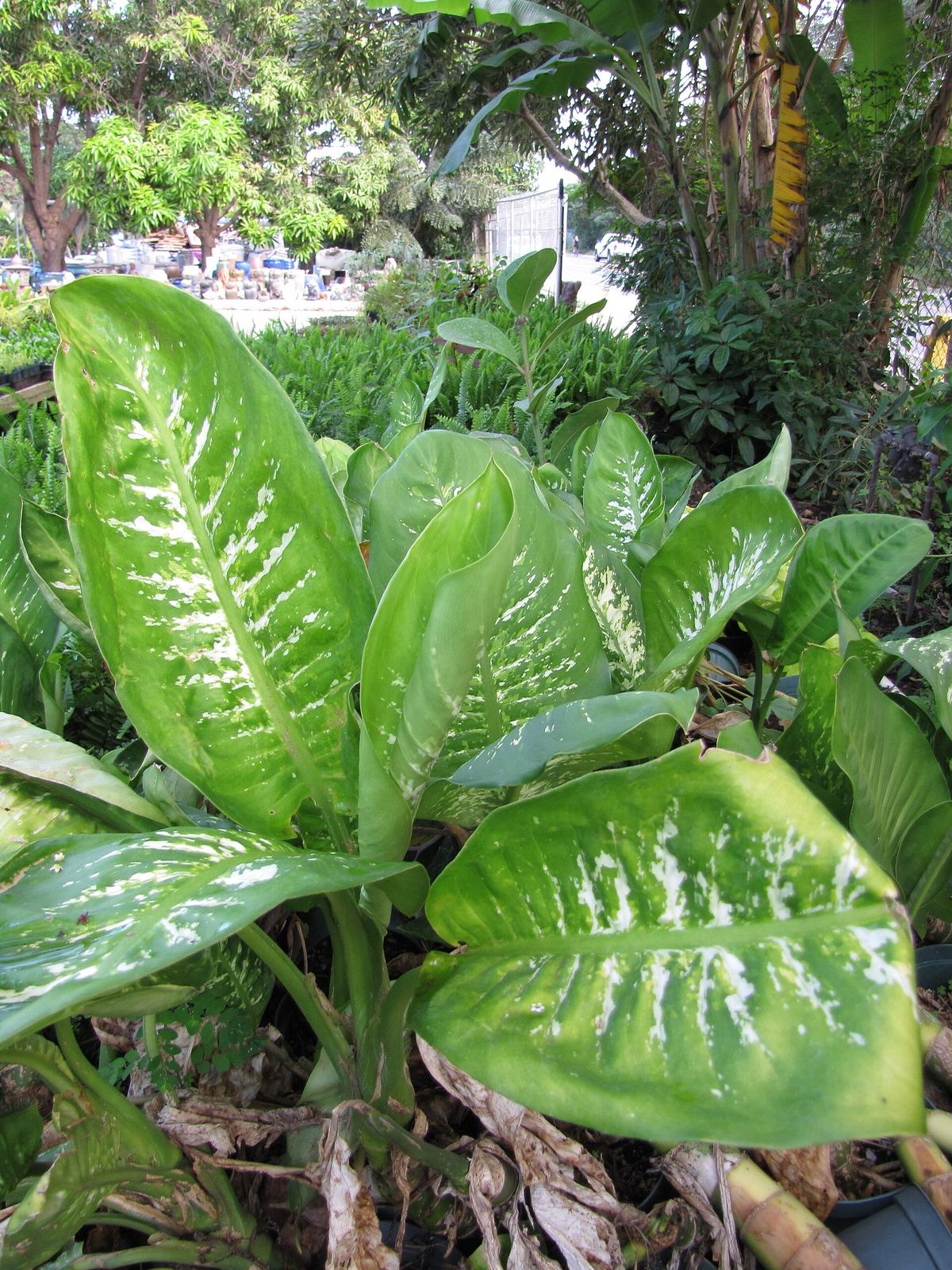
Photo: Forest and Kim Starr, CC BY 3.0 via Wikimedia Commons

Quick facts
| Light: | Bright, indirect light; tolerates low light and direct sun12 |
|---|---|
| Water: | Medium21 source |
| Soil: | Well drained, moist and occasionally dry11 source |
| Minimum temperature: | 64.4 °F (18 °C)31 source |
| Size: | 3–8 ft (0.91–2.44 m) × 2–3 ft (0.61–0.91 m)21 source |
| Cats: | Toxic to cats 42 |
| Dogs: | Toxic to dogs 42 |
| Family: | Araceae |
How much light does a Dumbcane need?
Dumbcane grows best in bright, indirect light when you keep it indoors. It tolerates low light as well as direct sun, covering both ends of that range. Bright light, including direct sunlight, works best for it during winter months. Outdoors, it takes partial shade, with direct sun reaching it for two to six hours a day.
How often to water a Dumbcane
Water dumbcane on a medium schedule, giving it a thorough soak each time. Let the top inch (2.5 cm) of soil dry out completely before you water it again. This species also tolerates soil that runs occasionally dry between waterings. It can also sit in soil that stays evenly moist without harm.
- Water: Medium2
Best soil for a Dumbcane
A well-drained container soil mix is what suits dumbcane best indoors. This kind of soil is one of three moisture conditions the plant is recorded as tolerating. It also tolerates soil that stays evenly moist, and separately, a mix that runs occasionally dry between waterings. Those three conditions, well drained, moist, and occasionally dry, mark the full range of soil moisture recorded for this species indoors and in containers.
- Soil drainage: Well drained, moist and occasionally dry1
Temperature and humidity
Keep dumbcane in a room that stays warmer than 64.4 degrees Fahrenheit (18 degrees Celsius) at all times, especially overnight. A spot that drops below that temperature at night is colder than what is recommended for this plant. This houseplant also prefers high humidity indoors. High humidity and a consistently warm room are the two conditions recorded for keeping dumbcane comfortable. Outdoors, dumbcane is hardy in USDA zones 10a through 11b.
Fertilizing a Dumbcane
Feed dumbcane every two weeks during its growing season, from March through September, using a fertilizer made for foliage houseplants. Hold off on fertilizing for the rest of the year, since the growing season for feeding runs only through those seven months.
- Fertilizer: Every two weeks in the growing season (Mar–Sep)1
Pruning a Dumbcane
To rejuvenate dumbcane, cut the stems back to about 6 in (15 cm) tall. This hard renewal cut is the pruning method recorded for this plant. Dumbcane can grow 3-8 ft (0.91-2.44 m) tall, and cutting it back to 6 in removes most of that height at once. It also spreads 2-3 ft (0.61-0.91 m) wide at full size.
- Pruning: Hard renewal pruning1
How to propagate a Dumbcane
You can propagate dumbcane several ways: by division, by stem cuttings, by root cuttings, or by layering. The recorded method uses cane cuttings, stem tip cuttings, or air layering, carried out in spring or early summer. Spring and early summer are the times of year recorded for starting new dumbcane plants this way.
- Propagation: Division, stem cuttings, root cuttings and layering1
Common problems
Watch dumbcane for common pests, including spider mites, scale, whiteflies, fungus gnats, aphids and mealybugs. Mealybugs and aphids feed by sucking the plant's juices. Potential diseases for dumbcane include fungal leaf spot, root rot, blight, bacterial leaf spot, bacterial stem rot and bacterial wilt.
| Problem | Kind |
|---|---|
| Spider mites | Pest |
| Scale insects | Pest |
| Whiteflies | Pest |
| Fungus gnats | Pest |
| Aphids | Pest |
| Mealybugs | Pest |
| Fungal leaf spot | Disease |
| Root rot | Disease |
| Blight | Disease |
| Bacterial leaf spot | Disease |
| Bacterial stem rot | Disease |
| Bacterial wilt | Disease |
Is Dumbcane toxic to cats and dogs?
Dumbcane is toxic to cats, according to the ASPCA's Animal Poison Control Center listing for this species. It is also toxic to dogs, according to the ASPCA's Animal Poison Control Center. NC State Extension's plant database separately lists dumbcane as a problem for cats and a problem for dogs. Both of your household pets, cats and dogs alike, are covered by this toxic listing.
Pet-safe alternatives
Recommended supplies
- Light: bright, indirect light, such as near an east window; a full-spectrum grow light substitutes where no window does.
- Soil: a free-draining mix, and a pot with a drainage hole.
- Humidity: it wants humid air; a pebble tray or a humidifier is the usual fix.
Questions and answers
- Is dumbcane toxic to cats and dogs?
- Yes, dumbcane is toxic to cats. It is also toxic to dogs, according to the ASPCA's Animal Poison Control Center. NC State Extension lists it as a problem for both pets as well.
- How much light does dumbcane need indoors?
- Dumbcane does best in bright, indirect light indoors. It also tolerates low light and direct sun. Bright light, including direct sunlight, works best for it during winter.
- How often should you water dumbcane?
- Water dumbcane on a medium schedule, letting the top inch (2.5 cm) of soil dry out before you water again. It also tolerates soil that runs occasionally dry between waterings.
Sources
- Clemson Cooperative Extension HGIC. https://hgic.clemson.edu/factsheet/dieffenbachia/. Accessed 15 November 2026.
- NC State Extension Gardener Plant Toolbox. https://plants.ces.ncsu.edu/plants/dieffenbachia-seguine/. Accessed 15 November 2026.
- University of Missouri Extension. https://extension.missouri.edu/publications/g6510. Accessed 15 November 2026.
- ASPCA Animal Poison Control Center. https://www.aspca.org/pet-care/aspca-poison-control/toxic-and-non-toxic-plants/dieffenbachia. Accessed 15 November 2026.
How this page was made
- Written with AI assistance from the sources listed on this page. AI is never the source of a fact.