Octopus Tree (Heptapleurum actinophyllum)
Formerly Aralia longipes, Brassaia actinophylla, Brassaia singaporensis
To keep an octopus tree alive, start with bright, indirect light, which this plant prefers indoors. It also tolerates medium and low light. Its water need runs from medium to wet. The ASPCA lists the plant as toxic to both cats and dogs. Temperature, humidity and feeding details follow below.
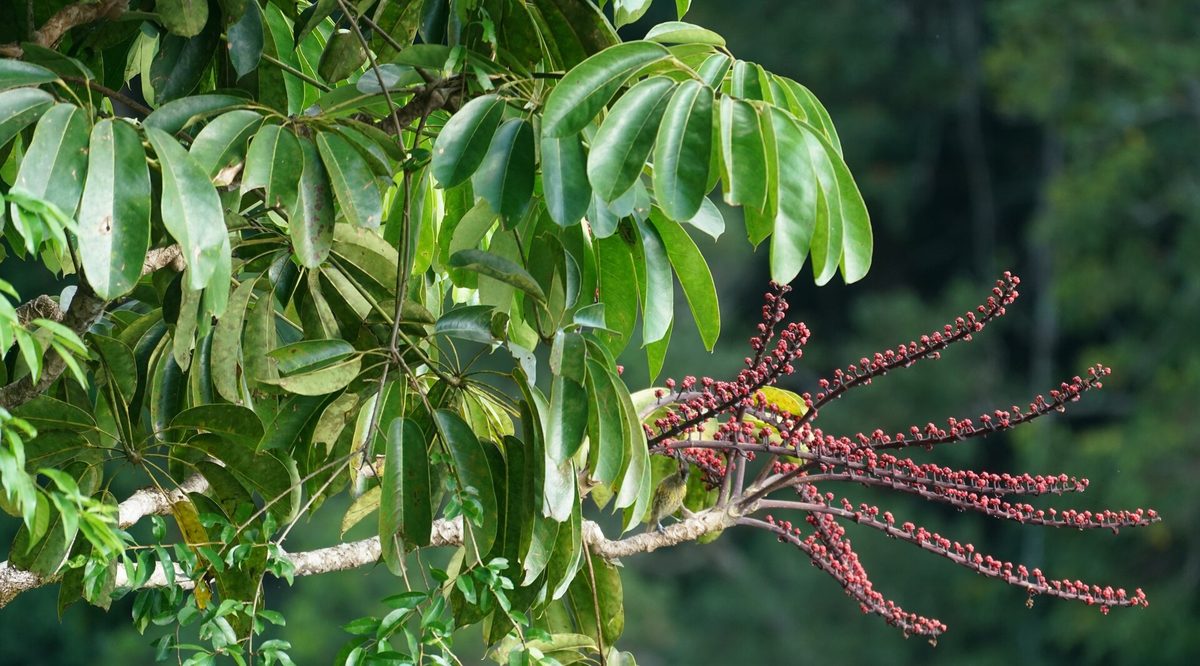
Photo: twan3253, CC BY 4.0 via Wikimedia Commons

Quick facts
| Light: | Bright, indirect light; tolerates medium light and low light11 source |
|---|---|
| Water: | Medium to wet21 source |
| Soil: | Well drained, moist and occasionally wet23 |
| Minimum temperature: | 60.8 °F (16 °C)21 source |
| Size: | 4–6 ft (1.22–1.83 m) × 3–6 ft (0.91–1.83 m)21 source |
| Growth rate: | Rapid23 |
| Bloom: | Jun–Sep, Pink and red21 source |
| Cats: | Toxic to cats (1 source) 7 |
| Dogs: | Toxic to dogs (1 source) 7 |
| Family: | Araliaceae |
How much light does an Octopus Tree need?
A spot near an east, west or south window suits this plant. The preferred indoor light is bright and indirect, and it tolerates medium and low light as well. Outdoors, it takes full sun, which means six or more hours of direct sunlight a day, or part shade. Full sun is the preferred outdoor setting.
- Light: Bright, indirect light; tolerates medium light and low light1
How often to water an Octopus Tree
The water range for this plant runs from medium to wet. The listing for it includes occasionally wet conditions. Soil that drains well is also listed, alongside moist and occasionally wet soil. Soils that stay too wet are linked to bacterial leaf spot and soft rot. No watering schedule is documented on this page.
- Water: Medium to wet2
Best soil for an Octopus Tree
Good drainage is listed for the soil of this plant. Its soil tolerances include clay, sand and loam, as well as slightly alkaline and acidic soil. Well-drained soil is among those tolerances. Its drainage range also takes in moist and occasionally wet soil. Soils that stay too wet bring bacterial leaf spot and soft rot. This page documents no soil pH range. Its listed water range is medium to wet.
Temperature and humidity
High humidity is preferred by this plant. It also prefers temperatures above 60 °F (16 °C). The stored minimum is 60.8 °F (16 °C). The same listing pairs high humidity with a bright sunny location and temperatures above 60 °F (16 °C). Outdoors, its listed hardiness range is USDA zones 10a to 12b. As a broadleaf evergreen, it keeps its leaves through the year.
Fertilizing an Octopus Tree
The listed frequency for fertilizer is every two weeks in the growing season. A dilute fertilizer solution is the form named in the listing. The same listing places feeding in spring and summer, at once or twice a month. Its growth rate is listed as rapid.
- Fertilizer: Every two weeks in the growing season1
How to propagate an Octopus Tree
Octopus tree can be propagated by seeds, layering or cuttings. The recorded methods are seed, stem cuttings and layering. Seed is one of the three recorded methods. Layering and stem cuttings make up the other two. These methods are recorded for Heptapleurum actinophyllum. Three methods are recorded in total. No rooting medium, timing or success rate is documented for any of them.
Common problems
Occasional pests include aphids, mealybugs, spider mites, thrips and scale insects. Yellow scale, Japanese wax scale and Florida wax scale are also on record. Shot hole borer, glassy winged sharpshooter, pink hibiscus mealybug and yellowstriped armyworm are also recorded. Recorded diseases include bacterial leaf spot, soft rot, impatiens necrotic spot virus and tomato spotted wilt virus.
- Common pests: aphids, mealybugs, spider mites, thrips, scale insects, yellow scale, japanese wax scale, florida wax scale, shot hole borer, glassy winged sharpshooter, pink hibiscus mealybug and yellowstriped armyworm2666666
- Common diseases: bacterial leaf spot, soft rot, impatiens necrotic spot virus and tomato spotted wilt virus266
| Problem | Kind |
|---|---|
| Aphids | Pest |
| Mealybugs | Pest |
| Spider mites | Pest |
| Thrips | Pest |
| Scale insects | Pest |
| Yellow scale | Pest |
| Japanese wax scale | Pest |
| Florida wax scale | Pest |
| Shot hole borer | Pest |
| Glassy winged sharpshooter | Pest |
| Pink hibiscus mealybug | Pest |
| Yellowstriped armyworm | Pest |
| Bacterial leaf spot | Disease |
| Soft rot | Disease |
| Impatiens necrotic spot virus | Disease |
| Tomato spotted wilt virus | Disease |
Is Octopus Tree toxic to cats and dogs?
For cats, the ASPCA entry lists this plant as toxic. For dogs, the entry gives the same position: toxic. The entry covers both animals in one line, and both are marked toxic. Cat owners should read this as toxic, and dog owners should read it the same way. Both animals share one position on this plant: toxic. The ASPCA lists the plant under toxic to cats and toxic to dogs. This site covers cats and dogs, and no severity grade or toxic plant part is documented for either one.
Pet-safe alternatives
Recommended supplies
- Light: bright, indirect light, such as near an east window; a full-spectrum grow light substitutes where no window does.
- Soil: a free-draining mix, and a pot with a drainage hole.
- Humidity: it wants humid air; a pebble tray or a humidifier is the usual fix.
Questions and answers
- Is octopus tree toxic to cats and dogs?
- The ASPCA lists the plant as toxic to cats and also toxic to dogs. The listing gives the same position for both animals.
- How much light does an octopus tree need?
- Indoors, bright, indirect light is preferred, near an east, west or south window. It tolerates medium and low light as well. Outdoors it takes full sun or part shade.
- How often should you fertilize an octopus tree?
- The listed frequency is every two weeks in the growing season. The fertilizer should be a dilute solution, applied in spring and summer. Its growth rate is rapid.
Sources
- Iowa State University Extension and Outreach. https://yardandgarden.extension.iastate.edu/faq/how-do-i-care-umbrella-tree. Accessed 25 October 2026.
- NC State Extension Gardener Plant Toolbox. https://plants.ces.ncsu.edu/plants/heptapleurum-actinophyllum/. Accessed 25 October 2026.
- UF/IFAS Extension (EDIS). https://ask.ifas.ufl.edu/publication/ST585. Accessed 25 October 2026.
- UF/IFAS Extension (EDIS). https://ask.ifas.ufl.edu/st585. Accessed 25 October 2026.
- Clemson Cooperative Extension HGIC. https://hgic.clemson.edu/factsheet/schefflera-2/. Accessed 25 October 2026.
- EPPO Global Database. https://gd.eppo.int/taxon/SCHAC/pests. Accessed 25 October 2026.
- ASPCA Animal Poison Control Center. https://www.aspca.org/pet-care/aspca-poison-control/toxic-and-non-toxic-plants/octopus-tree. Accessed 25 October 2026.
How this page was made
- Written with AI assistance from the sources listed on this page. AI is never the source of a fact.