Belladonna (Atropa bella-donna)
Formerly Boberella bella-donna, Atropa cordata, Atropa borealis
Give belladonna full sun, with part shade as a listed second choice, in well-drained, moist soil. It is a herbaceous perennial that reaches 3–4 ft (0.91–1.22 m) tall. The ASPCA lists it as toxic to both cats and dogs. No watering rule is documented for this plant, so this guide gives none.
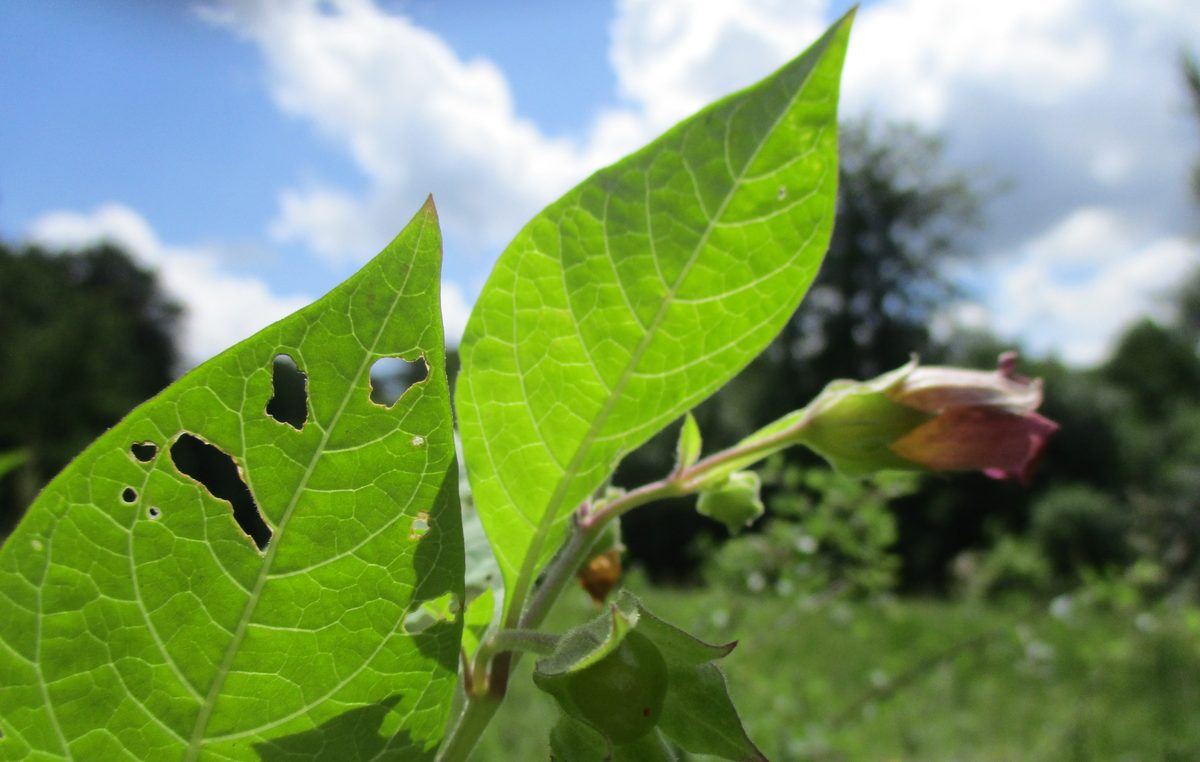
Photo: Wikimedia Commons contributor, CC0 via Wikimedia Commons

Quick facts
| Light: | Full sun and part shade (full sun preferred)11 source |
|---|---|
| Soil: | Well drained and moist11 source |
| Hardiness: | Zones 5a–9b11 source |
| Size: | 3–4 ft (0.91–1.22 m) × 3–4 ft (0.91–1.22 m)11 source |
| Growth rate: | Moderate111 source |
| Bloom: | Jun–Sep, Purple, green and red11 source |
| Cats: | Toxic to cats 314 |
| Dogs: | Toxic to dogs 314 |
| Native range: | ALB, ALG, AUT, BGM, BUL, COR, CZE, FRA, GER, GRB, GRC, HUN, IRN, ITA, KRY, LBS, MOR, NCS, NET, POL, POR, ROM, SAR, SIC, SPA, SWI, TCS, TUE, TUR, UKR, YUG5 |
| Family: | Solanaceae |
How much light does a Belladonna need?
Belladonna prefers full sun, which the source describes as 6 or more hours of direct sunlight a day. It also accepts part shade, where the plant gets direct sun for only part of the day. The listing for part shade gives a range of 2 to 6 hours of direct sun. That makes 2 hours a day the lowest figure on record. Pick a site with six or more hours of direct sun to match its stated preference.
Best soil for a Belladonna
Soil for belladonna should be well drained and moist, the two drainage conditions on record. One source says the plant grows best in well-drained sandy loam in full sun to part shade. Soil pH is not documented for this plant, so this page gives no target range. Match the light and the soil together, since the same source pairs sandy loam with full sun to part shade.
- Soil drainage: Well drained and moist1
Hardiness and temperature
Belladonna is listed for USDA hardiness zones 5a to 9b. That range covers ten half-zone steps, from 5a through 9b. No cited source records a minimum temperature for the plant. Humidity needs are not documented either. If you garden in zone 4 or colder, or in zone 10 or warmer, the listing does not cover your climate.
- Hardiness: Zones 5a–9b1
How to plant a Belladonna
Plant belladonna in USDA zones 5a to 9b, the range on record. Give each plant room for a spread of 3–4 ft (0.91–1.22 m). It reaches 3–4 ft (0.91–1.22 m) in height as well. Choose a site with full sun to part shade and well-drained, moist soil. It has a moderate growth rate. No cited source gives a planting depth or a time relative to frost, so those are not documented.
- Hardiness: Zones 5a–9b1
Winter care
Belladonna is a herbaceous perennial. It is listed for hardiness zones 5a to 9b, and the warm end of that listing is zone 9b. No cited source records a minimum temperature, so a cold limit in degrees is not documented. Mulching, covering and other winter protection steps are not documented either.
- Hardiness: Zones 5a–9b1
How to propagate a Belladonna
Belladonna is a herbaceous perennial, and seed is the propagation method on record. No cited source describes cuttings or division for this plant. Sowing details such as timing, depth and temperature are not documented here. If you want new plants, the record points you to seed.
- Propagation: Seed1
Common problems
Slugs are a common issue for belladonna. The pest record also names snails, tomato russet mite, silverleaf whitefly, spotted cucumber beetle, twenty-eight-spotted ladybird, thrips and fall armyworm. For disease, the record lists potato yellow dwarf virus. Treatment advice is not documented on this page.
| Problem | Kind |
|---|---|
| Slugs and snails | Pest |
| Snails | Pest |
| Tomato russet mite | Pest |
| Silverleaf whitefly | Pest |
| Spotted cucumber beetle | Pest |
| Twenty eight spotted ladybird | Pest |
| Thrips | Pest |
| Fall armyworm | Pest |
| Potato yellow dwarf virus | Disease |
Is Belladonna toxic to cats and dogs?
The ASPCA lists belladonna as toxic to cats. NC State Extension also flags it as a problem for cats. For dogs, the ASPCA lists the plant as toxic as well. NC State Extension flags it as a problem for dogs too. The position is the same for cats and for dogs. This page records no severity level for either animal.
Pet-safe alternatives
Recommended supplies
- Soil: a free-draining mix, and a pot with a drainage hole.
Questions and answers
- Is belladonna toxic to cats and dogs?
- The ASPCA lists belladonna as toxic to both cats and dogs. NC State Extension also marks it as a problem for both animals. This page does not state a severity level.
- How much sun does belladonna need?
- Belladonna prefers full sun, meaning 6 or more hours of direct sunlight a day. It also accepts part shade, which the source describes as 2 to 6 hours of direct sun.
- What color are belladonna flowers, and when do they bloom?
- The flowers are listed as purple, green and red, with one source describing them as dull reddish purple with a green tinge. Blossoms run from June to September.
Sources
- NC State Extension Gardener Plant Toolbox. https://plants.ces.ncsu.edu/plants/atropa-bella-donna/. Accessed 23 September 2026.
- EPPO Global Database. https://gd.eppo.int/taxon/ATRBE/pests. Accessed 23 September 2026.
- ASPCA Animal Poison Control Center. https://www.aspca.org/pet-care/aspca-poison-control/toxic-and-non-toxic-plants/deadly-nightshade. Accessed 23 September 2026.
- Pet Poison Helpline. https://www.petpoisonhelpline.com/poison/belladonna/. Accessed 23 September 2026.
- Royal Botanic Gardens, Kew (World Checklist of Vascular Plants). https://sftp.kew.org/pub/data-repositories/WCVP/wcvp.zip. Accessed 4 June 2026.
How this page was made
- Written with AI assistance from the sources listed on this page. AI is never the source of a fact.