Butterfly Milkweed (Asclepias tuberosa)
Formerly Acerates decumbens, Asclepias rolfsii, Asclepias revoluta
Grow butterfly milkweed in full sun, though it also accepts part shade, and give it soil that is dry to medium in moisture. Full sun here means 6 or more hours of direct sunlight a day. The ASPCA lists the plant as toxic to cats and toxic to dogs. Poorly drained, soggy soil is the main condition to avoid.
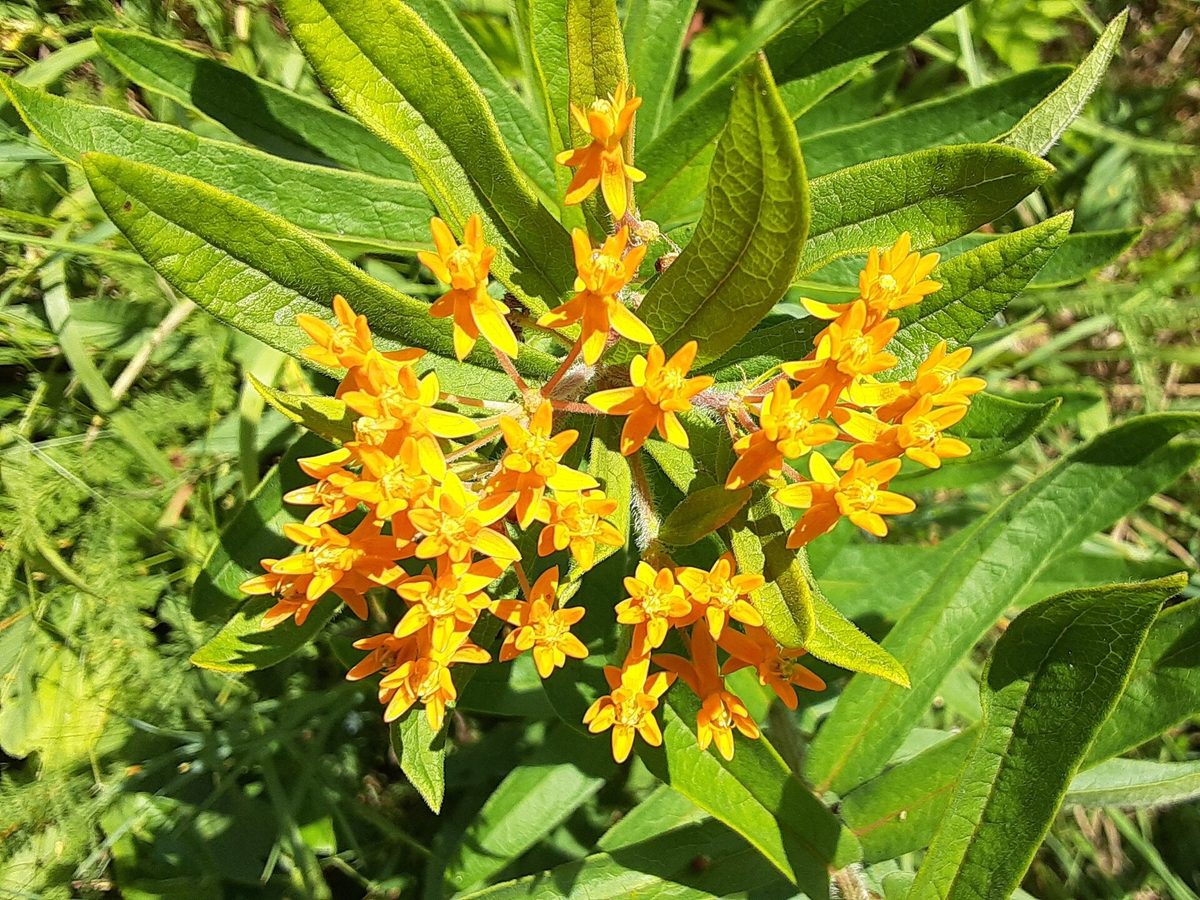
Photo: Larry Jensen, CC BY 4.0 via Wikimedia Commons

Quick facts
| Light: | Full sun and part shade (full sun preferred)12 |
|---|---|
| Water: | Dry to medium41 |
| Soil: | Well drained, moist and occasionally dry56 |
| Hardiness: | Zones 3a–9b21 source |
| Size: | 1–2 ft (0.3–0.6 m) × 1–1.5 ft (0.3–0.46 m)18 |
| Growth rate: | Slow11 source |
| Bloom: | May–Aug and May–Sep, Orange, yellow and red15468 |
| Cats: | Toxic to cats (1 source) 7 |
| Dogs: | Toxic to dogs (1 source) 7 |
| Native range: | ALA, ARI, ARK, CNT, COL, DEL, FLA, GEO, ILL, INI, IOW, KAN, KTY, LOU, MAI, MAS, MIC, MIN, MRY, MSI, MSO, MXE, MXN, NCA, NEB, NWH, NWJ, NWM, NWY, OHI, OKL, ONT, PEN, QUE, RHO, SCA, SDA, TEN, TEX, UTA, VER, VRG, WDC, WIS, WVA9 |
| Family: | Apocynaceae |
How much light does a Butterfly Milkweed need?
Butterfly milkweed prefers full sun and also accepts part shade. Full sun means 6 or more hours of direct sunlight a day. Part shade means direct sunlight for only part of the day, about 2 to 6 hours. Plan for at least 6 hours of direct sun per day.
How often to water a Butterfly Milkweed
Butterfly milkweed takes soil that is dry to medium in moisture. It is drought-tolerant and does well in poor, dry soils. It is also moderately salt-tolerant. Check the soil rather than a calendar, because dry to medium, well-drained ground is the target. Avoid soggy ground, since the central taproot is prone to rot in poorly drained soil.
Best soil for a Butterfly Milkweed
Plant butterfly milkweed in well-drained soil that ranges from dry to moist. The suitable conditions listed are well drained, moist and occasionally dry. Avoid poorly drained or soggy soil, since the central taproot is prone to rot. Poor, dry soils also suit it. Dry to medium soil moisture is the range given for this species. No cited source records a soil pH range for this plant. A deep, wet mulch layer may cause crown rot.
Hardiness and temperature
Butterfly milkweed is hardy in USDA zones 3a to 9b. Zone 3a is the cold end of that range and zone 9b is the warm end. Gardeners in zone 3a and in zone 9b both fall inside the listed range. The plant is native in the lower 48 US states.
- Hardiness: Zones 3a–9b2
Pruning a Butterfly Milkweed
The pruning task listed for butterfly milkweed is deadheading. Remove seedpods before they dry and split if you want to avoid self-seeding. The plant is erect, 1–2 ft (0.3–0.6 m) tall, and about 1–1.5 ft (0.3–0.46 m) wide at maturity. Its growth rate is slow.
- Pruning: Deadheading6
How to plant a Butterfly Milkweed
Plant butterfly milkweed in USDA zones 3a to 9b. Choose a spot with 6 or more hours of direct sunlight a day. The soil should be well drained, since the central taproot is prone to rot in poorly drained or soggy soil. Allow for a mature width of 1 to 1.5 ft (0.3–0.46 m). A mature plant stands 1–2 ft (0.3–0.6 m) tall. Avoid a deep, wet mulch layer, which may cause crown rot.
- Hardiness: Zones 3a–9b2
Winter care
Butterfly milkweed is listed as hardy to zone 3a at the cold end. Zones 3a to 9b are the range given for it. No cited source records a minimum temperature or specific winter protection. A deep, wet mulch layer may cause crown rot. The plant is a herbaceous perennial. Poorly drained or soggy soil is also a hazard, since the taproot is prone to rot. Its erect habit reaches 1–2 ft (0.3–0.6 m).
- Hardiness: Zones 3a–9b2
How to propagate a Butterfly Milkweed
You can propagate butterfly milkweed from seed or from root cuttings. The plant is a herbaceous perennial with a central taproot. For seed, it is best to direct seed into the landscape. Both seeds and root cuttings are listed as propagation material for the species. If you do not want seedlings, avoid self-seeding by removing seedpods before they dry and split.
Common problems
Aphids and oleander aphid are the pests listed for butterfly milkweed. Aphids may be a problem. Root rot and crown rot are the diseases listed. A deep, wet mulch layer may cause crown rot. The central taproot is prone to rot in poorly drained or soggy soil.
| Problem | Kind |
|---|---|
| Aphids | Pest |
| Oleander aphid | Pest |
| Root rot | Disease |
| Crown rot | Disease |
Is Butterfly Milkweed toxic to cats and dogs?
The ASPCA lists butterfly milkweed as toxic to cats. The ASPCA lists it as toxic to dogs as well. The position is the same for cats and for dogs. The plant is an erect herbaceous perennial that grows 1–2 ft (0.3–0.6 m) tall. At maturity it is 1–1.5 ft (0.3–0.46 m) wide. It is native in the lower 48 US states. No cited source here names the toxic parts or a severity for either animal.
Pet-safe alternatives
Recommended supplies
- Soil: a free-draining mix, and a pot with a drainage hole.
Questions and answers
- Is butterfly milkweed toxic to cats and dogs?
- The ASPCA lists it as toxic to cats and toxic to dogs. The position is the same for both animals. It is an erect herbaceous perennial about 1–2 ft (0.3–0.6 m) tall.
- How much sun does butterfly milkweed need?
- It prefers full sun, which means 6 or more hours of direct sunlight a day. It also accepts part shade, with direct sunlight for only part of the day.
- What kind of soil does butterfly milkweed need?
- It needs well-drained soil that ranges from dry to moist. Avoid poorly drained or soggy soil, since the central taproot is prone to rot. Soil moisture in the dry to medium range suits it.
Sources
- NC State Extension Gardener Plant Toolbox. https://plants.ces.ncsu.edu/plants/asclepias-tuberosa/. Accessed 12 October 2026.
- Penn State Extension. https://extension.psu.edu/rain-garden-plants-butterfly-weed. Accessed 12 October 2026.
- Iowa State University Extension and Outreach (Yard and Garden). https://yardandgarden.extension.iastate.edu/faq/what-would-be-good-planting-site-butterfly-weed. Accessed 30 October 2026.
- Clemson Cooperative Extension HGIC. https://hgic.clemson.edu/butterfly-weed/. Accessed 12 October 2026.
- Lady Bird Johnson Wildflower Center. https://www.wildflower.org/plants/result.php?id_plant=ASTU. Accessed 12 October 2026.
- Clemson Cooperative Extension HGIC. https://hgic.clemson.edu/factsheet/rain-garden-plants-butterfly-milkweed-asclepias-tuberosa/. Accessed 12 October 2026.
- ASPCA. https://www.aspca.org/pet-care/aspca-poison-control/toxic-and-non-toxic-plants/milkweed. Accessed 12 October 2026.
- Lady Bird Johnson Wildflower Center (Native Plant Database). https://www.wildflower.org/plants/result.php?id_plant=astu. Accessed 31 October 2026.
- Royal Botanic Gardens, Kew (World Checklist of Vascular Plants). https://sftp.kew.org/pub/data-repositories/WCVP/wcvp.zip. Accessed 4 June 2026.
How this page was made
- Written with AI assistance from the sources listed on this page. AI is never the source of a fact.