Italian Lords and Ladies (Arum italicum)
Formerly Arisarum italicum, Arum ponticum, Arum facchinii
Give Italian lords and ladies part shade, which it prefers, though full shade is also listed. It is listed for well drained, moist soil in USDA zones 5a to 9b. The ASPCA lists it as toxic to cats and toxic to dogs. Watering needs are not documented on this page.
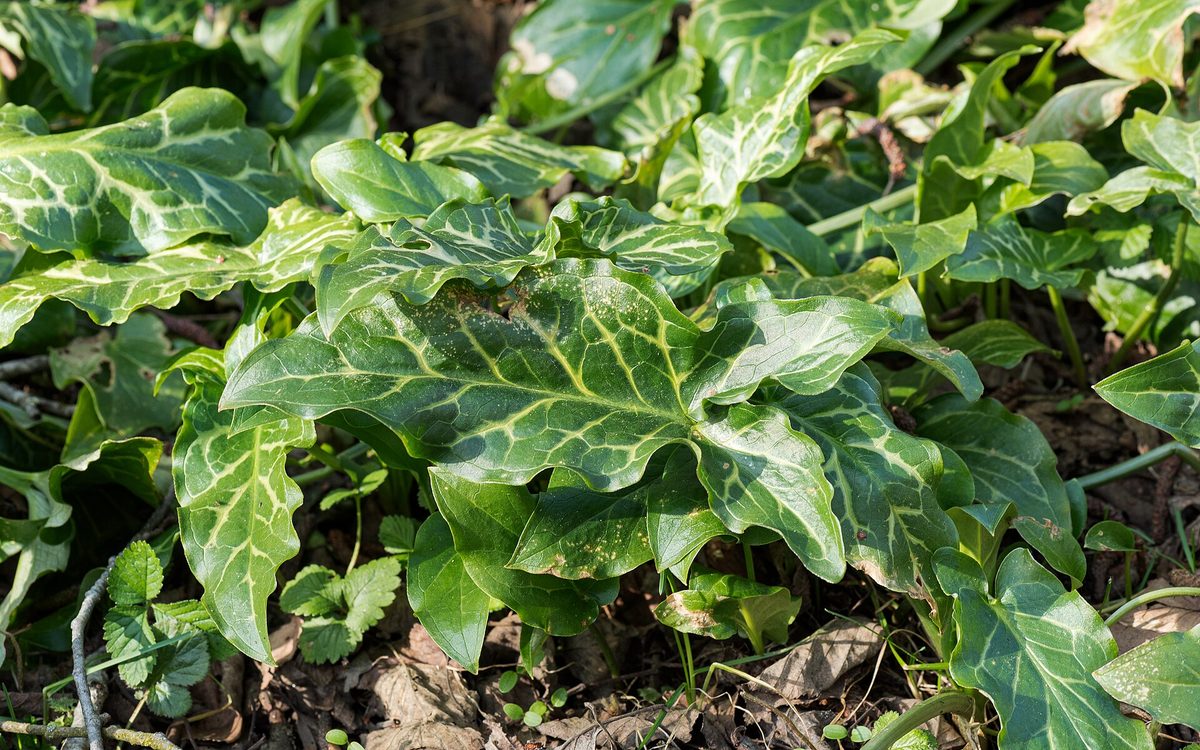
Photo: Flocci Nivis, CC BY 4.0 via Wikimedia Commons

Quick facts
| Light: | Part shade and full shade (part shade preferred)11 source |
|---|---|
| Soil: | Well drained and moist21 source |
| Hardiness: | Zones 5a–9b23 |
| Size: | 1–2 ft (0.3–0.61 m) × 1–2 ft (0.3–0.61 m)21 source |
| Growth rate: | Rapid221 source |
| Bloom: | Apr–May, Green, purple, white and yellow231 source |
| Cats: | Toxic to cats 24 |
| Dogs: | Toxic to dogs 24 |
| Native range: | ALB, ALG, AZO, BAL, BUL, CNY, COR, CYP, FRA, GRB, GRC, IRQ, ITA, KRI, KRY, LBS, MDR, MOR, NCS, POR, SAR, SIC, SPA, SWI, TCS, TUE, TUN, TUR, YUG5 |
| Family: | Araceae |
How much light does an Italian Lords and Ladies need?
Part shade is the preferred exposure for Italian lords and ladies, and full shade is also listed as suitable. Penn State Extension describes the plant as growing well in shady or partial sun. Mature plants stand 1–2 ft (0.3–0.61 m) tall and spread 1–2 ft (0.3–0.61 m) wide.
- Light: Part shade and full shade (part shade preferred)1
Best soil for an Italian Lords and Ladies
Drainage is the soil condition on file for this plant, and the listing gives well drained and moist. The NC State Extension Gardener Plant Toolbox entry for this plant lists good drainage among its soil needs. Soil that is both well drained and moist is the target to aim for when you prepare a bed. No soil pH range is recorded, so this page does not give one.
- Soil drainage: Well drained and moist2
Hardiness and temperature
The hardiness range on file runs from USDA zone 5a to zone 9b. The Chicago Botanic Garden Plant Finder gives the same range in whole zones, 5 to 9. NC State Extension Gardener Plant Toolbox lists every half zone from 5a up to 9b. No minimum temperature is recorded for this plant, so this page gives none. No humidity preference is recorded either.
How to plant an Italian Lords and Ladies
Beds in USDA zones 5a to 9b match the hardiness range on file for this plant. Each plant spreads 1–2 ft (0.3–0.61 m) wide and reaches 1–2 ft (0.3–0.61 m) tall. Choose a site in part shade or full shade, with part shade preferred. The soil listing is well drained and moist. Its plant type is listed as bulb. The US native status register lists it as introduced in the lower 48 states. No planting depth or planting time is recorded, so this page gives none.
Winter care
The plant is rated hardy in USDA zones 5a through 9b. Zone 5a is the coldest end of the range on file, and zone 9b is the warmest. No minimum temperature is recorded, so this page gives no cold limit. No mulching, covering or other winter protection advice is recorded for this plant.
How to propagate an Italian Lords and Ladies
Seed and division are the propagation methods on file for this plant. The NC State Extension Gardener Plant Toolbox says it is reproduced by seeds and corms. Its plant type is listed as bulb. No sowing depth, seed treatment, division method or timing is recorded for this plant, so this page does not give any.
- Propagation: Seed and division2
Common problems
No serious insect or disease problems are recorded for this plant by the NC State Extension Gardener Plant Toolbox. The record lists no common pests and no common diseases for it. Toxicity to pets is recorded separately, in the toxicity section. Because no problem is listed, there is no pest or disease treatment to describe here.
Is Italian Lords and Ladies toxic to cats and dogs?
For cats, the ASPCA Animal Poison Control Center gives the toxicity of this plant as toxic. For dogs, the same ASPCA listing also gives toxic. The NC State Extension Gardener Plant Toolbox flags the plant as a problem for cats and as a problem for dogs. No severity level, toxic plant part or clinical signs are recorded on this page, so none are stated. Treat the plant as one that both cats and dogs should stay away from.
Pet-safe alternatives
Recommended supplies
- Soil: a free-draining mix, and a pot with a drainage hole.
Questions and answers
- Is Italian lords and ladies toxic to cats and dogs?
- The ASPCA lists the plant as toxic to cats and toxic to dogs. The NC State Extension Gardener Plant Toolbox also flags it as a problem for both cats and dogs. Treat it as a plant that both animals should stay away from.
- How much light does Italian lords and ladies need?
- Part shade is the preferred exposure, and full shade is also listed. Penn State Extension describes the plant as growing well in shady or partial sun. Mature plants reach 1–2 ft (0.3–0.61 m) in height.
- When does Italian lords and ladies bloom, and what color are the flowers?
- The NC State Extension Gardener Plant Toolbox says the hood-like inflorescences usually appear in April and May. Bloom colors are listed as green, purple, white and yellow. The spathe is described as green-yellow or white with purplish margins.
Sources
- Penn State Extension. https://extension.psu.edu/programs/master-gardener/counties/warren/demonstration-gardens/betts-demonstration-garden/italian-lords-and-ladies. Accessed 21 October 2026.
- NC State Extension Gardener Plant Toolbox. https://plants.ces.ncsu.edu/plants/arum-italicum/. Accessed 14 October 2026.
- Chicago Botanic Garden Plant Finder. https://www.chicagobotanic.org/plant-information/plant-finder/arum-italicum-marmoratum-italian-arum. Accessed 14 October 2026.
- ASPCA Animal Poison Control Center. https://www.aspca.org/pet-care/aspca-poison-control/toxic-and-non-toxic-plants/arum. Accessed 14 October 2026.
- Royal Botanic Gardens, Kew (World Checklist of Vascular Plants). https://sftp.kew.org/pub/data-repositories/WCVP/wcvp.zip. Accessed 4 June 2026.
How this page was made
- Written with AI assistance from the sources listed on this page. AI is never the source of a fact.