Jack in the Pulpit (Arisaema triphyllum)
Formerly Arum triphyllum, Arisaema atrorubens, Arum vittatum
Outdoors, this plant prefers part shade or full shade, with direct sun for at most part of the day. It needs soil that stays constantly moist to wet, and never fully dries out. The plant is toxic to cats. It is also toxic to dogs.
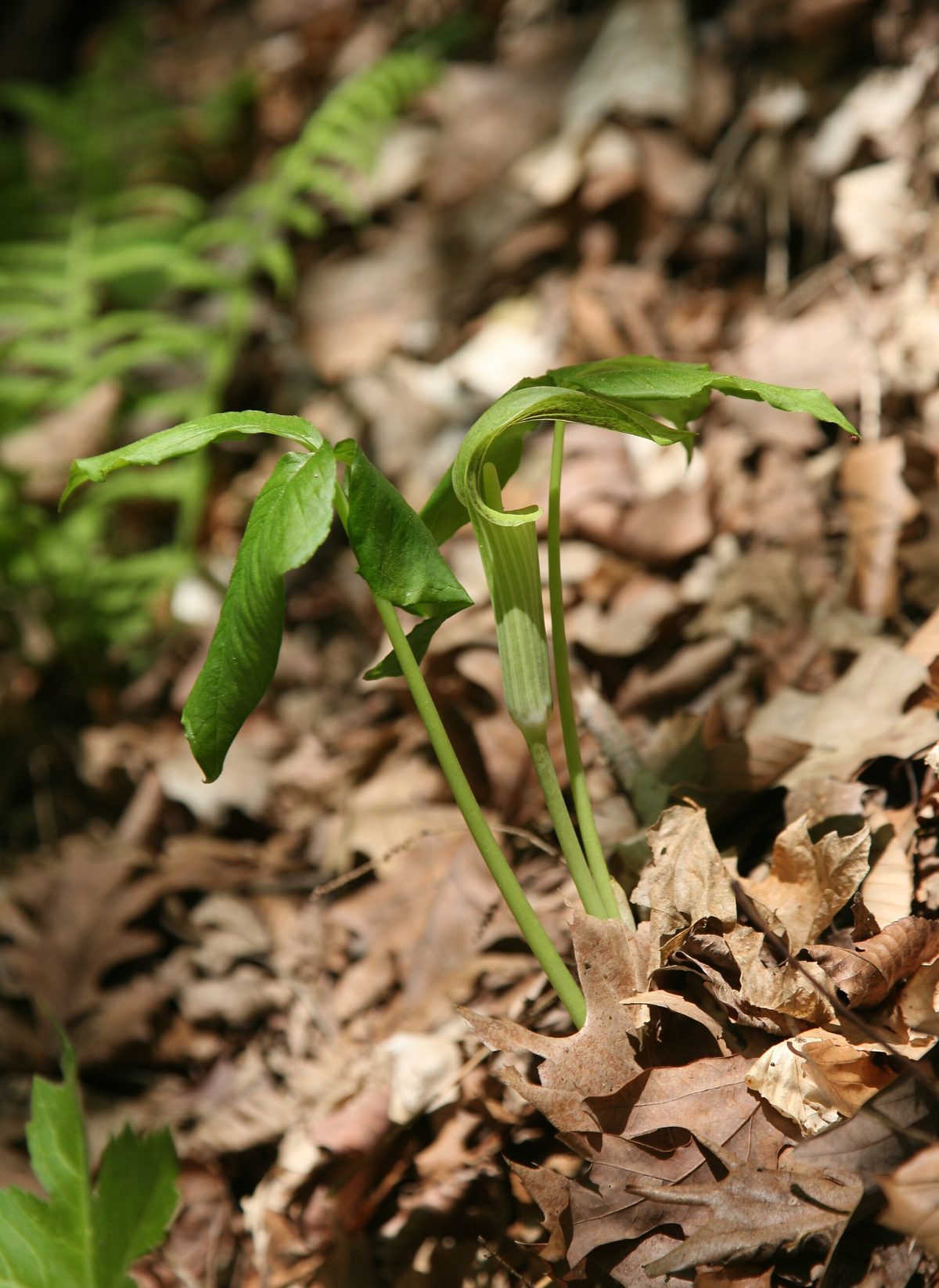
Photo: Daniel Schwen, CC BY-SA 4.0 via Wikimedia Commons

Quick facts
| Light: | Part shade and full shade (part shade preferred)111 source |
|---|---|
| Water: | Medium to wet12 |
| Soil: | Well drained, moist and occasionally wet11 source |
| Hardiness: | Zones 4a–9b11 source |
| Size: | 0.7–3 ft (0.2–0.91 m) × 1–2 ft (0.3–0.61 m)4561 |
| Growth rate: | Moderate111 source |
| Bloom: | Mar–Jun, Brown, green, purple and white2718 |
| Cats: | Toxic to cats (1 source) 3 |
| Dogs: | Toxic to dogs (1 source) 3 |
| Native range: | ALA, ARK, CNT, DEL, FLA, GEO, ILL, INI, IOW, KAN, KTY, LOU, MAI, MAN, MAS, MIC, MIN, MRY, MSI, MSO, NBR, NCA, NDA, NEB, NSC, NWH, NWJ, NWY, OHI, OKL, ONT, PEI, PEN, QUE, RHO, SCA, SDA, TEN, TEX, VER, VRG, WDC, WIS, WVA9 |
| Family: | Araceae |
How much light does a Jack in the Pulpit need?
Give this plant part shade to full shade outdoors. Part shade, meaning two to six hours of direct sun a day, is the condition it prefers most. Full shade, under two hours of direct sun, also suits it outdoors. The soil it grows in should stay moist with good drainage.
How often to water a Jack in the Pulpit
This plant needs soil that stays constantly moist. Its water needs run from medium-wet to wet, and the soil should rarely dry out. Water it often enough to keep the soil damp to the touch. Soil that is too dry for long stretches is not a good match for this plant.
Best soil for a Jack in the Pulpit
This plant grows well in soil with good drainage. It also tolerates soil that stays moist or is occasionally wet. Choose a planting site where the ground holds moisture rather than drying out quickly. In the wild, this species grows most vigorously in moist, shady, and seasonally wet locations. The soil should also be rich in organic matter and stay constantly moist.
Hardiness and temperature
This plant grows outdoors in USDA hardiness zones 4a through 9b. Zone 4a marks the coldest areas where it survives outdoors, and zone 9b marks the warmest. It is native to the lower 48 US states. Its flowers come in green, purple, brown, or white.
- Hardiness: Zones 4a–9b1
How to plant a Jack in the Pulpit
Plant this species outdoors in USDA zones 4a through 9b. It is native across much of the eastern and central United States, plus parts of eastern Canada. The US federal government also lists it as a native plant across the lower 48 states. Choose a planting spot with part shade to full shade, since that is what it takes outdoors.
- Hardiness: Zones 4a–9b1
Winter care
Zones 4a through 9b mark the USDA range where this plant survives outdoors. Within that span, it survives winter outdoors as a perennial. Winter conditions colder than zone 4a or warmer than zone 9b fall outside its documented range. It is native to a wide span of states and Canadian provinces. Its native range reaches from Florida north into Ontario and Quebec. That broad native range lines up with its wide 4a-9b hardiness rating. No cited source for this page records a specific minimum winter temperature it can tolerate.
- Hardiness: Zones 4a–9b1
How to propagate a Jack in the Pulpit
You can propagate this plant from seed, by division, or by separating offsets. Offsets are small cormlets that grow next to the parent corm. You can separate these cormlets from the parent corm in fall. Division and seed are the two other methods that work for this plant. This plant also grows at a moderate rate once it takes root.
Common problems
This plant has no significant insect or disease problems reported for it. Deer tend to avoid it too, since it contains bitter chemicals that discourage browsing. It also prefers soil with good drainage that stays moist. It grows at a moderate rate in the garden.
Is Jack in the Pulpit toxic to cats and dogs?
This plant is toxic to both cats and dogs. The ASPCA lists it as toxic to dogs, cats, and horses. If your cat or dog chews or eats any part of this plant, contact your vet or a pet poison line right away. Deer also tend to avoid browsing this plant because of its bitter chemicals. This plant grows from a bulb.
Pet-safe alternatives
Recommended supplies
- Soil: a free-draining mix, and a pot with a drainage hole.
Questions and answers
- Is Jack-in-the-pulpit toxic to cats and dogs?
- Yes, this plant is toxic to both cats and dogs, so keep it out of reach of your pets.
- Where should you plant Jack-in-the-pulpit outdoors?
- Give it part shade to full shade, since that is what it takes outdoors. It also grows best in USDA zones 4a through 9b, in soil that stays moist with good drainage.
- How do you propagate Jack-in-the-pulpit?
- You can grow new plants from seed, by division, or by separating offsets, which are small cormlets that form next to the parent corm. Fall is when these cormlets are typically separated for replanting.
Sources
- NC State Extension Gardener Plant Toolbox. https://plants.ces.ncsu.edu/plants/arisaema-triphyllum/. Accessed 14 October 2026.
- Lady Bird Johnson Wildflower Center. https://www.wildflower.org/plants/result.php?id_plant=artr. Accessed 14 October 2026.
- ASPCA Animal Poison Control Center. https://www.aspca.org/pet-care/aspca-poison-control/toxic-and-non-toxic-plants/jack-pulpit. Accessed 14 October 2026.
- University of Minnesota Extension. https://extension.umn.edu/garden-and-home/yard-and-garden/lawns-and-landscapes-in-minnesota/rain-gardens. Accessed 28 October 2026.
- University of Minnesota Extension. https://extension.umn.edu/natural-resources/forestry-and-wildlife/forestry/managing-woodlands/managing-black-walnut-forests. Accessed 28 October 2026.
- Penn State Extension. https://extension.psu.edu/programs/master-gardener/counties/york/native-plants/fact-sheets/native-plants-for-mid-atlantic-landscapes-shade-to-part-shade-wet-to-moist-soil. Accessed 28 October 2026.
- USDA Forest Service. https://www.fs.usda.gov/managing-land/wildflowers/plant-of-the-week/arisaema-triphyllum. Accessed 28 October 2026.
- Lady Bird Johnson Wildflower Center. https://www.wildflower.org/plants/result.php?id_plant=ARTR. Accessed 14 October 2026.
- Royal Botanic Gardens, Kew (World Checklist of Vascular Plants). https://sftp.kew.org/pub/data-repositories/WCVP/wcvp.zip. Accessed 4 June 2026.
How this page was made
- Written with AI assistance from the sources listed on this page. AI is never the source of a fact.