Spider Plant (Chlorophytum comosum)
Formerly Anthericum vittatum, Chlorophytum bukobense, Chlorophytum glaucidulum
Spider plant prefers medium light and tolerates both low light and bright, indirect light. It is intolerant of direct sunlight. It grows best in moist soil, though it tolerates drought and dry soil. The ASPCA and Pet Poison Helpline both describe it as non-toxic to cats and to dogs.
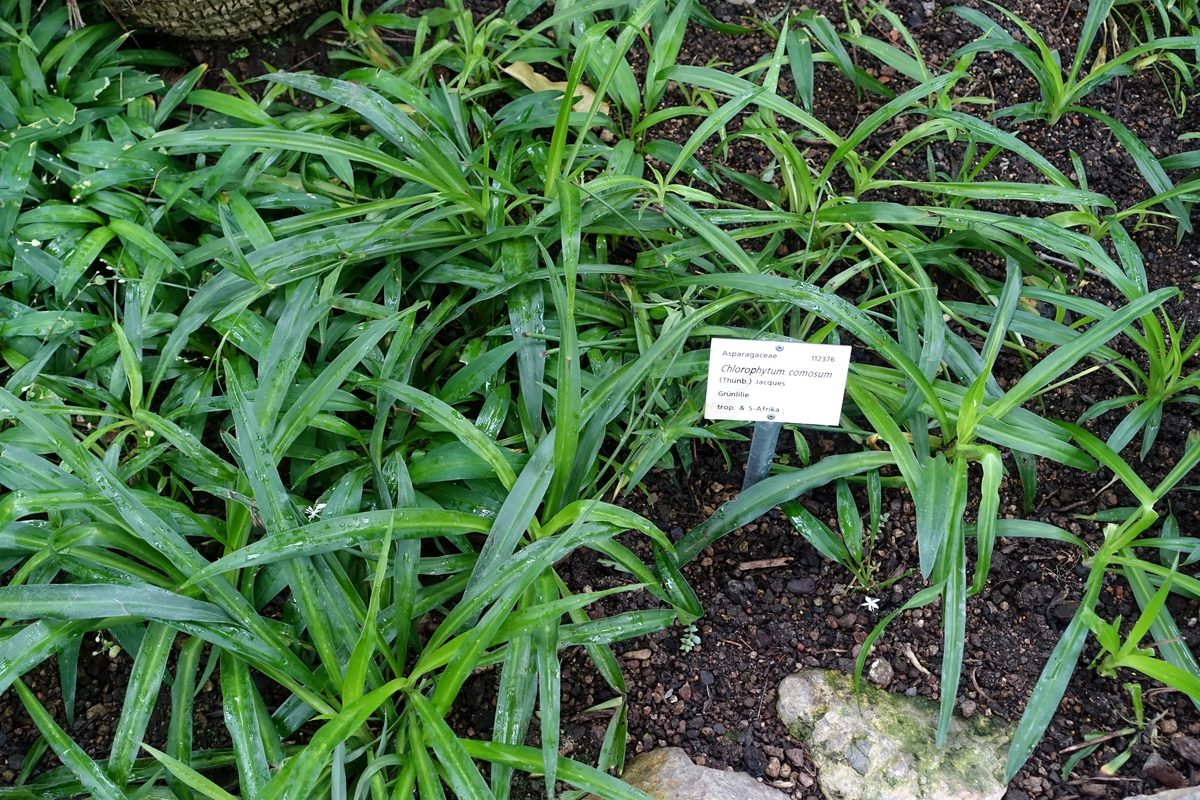
Photo: Daderot, CC0 via Wikimedia Commons

Quick facts
| Light: | Medium light; tolerates low light and bright, indirect light11 source |
|---|---|
| Water: | Dry to wet11 source |
| Soil: | Well drained and moist; pH 6–811 source |
| Minimum temperature: | 44.6 °F (7 °C)11 source |
| Size: | 1–1.5 ft (0.3–0.46 m) × 1–2 ft (0.3–0.61 m)191 source |
| Growth rate: | Moderate13910339 |
| Bloom: | White and yellow19106311 |
| Cats: | Non-toxic to cats 781 |
| Dogs: | Non-toxic to dogs 781 |
| Native range: | BUR, CMN, CPP, EQG, ETH, GGI, IVO, KEN, LBR, MLW, MOZ, NAT, NGA, SIE, SUD, SWZ, TAN, TVL, UGA, ZAM, ZIM12 |
| Family: | Asparagaceae |
How much light does a Spider Plant need?
Indoors, aim for medium light. The plant tolerates low light and bright, indirect light. It can also tolerate deep shade, but it is intolerant of direct sunlight. Outdoors, it grows in part shade or full shade, with part shade preferred. Deep shade means two hours of direct sun at most. Heavy shade is also on its list of tolerances.
- Light: Medium light; tolerates low light and bright, indirect light1
How often to water a Spider Plant
Moist soil is where spider plant grows best, though it is tolerant of drought and dry soil. Across the whole range, the water need runs from dry to wet. Overwatering or planting in poorly drained soil can lead to root rot. Good drainage and moisture are both listed for this plant's soil.
- Water: Dry to wet1
Best soil for a Spider Plant
Soil for this plant should be well drained and moist. The listed pH range is 6 to 8, which the source labels neutral. Moist soil is where the plant grows best, although it tolerates dry soil. Root rot usually results from a soil mix that does not drain quickly or from excessive watering. Planting in poorly drained soil can lead to it as well.
Temperature and humidity
Temperatures should stay above 45 °F (7 °C) for this plant. Outdoors, the listed hardiness range is USDA zones 9a to 11b. That range runs from zone 9a at the cold end to 11b at the warm end. Humidity is recorded as high for spider plant. A separate description says it grows best in moist soil and medium air humidity. That medium humidity figure differs from the high humidity record, so the exact level is not settled.
Fertilizing a Spider Plant
Fertilizer goes on monthly in the growing season. Feed during periods of active growth with a water-soluble or time-release houseplant fertilizer. Both forms, water-soluble and time-release, are named by the source. Its growth rate is listed as moderate, and its maintenance level as medium.
- Fertilizer: Monthly in the growing season3
Pruning a Spider Plant
The pruning type recorded for this plant is light shaping. Trim back the remaining stub, which may send out new growth. Spider plant grows 1–1.5 ft (0.3–0.46 m) tall and 1–2 ft (0.3–0.61 m) wide. Its habit is listed as spreading and trailing, with an arching, cascading form. Maintenance is rated medium.
- Pruning: Light shaping4
Repotting a Spider Plant
You can repot at any time of the year. The recorded timing covers every month, January through December. Whatever the month, the mix you repot into should be well drained and moist. A pH of 6 to 8 is the listed range. Its mature spread is 1–2 ft (0.3–0.61 m). Poorly drained soil can lead to root rot.
- Repotting: (Jan–Dec)3
How to propagate a Spider Plant
Spider plant propagates by division and by offsets. The plantlets can simply be snipped off and potted up. The plant produces numerous plantlets. A well-drained, moist soil with a pH of 6 to 8 is the listed soil for the plant. Temperatures should stay above 45 °F (7 °C). Medium light is the preferred level indoors.
Common problems
Root rot is the disease recorded for spider plant. It usually results from a soil mix that does not drain quickly or from excessive watering. Spider plants generally have few pest problems other than scale insects and mealybugs. The recorded pests are whiteflies, spider mites, scales, aphids, mealybugs and scale insects.
| Problem | Kind |
|---|---|
| Whiteflies | Pest |
| Spider mites | Pest |
| Scales | Pest |
| Aphids | Pest |
| Mealybugs | Pest |
| Scale insects | Pest |
| Root rot | Disease |
Is Spider Plant toxic to cats and dogs?
For cats, the ASPCA lists spider plant as non-toxic. For dogs, the ASPCA also lists it as non-toxic. Pet Poison Helpline's entry for Ribbon Plant, Chlorophytum comosum, also called Spider Plant, describes it as non-toxic to companion animals. The ASPCA entry reads non-toxicity, with non-toxic to dogs and non-toxic to cats. The scope here is cats and dogs, and both are listed. For households with both animals, the listing for cats and for dogs is the same.
Recommended supplies
- Light: a bright room out of direct sun; a full-spectrum grow light makes up the difference in a darker one.
- Soil: a free-draining mix, and a pot with a drainage hole.
- Humidity: it wants humid air; a pebble tray or a humidifier is the usual fix.
Questions and answers
- Is spider plant toxic to cats and dogs?
- The ASPCA lists spider plant as non-toxic to cats and non-toxic to dogs. Pet Poison Helpline also describes Ribbon Plant, Chlorophytum comosum, as non-toxic to companion animals.
- How much light does a spider plant need?
- Spider plant prefers medium light levels, and it tolerates low light and bright, indirect light. It is intolerant of direct sunlight, though it can tolerate deep shade.
- When can I repot a spider plant?
- You can repot at any time of the year. The timing record covers January through December. The mix should be well drained and moist, with a pH of 6 to 8.
Sources
- NC State Extension Gardener Plant Toolbox. https://plants.ces.ncsu.edu/plants/chlorophytum-comosum/common-name/spiderplant/. Accessed 23 September 2026.
- Clemson Cooperative Extension Home & Garden Information Center. https://hgic.clemson.edu/this-month-in-your-garden-january-2025/. Accessed 12 October 2026.
- Clemson Cooperative Extension Home & Garden Information Center. https://hgic.clemson.edu/factsheet/spider-plant/. Accessed 27 September 2026.
- Brooklyn Botanic Garden. https://www.bbg.org/article/escaping_spider_plant. Accessed 12 October 2026.
- Brooklyn Botanic Garden. https://www.bbg.org/article/how_to_propagate_houseplants. Accessed 23 September 2026.
- University of Wisconsin-Madison Division of Extension. https://hort.extension.wisc.edu/articles/spider-plant-chlorophytum-comosum/. Accessed 23 September 2026.
- ASPCA Animal Poison Control Center. https://www.aspca.org/pet-care/aspca-poison-control/toxic-and-non-toxic-plants/spider-plant. Accessed 23 September 2026.
- Pet Poison Helpline. https://www.petpoisonhelpline.com/poison/ribbon-plant/. Accessed 23 September 2026.
- NC State Extension Gardener Plant Toolbox. https://plants.ces.ncsu.edu/plants/chlorophytum-comosum/. Accessed 23 September 2026.
- NC State Extension Gardener Plant Toolbox. https://plants.ces.ncsu.edu/plants/chlorophytum-comosum/common-name/chlorophytum/. Accessed 30 October 2026.
- NC State Extension Gardener Plant Toolbox. https://plants.ces.ncsu.edu/plants/chlorophytum-comosum-variegatum/. Accessed 23 September 2026.
- Royal Botanic Gardens, Kew (World Checklist of Vascular Plants). https://sftp.kew.org/pub/data-repositories/WCVP/wcvp.zip. Accessed 4 June 2026.
How this page was made
- Written with AI assistance from the sources listed on this page. AI is never the source of a fact.