Joshua Tree (Yucca brevifolia)
Formerly Sarcoyucca brevifolia, Clistoyucca brevifolia, Yucca arborescens
Joshua tree grows in full sun, with a recorded water need of dry and well drained soil. The ASPCA lists it as toxic to both cats and dogs. It is a slow-growing tree recorded for USDA zones 7a to 10b. The sections below cover light, water, soil, propagation and pests.
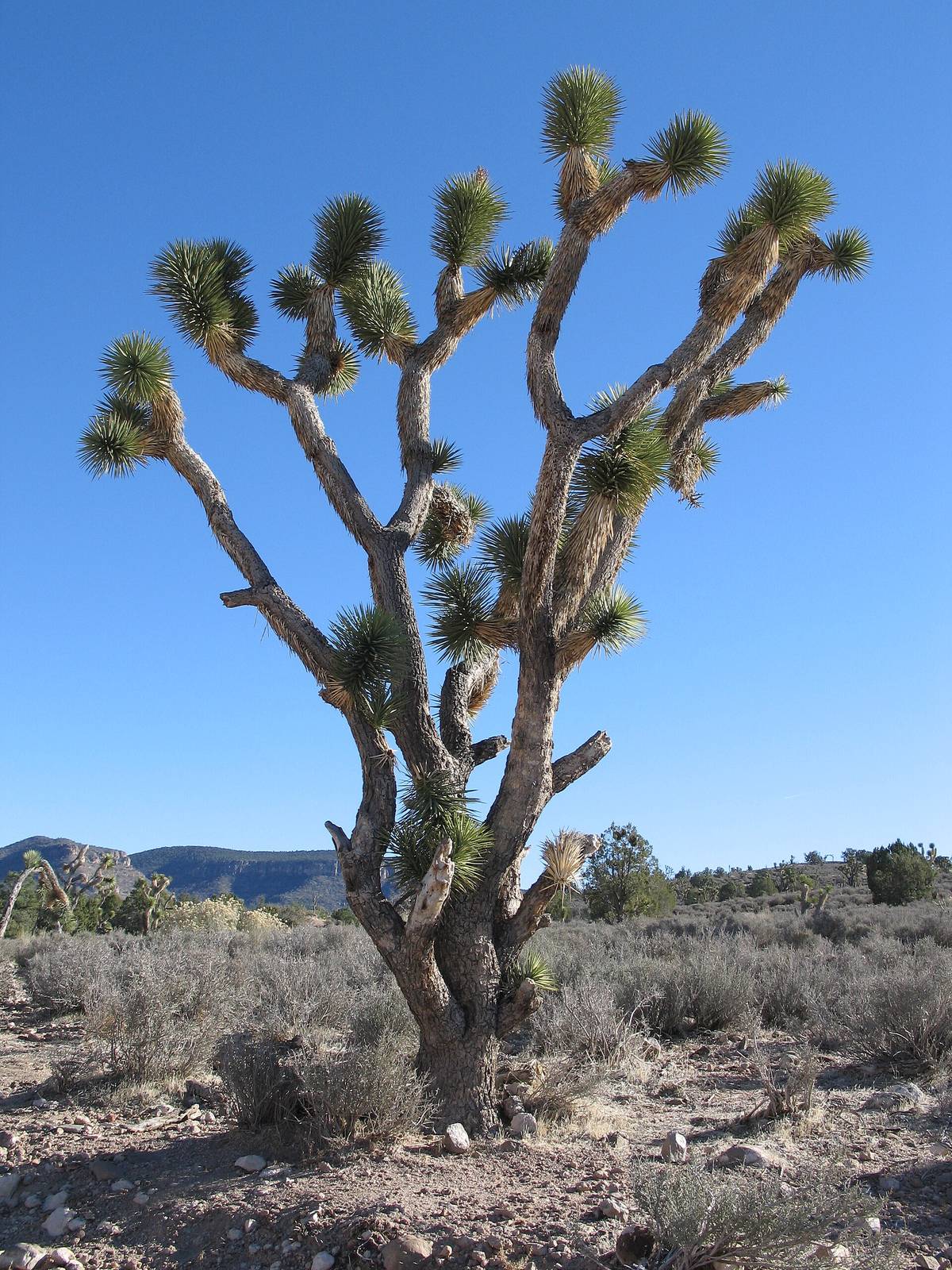
Photo: Keith Pomakis, CC BY-SA 2.5 via Wikimedia Commons

Quick facts
| Light: | Full sun11 source |
|---|---|
| Water: | Dry11 source |
| Soil: | Well drained21 source |
| Hardiness: | Zones 7a–10b11 source |
| Size: | 20 ft (6.1 m)11 source |
| Growth rate: | Slow31 |
| Bloom: | Mar–May, White and yellow211 source |
| Cats: | Toxic to cats 67 |
| Dogs: | Toxic to dogs 67 |
| Native range: | CAL, MXN, NEV8 |
| Family: | Asparagaceae |
How much light does a Joshua Tree need?
Full sun is where this tree belongs outdoors. No other light level is recorded for this species, and full sun is the preferred one. Utah State University Extension describes the tree as shade intolerant. Choose a spot where it will not stand in shade. No cited source gives a number of sun hours for it.
- Light: Full sun1
How often to water a Joshua Tree
Its water need is recorded as dry, at both the low end and the high end of the range. Drought tolerance is rated high by Utah State University Extension. Its soil drainage is recorded as well drained. No cited source gives a watering schedule or an amount for this species.
- Water: Dry1
Best soil for a Joshua Tree
Well drained soil is the one drainage type recorded for Joshua tree. The Lady Bird Johnson Wildflower Center advises transplanting into a well drained soil. The same records list its water need as dry. No cited source gives a pH range for this species, so soil pH is not documented here. Soil texture and amendments are not documented either.
- Soil drainage: Well drained2
Hardiness and temperature
USDA hardiness zones 7a to 10b are recorded for Joshua tree. Utah State University Extension words this as supposedly zones 7 to 10, which is a hedge. Check your own USDA zone against that range before you plant. No cited source records a minimum temperature for it. Humidity is not documented either.
- Hardiness: Zones 7a–10b1
How to plant a Joshua Tree
Check that your USDA hardiness zone falls between 7a and 10b before you plant a Joshua tree. Pick a spot in full sun with well drained soil. The tree is often shrubby but can reach 20 ft (6.1 m) tall, with a trunk up to 24 in (61 cm) across. Growth is slow, with unbranched seedlings averaging 3 in (7.6 cm) a year for their first 10 years.
- Hardiness: Zones 7a–10b1
Winter care
Winter limits are only partly documented for Joshua tree. It is recorded as hardy in USDA zones 7a to 10b. If your winters fall outside zones 7a to 10b, your site lies outside its recorded range. No cited source gives a minimum temperature, frost protection or winter watering advice. Its water need is recorded as dry.
- Hardiness: Zones 7a–10b1
How to propagate a Joshua Tree
You can propagate Joshua tree by seed, stem cuttings and offsets. The Lady Bird Johnson Wildflower Center says yuccas can be grown from stem cuttings, or by digging offsets from the side of established plants. The USDA Forest Service says Joshua tree reproduces sexually through seed production. No cited source gives germination times, rooting times or a growing medium for any of these methods.
Common problems
Yucca weevils, mealybugs and scales are the common pests recorded for Joshua tree. The diseases recorded are damping off, leaf spot and phytophthora root rot. The UC Statewide Integrated Pest Management Program lists agave and yucca weevils, and phytophthora root and crown rot. No cited source gives treatments or signs of these problems here.
| Problem | Kind |
|---|---|
| Yucca weevils | Pest |
| Mealybugs | Pest |
| Scales | Pest |
| Damping off | Disease |
| Leaf spot | Disease |
| Phytophthora root rot | Disease |
Is Joshua Tree toxic to cats and dogs?
For cats, the ASPCA lists Joshua tree as toxic. Pet Poison Helpline says it typically causes only mild vomiting and diarrhea in cats, and possibly pupil dilation.
For dogs, the ASPCA also lists the plant as toxic. Pet Poison Helpline gives the same typical picture for dogs: mild vomiting and diarrhea, and possibly pupil dilation. The cited records used here do not say which parts of the plant are involved.
Pet-safe alternatives
Recommended supplies
- Soil: a free-draining mix, and a pot with a drainage hole.
Questions and answers
- Does Joshua tree need full sun?
- Joshua tree is recorded for full sun, and it is described as shade intolerant. Full sun is the only light level listed for it. No cited source gives a number of sun hours.
- Is Joshua tree toxic to cats and dogs?
- The ASPCA lists Joshua tree as toxic to both cats and dogs. Pet Poison Helpline describes mild vomiting and diarrhea as the typical effect in both animals, with possible pupil dilation.
- How fast does Joshua tree grow?
- Joshua tree is a slow grower. The USDA Forest Service reports that unbranched seedlings grew about 3 in (7.6 cm) each year over the first decade. Utah State University Extension says the tree can reach 20 ft (6.1 m).
Sources
- Utah State University Extension. https://extension.usu.edu/treebrowser/catalog/joshua-tree. Accessed 14 October 2026.
- Lady Bird Johnson Wildflower Center. https://www.wildflower.org/plants/result.php?id_plant=YUBR. Accessed 14 October 2026.
- USDA Forest Service Fire Effects Information System. https://www.fs.usda.gov/database/feis/plants/tree/yucbre/all.html. Accessed 14 October 2026.
- UC Statewide Integrated Pest Management Program. https://ipm.ucanr.edu/home-and-landscape/agave/. Accessed 14 October 2026.
- UC Statewide Integrated Pest Management Program. https://ipm.ucanr.edu/PMG/GARDEN/PLANTS/agave.html. Accessed 14 October 2026.
- ASPCA Animal Poison Control Center. https://www.aspca.org/pet-care/aspca-poison-control/toxic-and-non-toxic-plants/yucca. Accessed 14 October 2026.
- Pet Poison Helpline. https://www.petpoisonhelpline.com/poison/yucca/. Accessed 14 October 2026.
- Royal Botanic Gardens, Kew (World Checklist of Vascular Plants). https://sftp.kew.org/pub/data-repositories/WCVP/wcvp.zip. Accessed 4 June 2026.
How this page was made
- Written with AI assistance from the sources listed on this page. AI is never the source of a fact.