Sweet Cherry (Prunus avium)
Formerly Cerasus avium, Cerasus juliana, Cerasus duracina
Sweet cherry grows best in full sun, with six or more hours of direct light each day. It needs medium water and does not tolerate soggy soil. All parts of this tree are toxic to both cats and dogs, and the toxicity to cats is rated mild.
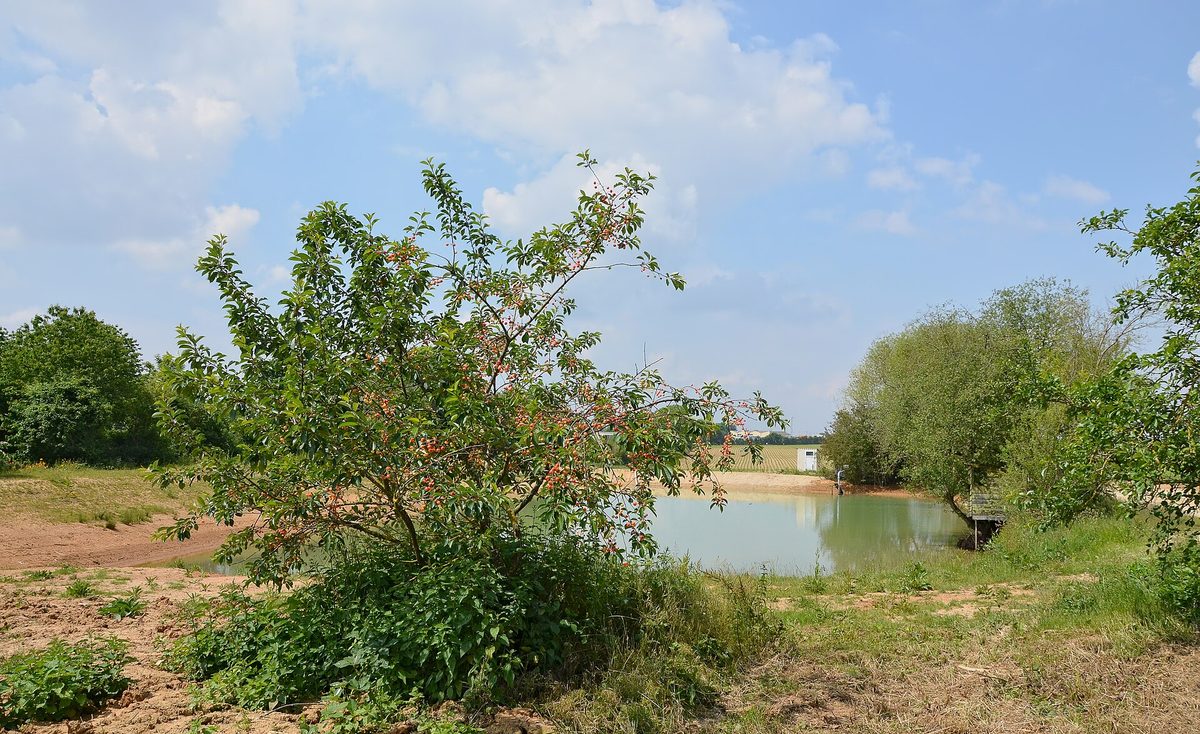
Photo: JLPC, CC BY-SA 3.0 via Wikimedia Commons

Quick facts
| Light: | Full sun121 source |
|---|---|
| Water: | Medium21 source |
| Soil: | Well drained and moist; pH 6–71345 |
| Hardiness: | Zones 3a–8b121 source |
| Size: | 15–30 ft (4.57–9.14 m) × 15–30 ft (4.57–9.14 m)211 source |
| Growth rate: | Moderate121 source |
| Bloom: | White213 |
| Cats: | Toxic to cats Severity reported: Mild 1011 |
| Dogs: | Toxic to dogs 1011 |
| Native range: | AFG, ALB, ALG, AUT, BGM, BLR, BUL, COR, CYP, CZE, DEN, FRA, GER, GRB, GRC, HUN, IRE, IRN, ITA, KRY, LBY, MOR, NCS, NET, NOR, POL, POR, ROM, SPA, SWE, SWI, TCS, TUE, TUN, TUR, UKR, YUG14 |
| Family: | Rosaceae |
How much light does a Sweet Cherry need?
Give sweet cherry a spot with full sun. Full sun means six hours or more of direct sunlight every day. This tree is not listed as tolerant of partial shade, so plan on an open, unshaded spot for it. An open, outdoor planting site in direct sun suits it best.
How often to water a Sweet Cherry
Sweet cherry needs medium water. It grows best in soil that stays moist but still drains well, since it will not tolerate wet soil. The same soil also needs to drain well, since heavy or poorly drained ground causes problems for this tree. Sources record medium as this tree's water need, not high or low.
- Water: Medium2
Best soil for a Sweet Cherry
Sweet cherry needs soil that drains well but still holds some moisture. It will not tolerate wet, waterlogged ground, and heavy or poorly drained soil causes it to perform very poorly. Aim for a soil pH between 6.0 and 7.0. Light, well-drained soil in that range is what this tree prefers. If the pH drifts outside that window, some modification of the soil is possible.
Hardiness and temperature
Sweet cherry is hardy in USDA zones 3a through 8b. Zone 3a is its coldest limit, and zone 8b its warmest. Outside that span, in colder or warmer zones, it is not rated as hardy. The zone range of 3a to 8b is the full hardiness window this tree is documented for.
Pruning a Sweet Cherry
Prune sweet cherry with a light touch rather than a heavy cut. The recorded timing for this is after the tree has fruited, or in early July. Light shaping cuts, not heavy pruning, are what this timing calls for. July pruning is the one exception noted for sweet cherry's schedule.
- Pruning: Light shaping (Jul)6
How to plant a Sweet Cherry
This tree can be planted across USDA zones 3a to 8b. Zones colder than 3a or warmer than 8b fall outside the range this tree is rated for. At maturity, this tree spreads 15 to 30 ft (4.57-9.14 m) wide, about the same as its height. That mature spread is the space to plan for when placing this tree.
Winter care
Winter hardiness for this tree spans USDA zones 3a to 8b. Zone 3a marks the coldest winters it is rated to handle. Gardens colder than zone 3a sit outside the winter hardiness recorded for this species. Zone 8b is the mildest-winter end of the range this tree is documented for.
How to propagate a Sweet Cherry
Sweet cherry is propagated by grafting. Commercial trees of this species are either budded or grafted. Grafting, not seed, is the method recorded for producing this tree commercially. Budding is the related technique recorded alongside grafting for propagating this tree. Growing this tree from seed is not the method documented for commercial production.
Common problems
Sweet cherry can face several pests, including aphids, fruit flies, sawflies, scale and cherry lace bug. Disease problems recorded for this tree include leaf spot, bacterial canker, brown rot, black knot, crown gall, leaf curl, leaf scorch, powdery mildew, root rot, scab and shot hole fungus.
| Problem | Kind |
|---|---|
| Aphids | Pest |
| Fruit flies | Pest |
| Sawflies | Pest |
| Scale insects | Pest |
| Cherry lace bug | Pest |
| Leaf spot | Disease |
| Bacterial canker | Disease |
| Brown rot | Disease |
| Black knot | Disease |
| Crown gall | Disease |
| Curling leaves | Symptom |
| Leaf scorch | Disease |
| Powdery mildew | Disease |
| Root rot | Disease |
| Scab | Disease |
| Shot hole fungus | Disease |
Is Sweet Cherry toxic to cats and dogs?
Sweet cherry is toxic to both cats and dogs. All parts of the plant except the ripe pulp around the seeds are toxic and contain cyanide. That cyanide risk applies to cats and dogs alike, since both are listed as affected. In cats, this toxicity is rated mild. A mild rating still means the plant is listed as toxic, not safe, for cats.
Pet-safe alternatives
Recommended supplies
- Soil: a free-draining mix, and a pot with a drainage hole.
Questions and answers
- Is sweet cherry toxic to cats and dogs?
- Yes, sweet cherry is toxic to both cats and dogs. All parts of the plant except the ripe pulp around the seeds are toxic and contain cyanide. In cats, this toxicity is rated mild.
- How much sun does sweet cherry need?
- Sweet cherry needs full sun, meaning six or more hours of direct sunlight each day. No source lists it as tolerant of partial shade.
- What zones is sweet cherry hardy in?
- Sweet cherry is hardy in USDA zones 3a through 8b. Zone 3a is its coldest limit, and zone 8b its warmest. Below or above that range, it is not rated as winter hardy.
Sources
- NC State Extension Gardener Plant Toolbox. https://plants.ces.ncsu.edu/plants/prunus-avium/. Accessed 14 October 2026.
- NC State Extension Gardener Plant Toolbox. https://plants.ces.ncsu.edu/plants/prunus-avium/common-name/sweet-cherry/. Accessed 14 October 2026.
- University of Illinois Extension. https://web.extension.illinois.edu/hortanswers/PlantDetail.cfm?PlantID=626&PlantTypeID=11. Accessed 14 October 2026.
- Oregon State University Extension Service. https://extension.oregonstate.edu/catalog/pub/pnw-642-sweet-cherry-orchard-establishment-pacific-northwest-0. Accessed 14 October 2026.
- Oregon State University Extension Service. https://extension.oregonstate.edu/catalog/em-9219-integrated-pest-management-strategic-plan-sweet-cherries-oregon-washington. Accessed 14 October 2026.
- Penn State Extension. https://extension.psu.edu/pruning-and-training-home-fruit-trees-to-an-open-center. Accessed 14 October 2026.
- Oregon State University Extension Service. https://extension.oregonstate.edu/pub/pnw-619. Accessed 15 October 2026.
- Oregon State University Extension Service. https://extension.oregonstate.edu/catalog/pnw-619-sweet-cherry-rootstocks-pacific-northwest. Accessed 15 October 2026.
- Oregon State University Extension Service. https://extension.oregonstate.edu/pub/ec-819. Accessed 15 October 2026.
- Pet Poison Helpline. https://www.petpoisonhelpline.com/poison/cherry/. Accessed 14 October 2026.
- ASPCA Animal Poison Control Center. https://www.aspca.org/pet-care/aspca-poison-control/toxic-and-non-toxic-plants/cherry. Accessed 14 October 2026.
- Utah State University Extension. https://extension.usu.edu/treebrowser/catalog/cherry-sweet-mazzard. Accessed 15 October 2026.
- Chicago Botanic Garden. https://www.chicagobotanic.org/plant-information/plant-finder/prunus-avium-royal-anne-royal-anne-cherry. Accessed 14 October 2026.
- Royal Botanic Gardens, Kew (World Checklist of Vascular Plants). https://sftp.kew.org/pub/data-repositories/WCVP/wcvp.zip. Accessed 4 June 2026.
How this page was made
- Written with AI assistance from the sources listed on this page. AI is never the source of a fact.