Russian Olive (Elaeagnus angustifolia)
Formerly Elaeagnus hortensis, Elaeagnus oxycarpa, Elaeagnus songarica
Plant Russian olive (Elaeagnus angustifolia) where it gets full sun, which means six or more hours of direct sunlight a day. One source describes it as shade intolerant. Its soil should be well drained, with a pH between 5 and 8. The ASPCA lists it as non-toxic to both cats and dogs.
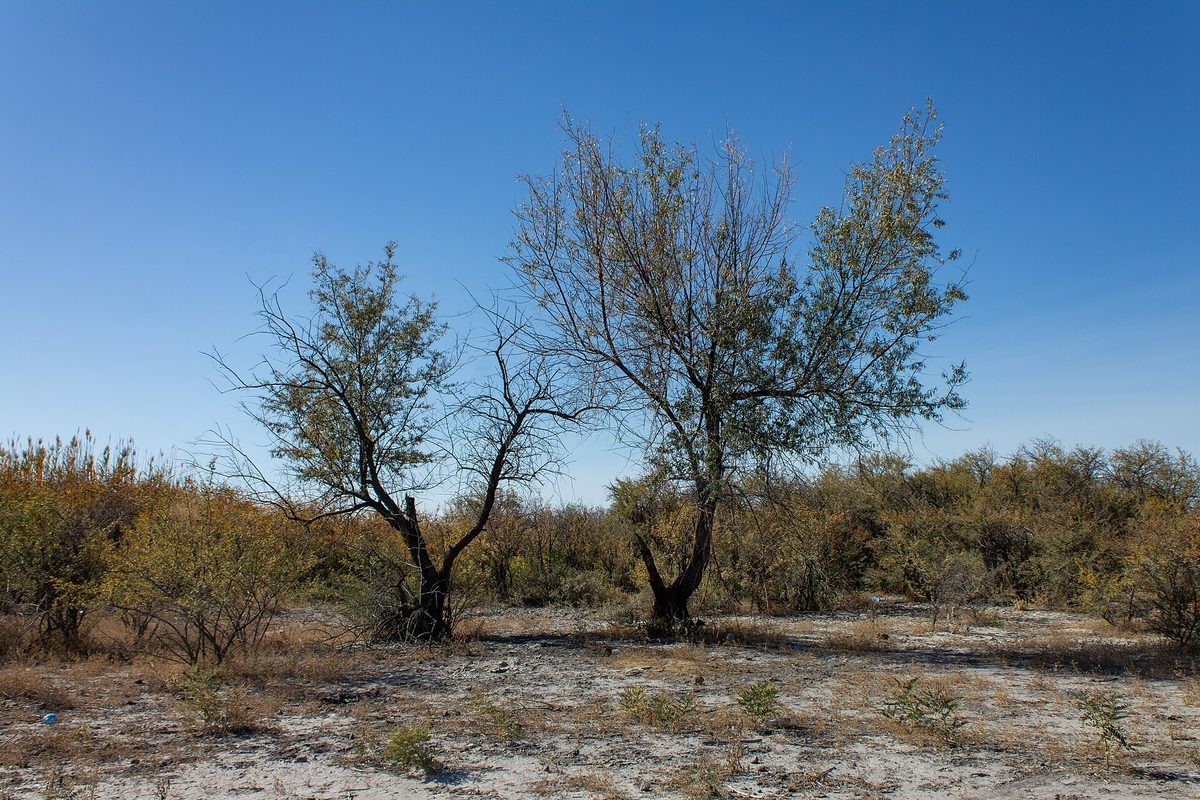
Photo: ElenaLitera, CC BY-SA 4.0 via Wikimedia Commons

Quick facts
| Light: | Full sun12 |
|---|---|
| Soil: | Well drained, moist and occasionally wet; pH 5–8131 source |
| Hardiness: | Zones 2a–7b11 source |
| Size: | 16.4–39.4 ft (5–12 m) × 12–15 ft (3.66–4.57 m)431 source |
| Growth rate: | Rapid12 |
| Bloom: | Apr–Jun, White and yellow11 source |
| Cats: | Non-toxic to cats 51 |
| Dogs: | Non-toxic to dogs 51 |
| Native range: | AFG, ALT, ASS, CHI, CHM, CHN, CHQ, CHS, CHX, EAI, IRN, KAZ, KGZ, LBS, MON, MYA, NCS, PAK, PAL, RUC, RUE, RUS, TCS, TKM, TUR, TZK, UKR, UZB, WHM, WSB6 |
| Family: | Elaeagnaceae |
How much light does a Russian Olive need?
Six or more hours of direct sunlight a day counts as full sun, which is the light this plant is listed for. The only light value on record for it is full sun. One source describes the species as shade intolerant. Choose an open position that matches that full sun listing.
Best soil for a Russian Olive
Soil drainage for this plant is listed as well drained, moist and occasionally wet. A source also gives the note good drainage. Occasionally wet soil appears in that list alongside well drained soil. Moist soil is also on the list. The pH range is 5 to 8, which covers acid to alkaline soil. Cornell's Woody Plants Database says the plant can tolerate that span, from pH 5.0 to 8.0.
Hardiness and temperature
Hardiness zones 2a through 7b are listed for this species. The list spells out each half step: 2a, 2b, 3a, 3b, 4a, 4b, 5a, 5b, 6a, 6b, 7a and 7b. The coldest zone listed is 2a and the warmest is 7b. Check your own USDA zone against that span before you plant.
- Hardiness: Zones 2a–7b1
How to plant a Russian Olive
Before planting, match your site to zones 2a through 7b, the span listed for this species. Mature height is 16 to 40 ft (5-12 m), according to the USDA Forest Service. Cornell gives a spread of 12 to 15 ft (3.66-4.57 m). Leave room for that spread when you choose a spot. Look for full sun and well drained soil. In the lower 48 US states, it is an introduced species.
- Hardiness: Zones 2a–7b1
Winter care
Zone 2a, the coldest zone listed, is where this plant's hardiness range begins. Zone 7b is the warm end of that range. NC State Extension describes it as a deciduous shrub. Check that your own zone falls between 2a and 7b before you rely on it outdoors through winter.
- Hardiness: Zones 2a–7b1
How to propagate a Russian Olive
Four propagation methods are listed for this plant: seed, stem cuttings, root cuttings and grafting. The USDA Forest Service says Russian olive reproduces by seed and postinjury sprouting. Stem cuttings and root cuttings are separate entries in the list. Grafting is the fourth method listed. Seed appears in both the list and the Forest Service statement.
- Propagation: Seed, stem cuttings, root cuttings and grafting4
Common problems
Three diseases are recorded for this plant: verticillium wilt, stem canker and Xylella fastidiosa. Cornell's Woody Plants Database lists it as susceptible to verticillium wilt. NC State Extension says canker disease is occasionally a problem. Xylella fastidiosa is the third disease in that list.
| Problem | Kind |
|---|---|
| Verticillium wilt | Disease |
| Stem canker | Disease |
| Xylella fastidiosa | Disease |
Is Russian Olive toxic to cats and dogs?
The ASPCA Animal Poison Control Center lists this plant as non-toxic to dogs and non-toxic to cats. NC State Extension's Plant Toolbox also describes it as non-toxic for cats. The same toolbox describes it as non-toxic for dogs. For cats, the position on record is non-toxic, from both the ASPCA and NC State Extension. For dogs, the position on record is also non-toxic, from the same two listings.
Recommended supplies
- Soil: a free-draining mix, and a pot with a drainage hole.
Questions and answers
- Is Russian olive toxic to cats or dogs?
- The ASPCA lists Russian olive as non-toxic to dogs and non-toxic to cats. NC State Extension's Plant Toolbox also describes it as non-toxic for cats and for dogs.
- How much sun does Russian olive need?
- It is listed for full sun, which means six or more hours of direct sunlight a day. Utah State University Extension describes the tree as shade intolerant.
- How big does Russian olive get?
- The USDA Forest Service describes mature plants as 16 to 40 ft (5-12 m) tall. Cornell's Woody Plants Database gives a spread of 12 to 15 ft (3.66-4.57 m).
Sources
- NC State Extension Gardener Plant Toolbox. https://plants.ces.ncsu.edu/plants/elaeagnus-angustifolia/. Accessed 14 October 2026.
- Utah State University Extension (TreeBrowser). https://extension.usu.edu/treebrowser/catalog/russian-olive.php. Accessed 14 October 2026.
- Cornell University CALS Woody Plants Database. https://woodyplants.cals.cornell.edu/plant/86. Accessed 14 October 2026.
- USDA Forest Service Fire Effects Information System. https://www.fs.usda.gov/database/feis/plants/tree/elaang/all.html. Accessed 14 October 2026.
- ASPCA Animal Poison Control Center. https://www.aspca.org/pet-care/aspca-poison-control/toxic-and-non-toxic-plants/russian-olive. Accessed 14 October 2026.
- Royal Botanic Gardens, Kew (World Checklist of Vascular Plants). https://sftp.kew.org/pub/data-repositories/WCVP/wcvp.zip. Accessed 4 June 2026.
How this page was made
- Written with AI assistance from the sources listed on this page. AI is never the source of a fact.