Goldenrain Tree (Koelreuteria paniculata)
Formerly Sapindus paniculata, Paullinia aurea, Sapindus sinensis
Give goldenrain tree full sun and a soil that runs from dry to medium in moisture, and this deciduous tree reaches 30 to 40 ft (9.1–12.2 m) tall. It bears yellow flowers. Toxicity for cats and for dogs is not documented in the sources checked for this page.
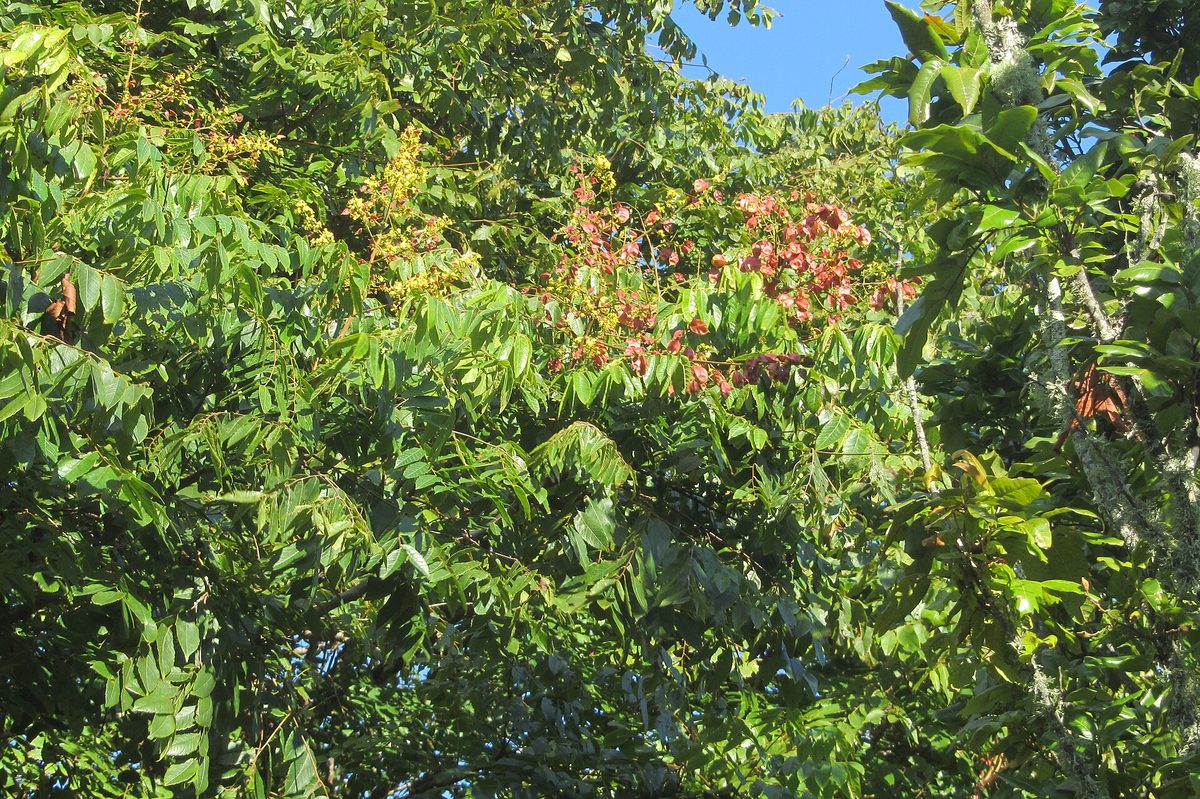
Photo: Ewen Cameron, CC BY 4.0 via Wikimedia Commons

Quick facts
| Light: | Full sun123 |
|---|---|
| Water: | Dry to medium21 source |
| Soil: | Well drained, moist, occasionally dry and poorly drained; pH 5–8121 source |
| Hardiness: | Zones 5a–8b11 source |
| Size: | 29.9–40 ft (9.1–12.2 m) × 29.9–40 ft (9.1–12.2 m)126 |
| Growth rate: | Sources differ: Utah State University Extension; Utah State University Extension; Utah State University Extension (TreeBrowser)11177Sources differ |
| Bloom: | Jul, Yellow161 source |
| Cats: | Not documented by major sources |
| Dogs: | Not documented by major sources |
| Native range: | CHC, CHI, CHM, CHN, CHS, KOR8 |
| Family: | Sapindaceae |
How much light does a Goldenrain Tree need?
Goldenrain tree does best in full sun outdoors. NC State Extension calls it a soil-adaptable tree and says to plant it in full sun. Cornell's woody plants database also lists full sun as the light condition. The recorded light preference is full sun, with no shade range listed. Give a sunny spot room for a tree that reaches 30 to 40 ft (9.1–12.2 m) tall.
How often to water a Goldenrain Tree
Water needs for this tree run from dry to medium. Cornell's woody plants database lists consistently moist, well-drained soil, occasional periods of dry soil and prolonged periods of dry soil. NC State Extension describes the soil as moist and well drained. The drainage record also includes poorly drained soil. No watering schedule in days is recorded for this page.
- Water: Dry to medium2
Best soil for a Goldenrain Tree
Drainage records for goldenrain tree list well drained, moist, occasionally dry and poorly drained soil. NC State Extension describes the soil as moist and well drained, and calls the tree soil-adaptable. Poorly drained soil is on the list alongside well drained soil. The pH range is 5 to 8, which covers acid to alkaline soil. Cornell's database states that it can tolerate acid to alkaline soil, pH 5.0 to 8.0.
Hardiness and temperature
NC State Extension lists USDA Plant Hardiness Zones 5a through 8b for goldenrain tree. That range includes zones 5a, 5b, 6a, 6b, 7a, 7b, 8a and 8b. Zone 5a is the coldest zone in the range and 8b is the warmest. Check your own zone against that range before you plant.
- Hardiness: Zones 5a–8b1
How to plant a Goldenrain Tree
Space goldenrain tree for a mature size of 30 to 40 ft (9.1–12.2 m) tall and about as wide. Choose a full sun site, the preferred light for this tree. It is listed for USDA zones 5a to 8b, so check that your zone falls inside that range. The soil can be well drained or moist, with a pH from 5 to 8. In the lower 48 states it is recorded as introduced rather than native.
- Hardiness: Zones 5a–8b1
Winter care
NC State Extension describes goldenrain tree as a medium-sized deciduous tree in the maple family. Its hardiness is recorded as USDA zones 5a to 8b. Zone 5a is the coldest zone listed, and 8b is the warmest. A site in zone 4 or colder falls outside the recorded range.
- Hardiness: Zones 5a–8b1
Common problems
Recorded pests for goldenrain tree include Anoplophora glabripennis, Halyomorpha halys, Corythucha arcuata, Euwallacea fornicatus, scale and boxelder bug. The list also names Cnestus mutilatus, Eotetranychus lewisi, Lopholeucaspis japonica, Oemona hirta, Oncometopia nigricans, Pochazia shantungensis and Selenothrips rubrocinctus. Recorded diseases are Lasiodiplodia theobromae, canker and verticillium wilt. University of Florida IFAS notes that a canker causes dead and sunken areas on the bark.
- Common pests: cnestus mutilatus, anoplophora glabripennis, corythucha arcuata, eotetranychus lewisi, euwallacea fornicatus, halyomorpha halys, lopholeucaspis japonica, oemona hirta, oncometopia nigricans, pochazia shantungensis, selenothrips rubrocinctus, scale and boxelder bug45
- Common diseases: lasiodiplodia theobromae, canker and verticillium wilt45
| Problem | Kind |
|---|---|
| Cnestus mutilatus | Pest |
| Anoplophora glabripennis | Pest |
| Corythucha arcuata | Pest |
| Eotetranychus lewisi | Pest |
| Euwallacea fornicatus | Pest |
| Halyomorpha halys | Pest |
| Lopholeucaspis japonica | Pest |
| Oemona hirta | Pest |
| Oncometopia nigricans | Pest |
| Pochazia shantungensis | Pest |
| Selenothrips rubrocinctus | Pest |
| Scale insects | Pest |
| Boxelder bug | Pest |
| Lasiodiplodia theobromae | Disease |
| Canker | Disease |
| Verticillium wilt | Disease |
Is Goldenrain Tree toxic to cats and dogs?
Recommended supplies
- Soil: a free-draining mix, and a pot with a drainage hole.
Questions and answers
- How big does goldenrain tree get?
- NC State Extension says the tree is 30 to 40 feet tall and equally as wide, or 9.1–12.2 m. It is a medium-sized deciduous tree. Its native range is recorded as CHC, CHI, CHM, CHN, CHS and KOR, and its status in the lower 48 states is introduced.
- What color are the flowers and when do they bloom?
- The flowers are yellow, and NC State Extension describes them as star-shaped with red centers. Chicago Botanic Garden describes yellow flowers with narrow petals. Yellow is the only bloom color recorded. Blooming occurs in July.
- What soil does goldenrain tree grow in?
- It is listed for moist and well drained soil, and also for poorly drained and occasionally dry soil. Cornell states it can tolerate acid to alkaline soil, pH 5.0 to 8.0. Full sun is the light to give it.
Sources
- NC State Extension Gardener Plant Toolbox. https://plants.ces.ncsu.edu/plants/koelreuteria-paniculata/. Accessed 14 October 2026.
- Cornell University CALS Woody Plants Database. https://woodyplants.cals.cornell.edu/plant/131. Accessed 14 October 2026.
- Utah State University Extension. https://extension.usu.edu/treebrowser/catalog/goldenraintree.php. Accessed 14 October 2026.
- EPPO Global Database. https://gd.eppo.int/taxon/KOTPA/pests. Accessed 14 October 2026.
- University of Florida IFAS Extension (EDIS). https://ask.ifas.ufl.edu/publication/ST339. Accessed 14 October 2026.
- Chicago Botanic Garden. https://www.chicagobotanic.org/plant-information/plant-finder/koelreuteria-paniculata-panicled-golden-rain-tree. Accessed 14 October 2026.
- Utah State University Extension. https://extension.usu.edu/treebrowser/catalog/goldenraintree. Accessed 14 October 2026.
- Royal Botanic Gardens, Kew (World Checklist of Vascular Plants). https://sftp.kew.org/pub/data-repositories/WCVP/wcvp.zip. Accessed 4 June 2026.
How this page was made
- Written with AI assistance from the sources listed on this page. AI is never the source of a fact.