English Walnut (Juglans regia)
Formerly Juglans arguta, Juglans fallax, Juglans fertilis
Give English walnut full sun. It prefers well-drained, moist soil. The soil pH range is 6 to 8. It is a tree that reaches 40 to 60 ft (12.19–18.29 m) tall. It is listed for hardiness zones 3a to 7b. Its growth rate is moderate. Watering needs and toxicity to cats and dogs are not documented here.
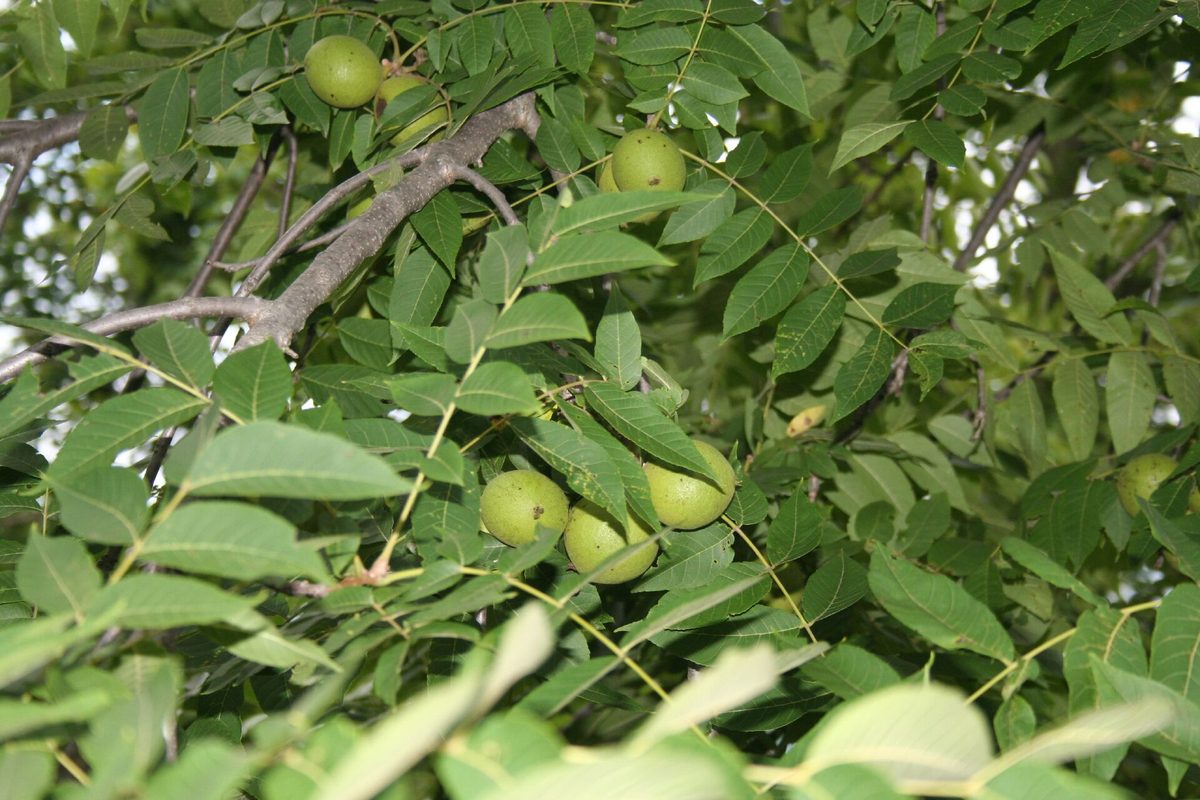
Photo: Robert Taylor from Stirling, ON, Canada, CC BY 2.0 via Wikimedia Commons

Quick facts
| Light: | Full sun12 |
|---|---|
| Soil: | Well drained and moist; pH 6–8311 source |
| Hardiness: | Zones 3a–7b11 source |
| Size: | 40–60 ft (12.19–18.29 m) × 40–60 ft (12.19–18.29 m)11 source |
| Growth rate: | Moderate21 source |
| Bloom: | May–Jun and Mar–Apr, Yellow and green156 |
| Cats: | Not documented by major sources |
| Dogs: | Not documented by major sources |
| Native range: | AFG, IRN, IRQ, LBS, NCS, PAK, TCS, TUR, WHM7 |
| Family: | Juglandaceae |
How much light does an English Walnut need?
English walnut needs full sun, meaning 6 or more hours of direct sunlight a day. It is shade intolerant and prefers rich, deep soils. Full sun is the only light level recorded for this tree. At maturity it reaches 40 to 60 ft (12.19–18.29 m) in both height and spread.
Best soil for an English Walnut
Walnuts prefer well-drained, moist, loamy soil, but they grow in many local soil types with proper drainage. The listed soil pH runs from 6 to 8, which the extension source calls neutral. Drainage is recorded as both well drained and moist. Rich, deep soils are also preferred. In short, aim for loamy, well-drained soil that stays moist and tests between pH 6 and 8.
Hardiness and temperature
English walnut is listed for USDA hardiness zones 3a to 7b. The listed divisions are 3a, 3b, 4a, 4b, 5a, 5b, 6a, 6b, 7a and 7b. In the United States it is recorded as introduced in the lower 48 states. Gardeners in zones colder than 3a or warmer than 7b fall outside the listed range.
- Hardiness: Zones 3a–7b1
How to plant an English Walnut
Check that your zone falls between 3a and 7b before you plant English walnut. Pick a full sun spot. The tree is shade intolerant. Leave room for a mature width of 40 to 60 ft (12.19–18.29 m). Mature height is also 40 to 60 ft (12.19–18.29 m). Choose well-drained, moist, loamy soil with a pH between 6 and 8. The growth rate is moderate.
- Hardiness: Zones 3a–7b1
Winter care
Winter hardiness is recorded as zones 3a to 7b. The listing reaches zone 3a at the cold end and 7b at the warm end. The full list is 3a, 3b, 4a, 4b, 5a, 5b, 6a, 6b, 7a and 7b. Outside zones 3a to 7b, hardiness is not recorded. Check your zone against the listing before you count on the tree surviving winter.
- Hardiness: Zones 3a–7b1
Common problems
Codling moth and walnut husk fly are the pests recorded for English walnut. The recorded diseases are anthracnose, root rot, canker, leaf spot, walnut blight and thousand cankers disease. The extension text also names bacterial blight and shoot dieback as problems that can occur. The UC pest management text also names navel orangeworm and ants among the things to look for.
| Problem | Kind |
|---|---|
| Codling moth | Pest |
| Walnut husk fly | Pest |
| Anthracnose | Disease |
| Root rot | Disease |
| Canker | Disease |
| Leaf spot | Disease |
| Walnut blight | Disease |
| Thousand cankers disease | Disease |
Is English Walnut toxic to cats and dogs?
Recommended supplies
- Soil: a free-draining mix, and a pot with a drainage hole.
Questions and answers
- How much sun does English walnut need?
- English walnut needs full sun, meaning 6 or more hours of direct sunlight a day. It is shade intolerant and prefers rich, deep soils. Full sun is the only light level recorded.
- How big does English walnut get?
- It usually grows 40 to 60 ft (12.19–18.29 m) tall. Its width is also 40 to 60 ft (12.19–18.29 m). The growth rate is moderate, and the plant type is a tree.
- Where is English walnut native?
- The native range record lists AFG, IRN, IRQ, LBS, NCS, PAK, TCS, TUR and WHM. In the lower 48 US states it is recorded as introduced.
Sources
- NC State Extension Gardener Plant Toolbox. https://plants.ces.ncsu.edu/plants/juglans-regia/. Accessed 14 October 2026.
- Utah State University Extension. https://extension.usu.edu/treebrowser/catalog/walnut-english-persian. Accessed 14 October 2026.
- Utah State University Extension. https://extension.usu.edu/yardandgarden/research/walnuts-in-the-home-orchard. Accessed 14 October 2026.
- UC Statewide Integrated Pest Management Program. https://ipm.ucanr.edu/agriculture/walnut/seasonal-pest-damage-in-harvest-samples/. Accessed 31 October 2026.
- Chicago Botanic Garden. https://www.chicagobotanic.org/plant-information/plant-finder/juglans-regia-lake-lake-english-walnut. Accessed 27 October 2026.
- Chicago Botanic Garden. https://www.chicagobotanic.org/plant-information/plant-finder/juglans-regia-hansen-hansen-english-walnut. Accessed 27 October 2026.
- Royal Botanic Gardens, Kew (World Checklist of Vascular Plants). https://sftp.kew.org/pub/data-repositories/WCVP/wcvp.zip. Accessed 4 June 2026.
How this page was made
- Written with AI assistance from the sources listed on this page. AI is never the source of a fact.