Purple Passionflower (Passiflora incarnata)
Formerly Granadilla incarnata, Passiflora keri, Passiflora rigidula
Purple passionflower grows best in full sun, though part shade is also listed. Its water use runs from dry to medium. NC State Extension lists it as a problem for cats and for dogs. The vine is deciduous and hardy in zones 5a to 9b.
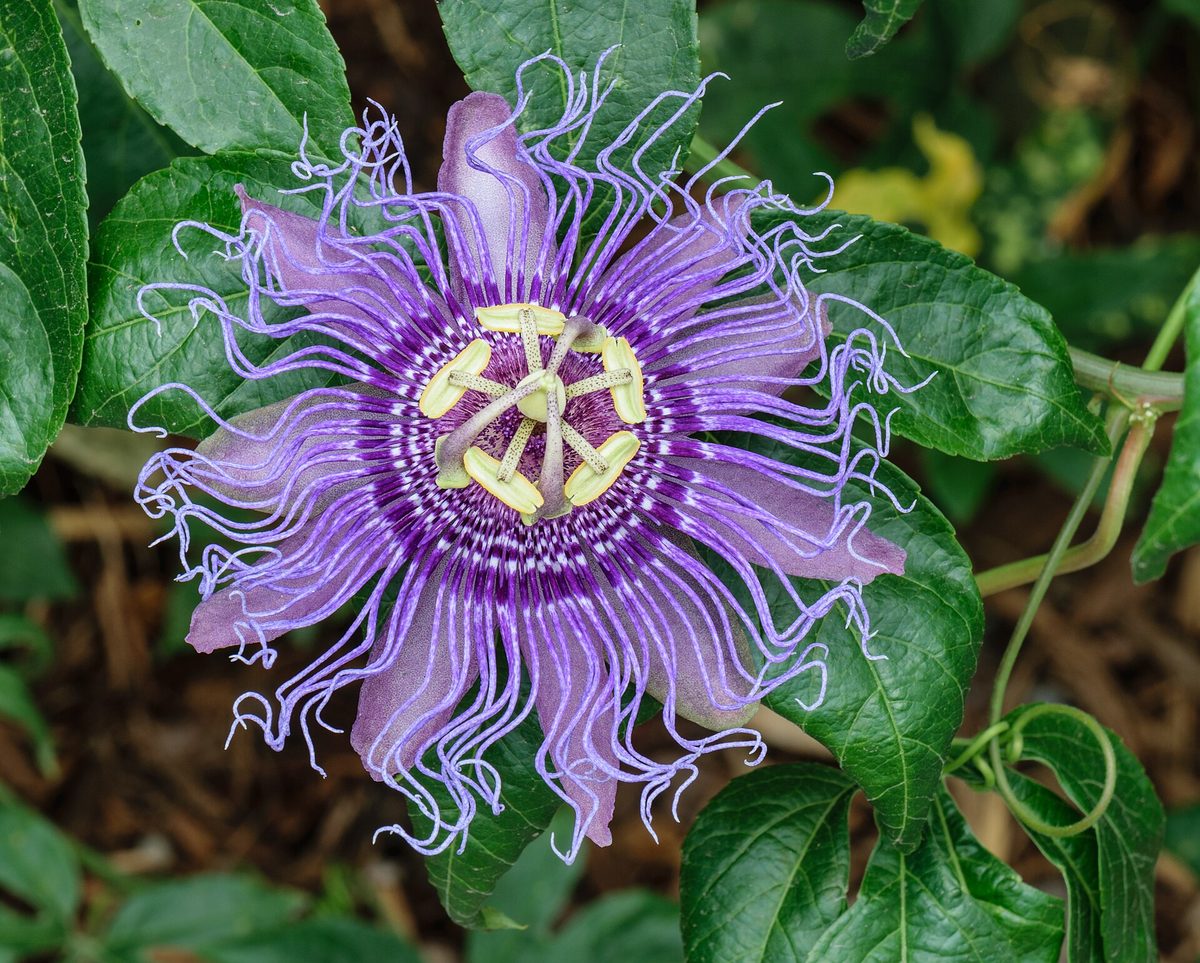
Photo: PumpkinSky, CC BY-SA 4.0 via Wikimedia Commons

Quick facts
| Light: | Full sun and part shade (full sun preferred)123 |
|---|---|
| Water: | Dry to medium21 source |
| Soil: | Well drained, moist and occasionally dry13 |
| Hardiness: | Zones 5a–9b11 source |
| Size: | 1–3 ft (0.3–0.91 m) × 12–24 ft (3.66–7.32 m)611 source |
| Growth rate: | Rapid15 |
| Bloom: | Jul–Oct, Pink, blue and purple6251 source |
| Cats: | Toxic to cats (1 source) 1 |
| Dogs: | Toxic to dogs (1 source) 1 |
| Native range: | ALA, ARK, BER, FLA, GEO, ILL, INI, KAN, KTY, LOU, MSI, MSO, NCA, OHI, OKL, PEN, SCA, TEN, TEX, VRG, WVA7 |
| Family: | Passifloraceae |
How much light does a Purple Passionflower need?
Full sun is the preferred exposure for this vine. NC State Extension defines that as six or more hours of direct sunlight a day. The Lady Bird Johnson Wildflower Center lists sun and part shade as the light requirement. Part shade is a listed alternative where full sun is not available.
How often to water a Purple Passionflower
The water use recorded for this plant runs from dry to medium. Both ends of that range are on record, from dry through medium. Its soil drainage is listed as well drained, moist and occasionally dry. Wet ground that drains poorly is the condition linked to root rot.
- Water: Dry to medium2
Best soil for a Purple Passionflower
NC State Extension lists good drainage for this vine. Clemson Cooperative Extension names average, well drained soils. The full drainage record covers three conditions: well drained, moist and occasionally dry. NC State Extension records root rot in poorly drained wet soils, especially in winter. The Lady Bird Johnson Wildflower Center lists that water use as low and medium.
Hardiness and temperature
NC State Extension lists hardiness in each half-zone from 5a to 9b. The plant is deciduous. Its native range includes the region codes ALA, ARK and FLA. It is listed as native in the lower 48 US states. NC State Extension records the growth rate as rapid. The University of Florida IFAS Extension lists the growth rate as fast.
- Hardiness: Zones 5a–9b1
Fertilizing a Purple Passionflower
Fertilizer is recorded as a light application once a year. The University of Florida IFAS Extension says to fertilize two or three times each year to maintain vigorous growth. These two records differ on how often to feed. The plant's growth rate is rapid.
- Fertilizer: Light, once a year4
Pruning a Purple Passionflower
Pruning for this plant is limited to light shaping. NC State Extension says to pinch the vines back after the first growing season. The plant is deciduous, with a rapid growth rate. Mature spread is 12–24 ft (3.66–7.32 m). Mature height is listed as 1–3 ft (0.3–0.91 m).
- Pruning: Light shaping1
How to plant a Purple Passionflower
Choose a site within zones 5a–9b, the hardiness range NC State Extension lists. Allow for a mature spread of 12–24 ft (3.66–7.32 m). Look for a spot with full sun, with part shade as the alternative. Pick ground that is well drained, moist or occasionally dry.
- Hardiness: Zones 5a–9b1
Winter care
NC State Extension lists the plant as deciduous. It is recorded as hardy across zones 5a–9b. Zone 5a is the cold end of the listed range and 9b the warm end. Root rot can occur in wet soils that drain poorly, especially in winter. Well drained, moist and occasionally dry soils are all listed.
- Hardiness: Zones 5a–9b1
How to propagate a Purple Passionflower
Seed, stem cuttings and root cuttings are the recorded propagation methods. The Lady Bird Johnson Wildflower Center advises taking 6–8 in (15–20 cm) stem cuttings early in the season. NC State Extension lists root cutting as a method. Seed is also listed, though the cited record gives no sowing details. These three methods are the full propagation list on record.
Common problems
Recorded pests are phlox plant bug, barnacle scale, nematodes and caterpillars. The University of Florida IFAS Extension says nematodes can be a serious problem. Root rot is the one disease listed, and wet soils with poor drainage are where it is recorded.
| Problem | Kind |
|---|---|
| Phlox plant bug | Pest |
| Barnacle scale | Pest |
| Nematodes | Pest |
| Caterpillars | Pest |
| Root rot | Disease |
Is Purple Passionflower toxic to cats and dogs?
NC State Extension lists purple passionflower as a problem for cats, and the recorded toxicity value for cats is toxic. It carries the same kind of listing for dogs, and the recorded toxicity value for dogs is toxic. The two records are separate, one for each animal. Neither record is marked as non-toxic. Each listing is a flag only and gives no detail on symptoms or plant parts.
Pet-safe alternatives
Recommended supplies
- Soil: a free-draining mix, and a pot with a drainage hole.
Questions and answers
- Is purple passionflower toxic to cats and dogs?
- NC State Extension lists it as a problem for both cats and dogs, and the recorded value is toxic for each. The cat record and the dog record are separate entries, and both say toxic.
- How much sun does purple passionflower need?
- Full sun is preferred, which NC State Extension defines as six or more hours of direct sunlight a day. Part shade is also listed.
- How do you propagate purple passionflower?
- Seed, stem cuttings and root cuttings are all listed. The Lady Bird Johnson Wildflower Center says to take 6–8 in (15–20 cm) stem cuttings early in the season.
Sources
- NC State Extension Gardener Plant Toolbox. https://plants.ces.ncsu.edu/plants/passiflora-incarnata/. Accessed 14 October 2026.
- Lady Bird Johnson Wildflower Center. https://www.wildflower.org/plants/result.php?id_plant=pain6. Accessed 14 October 2026.
- Clemson Cooperative Extension HGIC. https://hgic.clemson.edu/factsheet/vine-selections-for-landscaping/. Accessed 14 October 2026.
- University of Florida IFAS Extension (EDIS). https://ask.ifas.ufl.edu/fp457. Accessed 14 October 2026.
- University of Florida IFAS Extension (EDIS). https://ask.ifas.ufl.edu/publication/FP457. Accessed 14 October 2026.
- Lady Bird Johnson Wildflower Center (Native Plant Database). https://www.wildflower.org/plants/result.php?id_plant=PAIN2. Accessed 31 October 2026.
- Royal Botanic Gardens, Kew (World Checklist of Vascular Plants). https://sftp.kew.org/pub/data-repositories/WCVP/wcvp.zip. Accessed 4 June 2026.
How this page was made
- Written with AI assistance from the sources listed on this page. AI is never the source of a fact.