Purple Granadilla (Passiflora edulis)
Formerly Granadilla edulis, Passiflora diaden, Passiflora fragrans
Passiflora edulis needs medium water and has a moderate tolerance for drought. This vine is toxic to cats, and one listing rates that toxicity as medium in severity. It is also listed as toxic to dogs, though no separate severity rating is given for them.
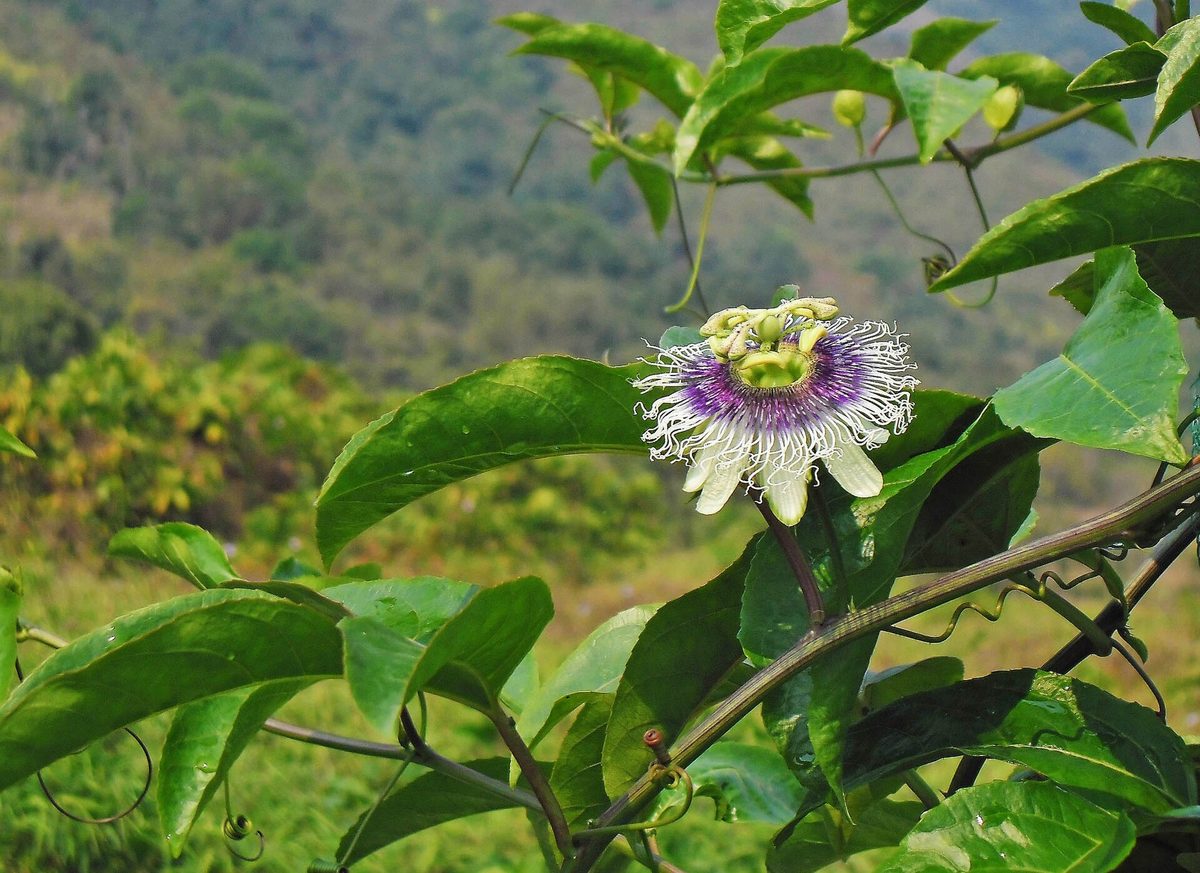
Photo: Earth100, CC BY-SA 3.0 via Wikimedia Commons

Quick facts
| Water: | Medium11 source |
|---|---|
| Soil: | Well drained and occasionally wet; pH 6–7.5231 source |
| Minimum temperature: | 24.8 °F (-4 °C)41 source |
| Growth rate: | Rapid31 source |
| Bloom: | Purple, white, pink and blue36 |
| Cats: | Toxic to cats (1 source) 6 |
| Dogs: | Toxic to dogs (1 source) 6 |
| Native range: | AGE, BZC, BZE, BZL, BZS, PAR7 |
| Family: | Passifloraceae |
How often to water a Purple Granadilla
Medium is the water rating Passiflora edulis carries, on both the low and high end of its range. One source rates its drought tolerance as moderate, keeping it in the middle of the scale rather than at either extreme. Plant it in soil that drains well but can also handle being occasionally wet.
- Water: Medium1
Best soil for a Purple Granadilla
Well-drained soil suits Passiflora edulis best. Even so, it can tolerate soil that is occasionally wet, along with sand, loam, or clay textures. Together, these ratings describe a soil that sheds extra water quickly but is not harmed by an occasional wet stretch. Soil pH can run from 6 to 7.5, a range described as near-neutral to slightly alkaline. Despite that wide tolerance, slightly acid soils are the best fit for this vine.
Temperature and humidity
Cold hardiness for this vine runs down to about 25°F (-4°C) before damage sets in. Exposure to temperatures in the mid-20s Fahrenheit can kill the entire vine back to the ground. Separately, extension sources also place this vine in USDA hardiness zones 9b through 11b.
- Minimum temperature: 24.8 °F (-4 °C)4
Fertilizing a Purple Granadilla
Feed Passiflora edulis from late winter through fall. Applications are spaced four to six weeks apart during that stretch, which runs roughly from February through November. In practice, that works out to feeding roughly once a month through the growing season. No feeding is reported for the winter months outside that stretch.
- Fertilizer: Monthly in the growing season (Feb–Nov)4
Pruning a Purple Granadilla
You prune Passiflora edulis in January and February. At this time, take out any dead or weak stems. Cut them back to a point where the remaining stem is vigorous and healthy. This is the only pruning reported for this vine. Extension guidance limits this pruning to dead and weak growth only.
- Pruning: Remove dead growth only (Jan–Feb)4
Care calendar
| Task | Jan | Feb | Mar | Apr | May | Jun | Jul | Aug | Sep | Oct | Nov | Dec |
|---|---|---|---|---|---|---|---|---|---|---|---|---|
| Fertilize | Fertilize in Feb | Fertilize in Mar | Fertilize in Apr | Fertilize in May | Fertilize in Jun | Fertilize in Jul | Fertilize in Aug | Fertilize in Sep | Fertilize in Oct | Fertilize in Nov | ||
| Prune | Prune in Jan | Prune in Feb |
How to propagate a Purple Granadilla
You can propagate Passiflora edulis from seed, from stem cuttings, or by grafting. Cuttings and fresh seed are both named as ways to start new plants. Grafting is listed as a further option for this vine. Whichever method you choose, all three are reported ways to grow a new Passiflora edulis. No other propagation method is reported for this vine.
- Propagation: Seed, stem cuttings and grafting2
Common problems
Nematodes can be a serious problem for this vine. Other common pests include caterpillars, the gulf fritillary caterpillar, fruit flies, mites, aphids, and stink bugs. Several diseases are also reported, among them passion fruit woodiness virus, brown spot, and fusarium wilt. Collar rot, root and crown rot, anthracnose, scab, and bacterial spot round out the list. These are the pests and diseases reported for this vine.
| Problem | Kind |
|---|---|
| Nematodes | Pest |
| Caterpillars | Pest |
| Gulf fritillary caterpillar | Pest |
| Fruit flies | Pest |
| Mites | Pest |
| Aphids | Pest |
| Stink bugs | Pest |
| Passion fruit woodiness virus | Disease |
| Brown spot | Disease |
| Fusarium wilt | Disease |
| Collar rot | Disease |
| Root and crown rot | Disease |
| Anthracnose | Disease |
| Scab | Disease |
| Bacterial spot | Disease |
Is Purple Granadilla toxic to cats and dogs?
Cats face a toxicity risk from Passiflora edulis, according to one source. That source rates the severity of this toxicity to cats as medium. The same plant is also listed as toxic to dogs. Unlike the cat listing, the dog listing does not include a separate severity rating. No other severity level is recorded for either cats or dogs beyond that medium rating for cats.
Pet-safe alternatives
Recommended supplies
- Soil: a free-draining mix, and a pot with a drainage hole.
Questions and answers
- Is Passiflora edulis toxic to cats and dogs?
- Yes, Passiflora edulis is listed as toxic to both cats and dogs. One listing rates its severity for cats as medium, with no separate rating given for dogs.
- How often should you water Passiflora edulis?
- This vine has medium water needs and a moderate tolerance for drought. Plant it in soil that drains well but can also handle being occasionally wet.
- How do you propagate Passiflora edulis?
- You can propagate Passiflora edulis from seed, from stem cuttings, or by grafting. All three methods are reported ways to start a new plant, with no single method singled out as the only option.
Sources
- University of Florida IFAS Extension. https://ask.ifas.ufl.edu/fp456. Accessed 14 October 2026.
- University of Florida IFAS Extension. https://ask.ifas.ufl.edu/publication/HS1406. Accessed 14 October 2026.
- University of Florida IFAS Extension. https://ask.ifas.ufl.edu/publication/FP456. Accessed 14 October 2026.
- University of Florida IFAS Extension. https://ask.ifas.ufl.edu/hs1406. Accessed 14 October 2026.
- University of Florida IFAS Extension. https://ask.ifas.ufl.edu/publication/HS1397. Accessed 14 October 2026.
- NC State Extension Gardener Plant Toolbox. https://plants.ces.ncsu.edu/plants/passiflora-incarnata/. Accessed 14 October 2026.
- Royal Botanic Gardens, Kew (World Checklist of Vascular Plants). https://sftp.kew.org/pub/data-repositories/WCVP/wcvp.zip. Accessed 4 June 2026.
How this page was made
- Written with AI assistance from the sources listed on this page. AI is never the source of a fact.