Monstera (Monstera deliciosa)
Also called Swiss Cheese Plant, Tarovine
Formerly Monstera lennea, Monstera borsigiana, Philodendron pertusum
Grow your Monstera deliciosa in bright, indirect light and let the topsoil dry slightly before you water again. It also tolerates medium light and a few hours of direct sun. This plant is toxic to cats and to dogs, so keep it away from pets and call your vet if they chew on it.
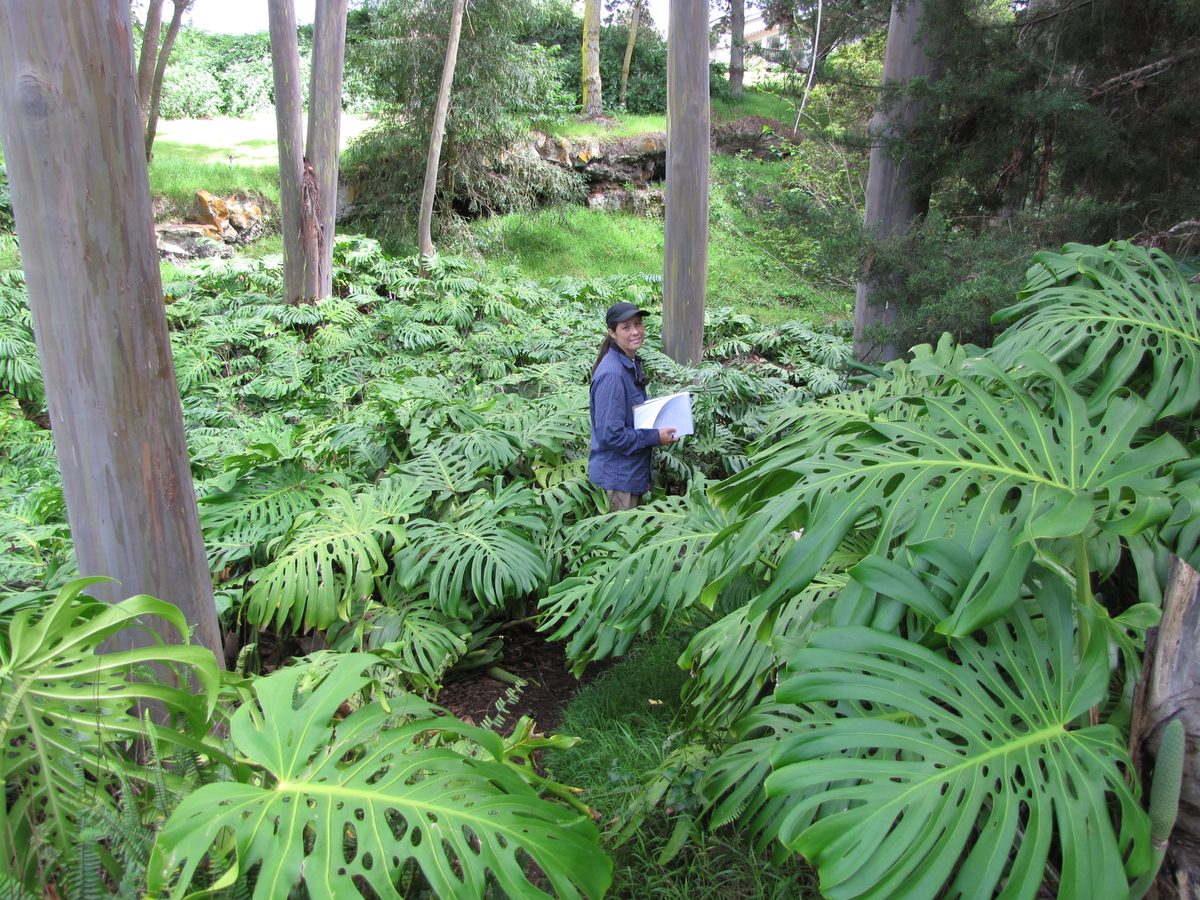
Photo: Forest and Kim Starr, CC BY 3.0 via Wikimedia Commons

Quick facts
| Light: | Bright, indirect light; tolerates medium light and direct sun11 source |
|---|---|
| Water: | Dry to medium23 |
| Soil: | Well drained and moist; pH 6–823 |
| Minimum temperature: | 30.2 °F (-1 °C)41 source |
| Size: | Sources differ: NC State Extension Gardener Plant Toolbox; NC State Extension Gardener Plant Toolbox; NC State Extension Gardener Plant Toolbox; NC State Extension Gardener Plant Toolbox; NC State Extension Gardener Plant Toolbox; University of Florida IFAS Extension × 5.9–12.1 ft (1.8–3.7 m)324Sources differ |
| Growth rate: | Rapid21 source |
| Bloom: | White71 source |
| Cats: | Toxic to cats (1 source) Severity reported: Mild 9 |
| Dogs: | Toxic to dogs (1 source) 9 |
| Native range: | GUA, MXG, MXS, MXT10 |
| Family: | Araceae |
How much light does a Monstera need?
Bright, indirect light is what Monstera deliciosa needs most indoors. Place it near a window that gets plenty of light but stays out of the sun's direct path for most of the day. This plant also tolerates medium light, so it still grows well a few feet back from a bright window. It can handle some hours of strong, direct sun too, though bright, indirect light suits it best overall. A north or east facing window often gives the right mix of bright light without too much harsh, direct sun. Whether the light is bright and indirect, medium, or occasionally direct, this plant has some flexibility in what it accepts.
- Light: Bright, indirect light; tolerates medium light and direct sun1
How often to water a Monstera
The soil should stay between slightly dry and medium for this plant, never bone dry or soggy. Let the top few inches of soil dry out somewhat before you add more water. Once the soil reaches that medium moisture level again, it is time for your next watering. This plant does not need constant moisture, but it also should not sit in fully dry soil for long stretches. Aim for a middle ground, soil that feels lightly moist to slightly dry rather than wet or parched. Checking the soil directly, rather than watering on a set number of days, gives the most reliable result for this plant.
Best soil for a Monstera
Well-drained soil that still holds some moisture suits Monstera deliciosa best. Soggy, waterlogged soil is not a good match for this plant, and neither is soil that dries out completely and stays that way. This species also grows well across a fairly wide pH range, from about 6 to 8. That range covers slightly acidic, neutral, and slightly alkaline soil, so most general potting mixes will work. Both the drainage and the pH matter, since roots need air as much as they need water and the right pH range.
Temperature and humidity
This plant's cold tolerance stops at about 30°F (-1°C). Below that point, cold can damage its leaves and stems. It grows best in warm, steady conditions well above that low mark. Keep it away from cold drafts, chilly windowsills, and unheated rooms in winter. Indoors, most homes stay warm enough for this plant without any extra heating. Outdoors, only grow it where winter temperatures stay well above that same low point. This minimum matters most for plants kept outdoors or on a cold porch, rather than in a heated home. Humidity needs are not documented for this plant.
Fertilizing a Monstera
During its growing season, feed Monstera deliciosa every two weeks. This regular, biweekly schedule helps support its big, glossy, splitting leaves through the growing season. Outside the active growing season, this plant does not need that same biweekly feeding schedule. Stick to the two-week rhythm rather than feeding it more often. A balanced approach on this two-week cycle avoids both overfeeding and underfeeding during active growth.
- Fertilizer: Every two weeks in the growing season3
Pruning a Monstera
Light shaping, not heavy cutting, is all Monstera deliciosa usually needs. Trim it now and then to control its size or remove a stem growing in an awkward direction. This kind of light, occasional shaping is enough to keep the plant looking full and tidy. You do not need to cut it back hard on a set schedule. Regular light trims also let you shape the plant's growth as it climbs or spreads.
- Pruning: Light shaping6
How to propagate a Monstera
Several methods work for propagating Monstera deliciosa. Growing it from seed works, though it takes patience. Division and offsets let you split off a rooted piece from an established plant. Stem cuttings are a common and simple method, since a cut piece with a node can root in water or soil. Layering, where a stem roots while still attached to the parent plant, is another option. Whichever method you choose, seed, division, stem cuttings, layering, or offsets, each is a documented way to start a new plant.
Common problems
A wide range of pests can affect Monstera deliciosa, including aphids, mealybugs, scale insects, spider mites, fungus gnats, and thrips. It can also attract citrus blackfly, Japanese wax scale, Florida red scale, and armyworms in some cases. The main diseases reported for this plant are anthracnose and root rot. Check leaves and stems regularly so you can catch any of these problems early.
| Problem | Kind |
|---|---|
| Citrus blackfly | Pest |
| Japanese wax scale | Pest |
| Florida red scale | Pest |
| Fiorinia phantasma | Pest |
| Yellowstriped armyworm | Pest |
| Aphids | Pest |
| Mealybugs | Pest |
| Scale insects | Pest |
| Spider mites | Pest |
| Fungus gnats | Pest |
| Thrips | Pest |
| Anthracnose | Disease |
| Root rot | Disease |
Is Monstera toxic to cats and dogs?
Monstera deliciosa is toxic to cats. It is also toxic to dogs. This plant can cause a reaction if a cat or dog chews or eats any part of it. The toxic effect applies to both types of pets, not just one. Cats and dogs face the same toxic risk from this plant. Because both pets are at risk, treat this plant as unsafe in any home with cats or dogs. Even a small amount chewed or swallowed is enough to cause a reaction in either species. Keep it out of reach of your pets, and contact your vet or a pet poison line right away if a cat or dog chews on it.
Pet-safe alternatives
Recommended supplies
- Light: bright, indirect light, such as near an east window; a full-spectrum grow light substitutes where no window does.
- Soil: a free-draining mix, and a pot with a drainage hole.
- Humidity: it wants humid air; a pebble tray or a humidifier is the usual fix.
Questions and answers
- Is Monstera deliciosa toxic to cats and dogs?
- Yes, Monstera deliciosa is toxic to both cats and dogs. Keep it out of reach of your pets, and contact your vet or a pet poison line if your cat or dog chews on it.
- How often should I water Monstera deliciosa?
- Water it once the soil moisture drops to somewhere between slightly dry and medium, rather than on a fixed schedule. Avoid letting it sit in fully dry soil or in soil that stays wet and soggy.
- What kind of light does Monstera deliciosa need indoors?
- Give it bright, indirect light for the best growth. It also tolerates medium light and can handle some hours of direct sun as well. A spot a few feet back from a bright window usually works well for this plant.
Sources
- Brooklyn Botanic Garden. https://www.bbg.org/article/whats_wrong_with_my_monstera. Accessed 23 September 2026.
- NC State Extension Gardener Plant Toolbox. https://plants.ces.ncsu.edu/plants/monstera-deliciosa/. Accessed 23 September 2026.
- Penn State Extension. https://extension.psu.edu/monstera-as-a-houseplant. Accessed 23 September 2026.
- University of Florida IFAS Extension. https://ask.ifas.ufl.edu/publication/HS311. Accessed 23 September 2026.
- Iowa State University Extension and Outreach. https://yardandgarden.extension.iastate.edu/how-to/all-about-aroids. Accessed 13 October 2026.
- Clemson Cooperative Extension Home & Garden Information Center. https://hgic.clemson.edu/factsheet/philodendron-pothos-monstera/. Accessed 23 September 2026.
- University of Wisconsin-Madison Division of Extension. https://hort.extension.wisc.edu/articles/monstera-deliciosa/. Accessed 23 September 2026.
- EPPO Global Database. https://gd.eppo.int/taxon/MOSDE/pests. Accessed 23 September 2026.
- ASPCA. https://www.aspca.org/pet-care/aspca-poison-control/toxic-and-non-toxic-plants/ceriman. Accessed 23 September 2026.
- Royal Botanic Gardens, Kew (World Checklist of Vascular Plants). https://sftp.kew.org/pub/data-repositories/WCVP/wcvp.zip. Accessed 4 June 2026.
How this page was made
- Written with AI assistance from the sources listed on this page. AI is never the source of a fact.