Mango (Mangifera indica)
Formerly Mangifera amba, Mangifera balba, Mangifera oryza
Mango (Mangifera indica) is a fast-growing tree that spreads wide as it matures. Outdoors it needs full sun, and mature trees need only dry to medium water. It is hardy outdoors only in USDA zones 10b through 11b. At maturity, it can spread 30 to 50 ft (9.1-15.24 m) wide. Mangifera indica is native to Assam, China, the eastern Himalayas, Myanmar, and Thailand.
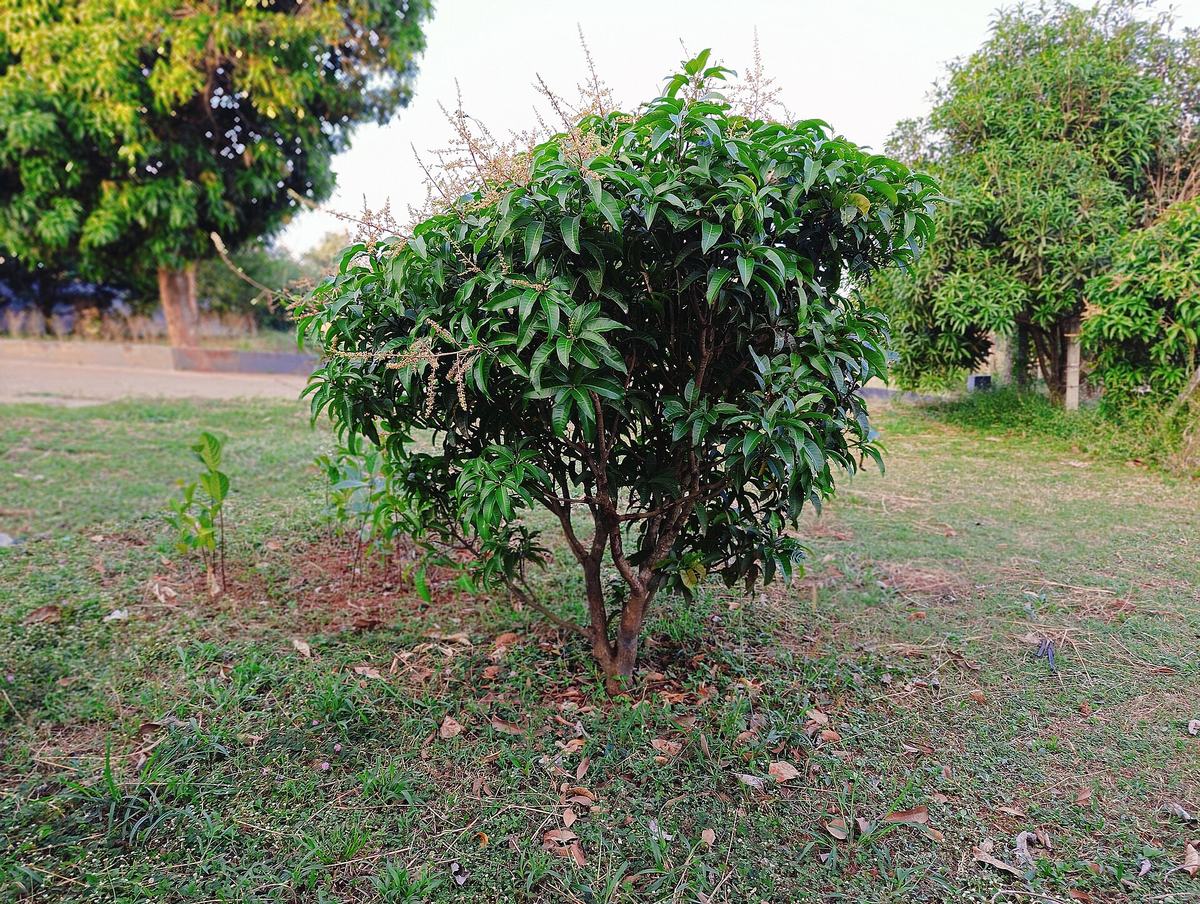
Photo: Anish nellickal, CC BY-SA 4.0 via Wikimedia Commons

Quick facts
| Water: | Dry to medium11 source |
|---|---|
| Soil: | Well drained and occasionally wet211 source |
| Minimum temperature: | 25 °F (-3.9 °C)11 source |
| Size: | Sources differ: University of Florida IFAS Extension (EDIS); University of Florida IFAS Extension (EDIS) × 29.9–50 ft (9.1–15.24 m)214Sources differ |
| Growth rate: | Rapid421 source |
| Bloom: | White, yellow, pink and red211 source |
| Cats: | Not documented by major sources |
| Dogs: | Not documented by major sources |
| Native range: | ASS, CHC, EHM, MYA, THA5 |
| Family: | Anacardiaceae |
How often to water a Mango
Mature mango trees need only dry to medium water, and they do not need frequent watering. Giving them too much water can lower fruit quality or leave the tree unthrifty and in decline. The soil can be well drained or occasionally wet, but mango trees do not do well in soil that drains poorly. That means a mango tree can handle some wet spells in the soil, but not soil that stays wet all the time.
- Water: Dry to medium1
Best soil for a Mango
Mango trees grow best in soil that drains well, not soil that stays wet for long stretches. They are moderately tolerant of occasional flooding or soil that turns excessively wet for a short time. Even with that tolerance, a mango tree will not do well if its soil drains poorly. Mango trees also need only dry to medium water, and getting too much can lower fruit quality or leave the tree unthrifty.
Temperature and humidity
Once mango trees are mature, they can withstand air temperatures as low as 25 degrees Fahrenheit (-3.9 degrees Celsius) for a few hours. That cold will injure the leaves and small branches. Outdoors, mango trees are only hardy in USDA hardiness zones 10b through 11b. In the United States, mango is considered an introduced species in Hawaii, the mainland, and Puerto Rico.
- Minimum temperature: 25 °F (-3.9 °C)1
Pruning a Mango
You can keep a mango tree in shape with light shaping cuts, or with harder renewal pruning. Renewal pruning on a mango tree means selectively removing just a few upper limbs back to their origin, known as the crotches. This cut is done again each year. Both light shaping and hard renewal pruning are recognized ways to manage this tree's growth.
- Pruning: Light shaping and Hard renewal pruning1
How to propagate a Mango
You can propagate a mango tree from seed, or you can instead propagate it by grafting. Growers most often graft by budding or by veneer grafting onto seedling rootstocks. In Florida, veneer grafting, cleft grafting, and chip budding are the most common and successful grafting methods used on this tree. Both methods are used on this tree.
Common problems
Mango trees can be affected by bud mites, red banded thrips, false oleander scale, pyriform scale, and dictyospermum scale. They can also be affected by florida red scale, spider mites, florida thrips, and ambrosia beetles. The main diseases are powdery mildew and anthracnose, two fungal problems that attack new flower clusters, flowers, and young fruit. These insects and fungi are among the pests and diseases recorded for mango trees.
| Problem | Kind |
|---|---|
| Bud mites | Pest |
| Red banded thrips | Pest |
| False oleander scale | Pest |
| Pyriform scale | Pest |
| Dictyospermum scale | Pest |
| Florida red scale | Pest |
| Spider mites | Pest |
| Florida thrips | Pest |
| Ambrosia beetles | Pest |
| Anthracnose | Disease |
| Powdery mildew | Disease |
Is Mango toxic to cats and dogs?
Recommended supplies
- Soil: a free-draining mix, and a pot with a drainage hole.
Questions and answers
- How much water does a mango tree need?
- Mature mango trees need only dry to medium water, and they do not need frequent watering. Giving them too much water can lower fruit quality or leave the tree unthrifty. The soil it grows in can be well drained or occasionally wet, but not soil that drains poorly.
- How cold can a mango tree tolerate?
- Mature mango trees can withstand air temperatures as low as 25°F (-3.9°C) for a few hours. That cold will injure the leaves and small branches. Outdoors, it is only hardy in USDA zones 10b through 11b.
- How do you propagate a mango tree?
- You can grow a mango tree from seed or propagate it by grafting. In Florida, these grafting methods are considered the most common and successful ones for mango trees.
Sources
- University of Florida IFAS Extension (EDIS). https://ask.ifas.ufl.edu/publication/MG216. Accessed 15 October 2026.
- University of Florida IFAS Extension (EDIS). https://ask.ifas.ufl.edu/publication/ST404. Accessed 24 September 2026.
- EPPO Global Database. https://gd.eppo.int/taxon/MNGIN/pests. Accessed 15 October 2026.
- University of Florida IFAS Extension (EDIS). https://ask.ifas.ufl.edu/st404. Accessed 24 September 2026.
- Royal Botanic Gardens, Kew (World Checklist of Vascular Plants). https://sftp.kew.org/pub/data-repositories/WCVP/wcvp.zip. Accessed 4 June 2026.
How this page was made
- Written with AI assistance from the sources listed on this page. AI is never the source of a fact.