Lindheimer's Beeblossom (Oenothera lindheimeri)
Formerly Gaura lindheimeri, Gaura filiformis var. munzii
Outdoors, this plant prefers full sun but also tolerates part shade, and it needs a medium amount of water to stay healthy. No cited source lists Lindheimer's beeblossom's toxicity to cats or dogs, so that status is not documented on this page for either animal.
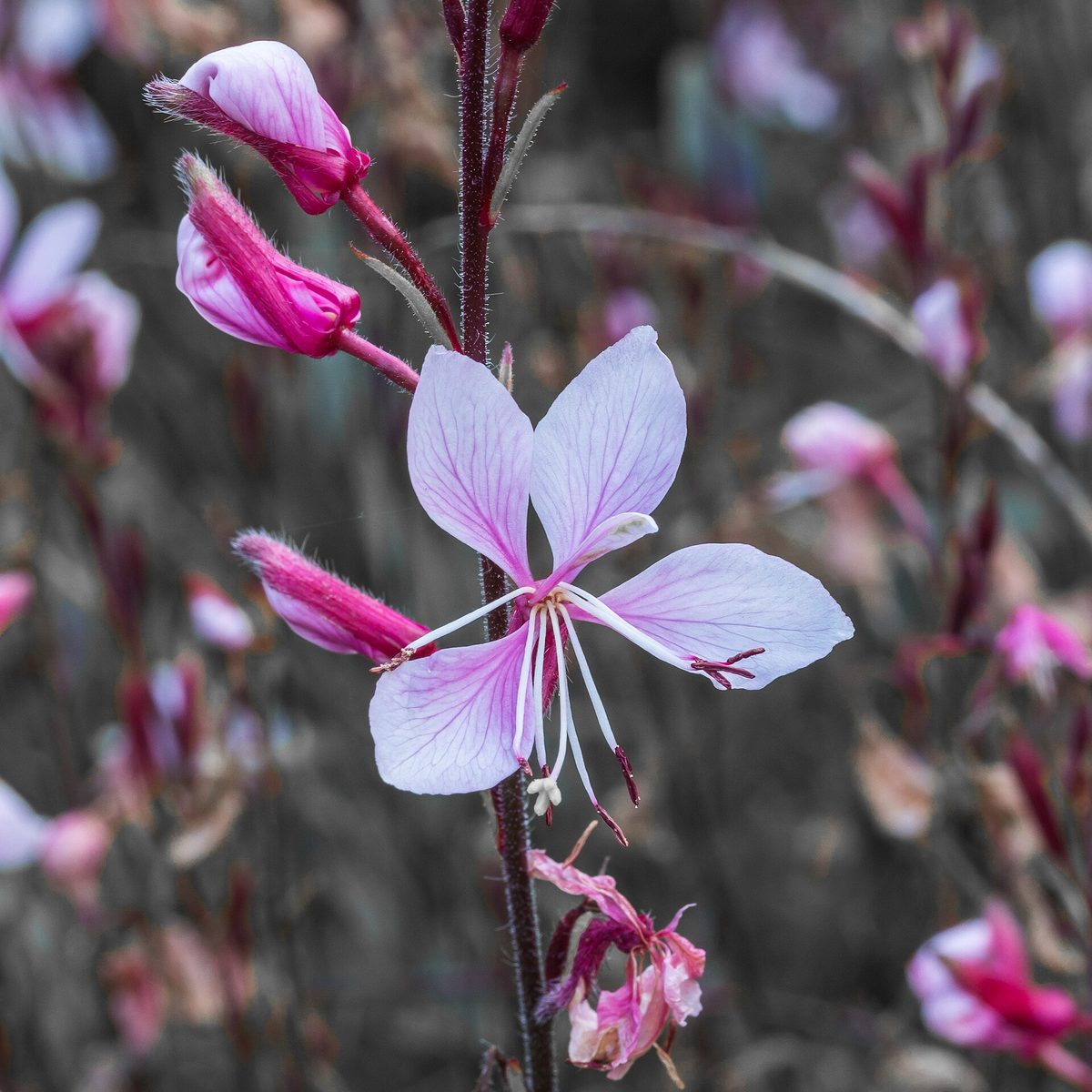
Photo: Agnes Monkelbaan, CC BY-SA 4.0 via Wikimedia Commons

Quick facts
| Light: | Full sun and part shade (full sun preferred)123 |
|---|---|
| Water: | Medium21 source |
| Soil: | Well drained and moist31 source |
| Hardiness: | Zones 5a–9b11 source |
| Size: | 3–5 ft (0.91–1.52 m) × 1–2 ft (0.3–0.61 m)11 source |
| Growth rate: | Moderate11 source |
| Bloom: | Apr–Jul, White and pink231 source |
| Cats: | Not documented by major sources |
| Dogs: | Not documented by major sources |
| Family: | Onagraceae |
How much light does a Lindheimer's Beeblossom need?
This plant does best outdoors in full sun, meaning six or more hours of direct sunlight each day. It also tolerates part shade as a light condition, giving you a second, more shaded option if your site does not get full sun all day outdoors.
How often to water a Lindheimer's Beeblossom
Give this plant a medium amount of water outdoors to stay healthy. It also grows best in soil that stays moist. At the same time, that soil still needs to drain well rather than stay waterlogged. Together, that medium water need and moisture-retentive, well-drained soil describe a planting spot that is watered regularly but never left soggy.
- Water: Medium2
Best soil for a Lindheimer's Beeblossom
Light, well-drained soil suits this plant best outdoors. It also tolerates heavier clay soil. That clay tolerance holds only as long as the soil still drains well. The soil can also stay moist rather than turning bone dry. Well-drained and moist are both listed as conditions this plant accepts outdoors. That combination points to soil that holds some moisture without ever staying waterlogged. No cited source gives a preferred soil pH range for this plant, so that detail is not documented here.
- Soil drainage: Well drained and moist3
Hardiness and temperature
USDA hardiness zones 5a through 9b are where this plant is rated hardy outdoors. Zone 5a marks the cold end of that rating. Zone 9b marks the warm end of it. A reader gardening in zone 5a is at the coldest edge this plant is rated to survive outdoors. A reader in zone 9b is at the warmest edge of that same rated range. Outside zones 5a to 9b, this plant is not listed as hardy outdoors. No cited source gives a specific minimum winter temperature in degrees, so that figure is not documented beyond the USDA zone range above.
- Hardiness: Zones 5a–9b1
Pruning a Lindheimer's Beeblossom
Deadhead the spent blooms on this plant to encourage it to keep flowering. In fall, cut back the flower spikes, and in spring, remove all the dead foliage. Together, these two steps cover the pruning this plant needs: deadheading during the bloom period, and a fall-to-spring cleanup of spikes and foliage.
How to plant a Lindheimer's Beeblossom
Plant this species outdoors within USDA zones 5a through 9b, where it is rated to survive winter conditions. At maturity it spreads 1 to 2 ft (0.3-0.61 m) wide, which is the spacing to leave between plants. It also grows 3 to 5 ft (0.91-1.52 m) tall, so choose a planting spot with room for that height.
- Hardiness: Zones 5a–9b1
Winter care
Winter survival for this plant outdoors is rated through USDA zones 5a to 9b. Outside that zone range, in colder or warmer areas than 5a to 9b, the plant is not rated to survive outdoors through winter. As part of winter cleanup, cut back the flower spikes in fall. Remove all the dead foliage left on the plant in spring.
- Hardiness: Zones 5a–9b1
How to propagate a Lindheimer's Beeblossom
You can propagate this plant from seed, by division, or from stem cuttings. Sow seed in spring or fall, since this plant is easy to start that way in either season. Division works in spring as well. Both seed sowing and division are described as straightforward ways to start new plants of this species.
- Propagation: Seed, division and stem cuttings3
Common problems
Watch for aphids, whiteflies, flea beetles and Japanese beetles on this plant outdoors. In poorly drained soil outdoors, it can develop root rot. Rust, powdery mildew and leaf spot are also described as problems that occasionally affect this plant outdoors.
| Problem | Kind |
|---|---|
| Aphids | Pest |
| Whiteflies | Pest |
| Flea beetles | Pest |
| Japanese beetles | Pest |
| Root rot | Disease |
| Rust | Disease |
| Powdery mildew | Disease |
| Leaf spot | Disease |
Is Lindheimer's Beeblossom toxic to cats and dogs?
Recommended supplies
- Soil: a free-draining mix, and a pot with a drainage hole.
Questions and answers
- How much sun does Lindheimer's beeblossom need?
- Full sun is best for this plant outdoors, with six or more hours of direct sunlight a day needed. It also tolerates part shade, giving you a second option if your site doesn't get full sun all day.
- What pests and diseases affect Lindheimer's beeblossom?
- Aphids, whiteflies, flea beetles and Japanese beetles are the pests recorded on this plant. In poorly drained soil it can develop root rot, and rust, powdery mildew and leaf spot are described as occasional problems as well.
- What color are the flowers, and when does Lindheimer's beeblossom bloom?
- Pink buds open to white flowers that slowly fade to pink as they age. This plant blooms outdoors from April through July. That bloom window runs for about four months each growing season outdoors.
Sources
- NC State Extension Gardener Plant Toolbox. https://plants.ces.ncsu.edu/plants/oenothera-lindheimeri/. Accessed 15 November 2026.
- Lady Bird Johnson Wildflower Center. https://www.wildflower.org/plants/result.php?id_plant=OELI2. Accessed 15 November 2026.
- University of Wisconsin-Madison Division of Extension. https://hort.extension.wisc.edu/articles/gaura-gaura-lindheimeri/. Accessed 15 November 2026.
- EPPO Global Database. https://gd.eppo.int/taxon/GAALI/pests. Accessed 15 November 2026.
How this page was made
- Written with AI assistance from the sources listed on this page. AI is never the source of a fact.