Scarlet Beebalm (Monarda didyma)
Formerly Monarda coccinea, Monarda contorta, Monarda didynama
To keep scarlet beebalm alive outdoors, give it full sun to part shade, with full sun preferred, and a medium amount of water. Toxicity to cats and dogs is not documented for this species among the sources checked for this page.
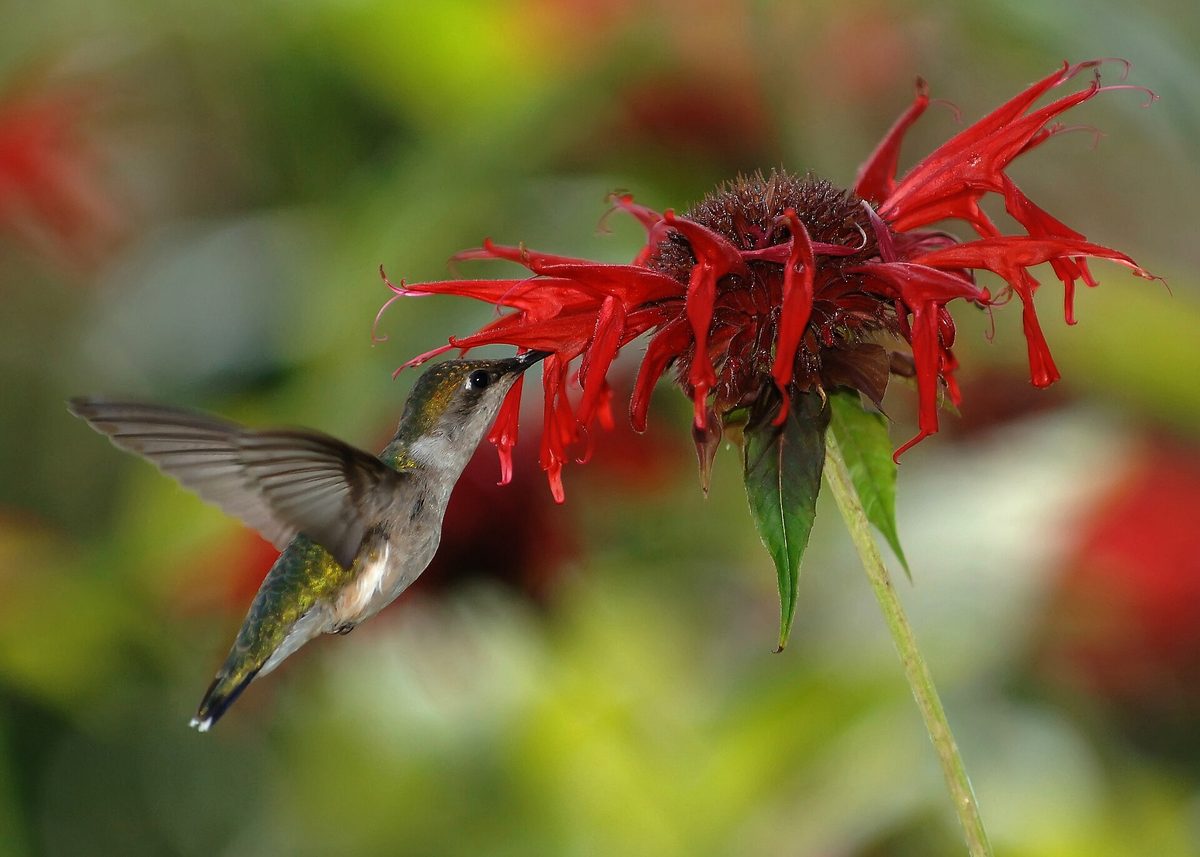
Photo: Joe Schneid, Louisville, Kentucky, CC BY 3.0 via Wikimedia Commons

Quick facts
| Light: | Full sun and part shade (full sun preferred)12 |
|---|---|
| Water: | Medium21 source |
| Soil: | Moist and occasionally wet21 source |
| Hardiness: | Zones 4a–9b11 source |
| Size: | 2–4 ft (0.61–1.22 m) × 2–3 ft (0.61–0.91 m)11 source |
| Growth rate: | Moderate11 source |
| Bloom: | May–Oct, Red211 source |
| Cats: | Not documented by major sources |
| Dogs: | Not documented by major sources |
| Family: | Lamiaceae |
How much light does a Scarlet Beebalm need?
Give this plant full sun outdoors, with six or more hours of direct sun a day, though it also grows in part shade. Between the two, full sun is the preferred choice, so save part shade for spots where that much direct sun is not available.
How often to water a Scarlet Beebalm
This plant's documented water need is medium, and that same medium level is given as both the minimum and maximum for it, with no separate low or high figure recorded. The soil it grows in should stay moist, and it also tolerates soil that becomes occasionally wet.
- Water: Medium2
Best soil for a Scarlet Beebalm
This plant's documented soil-moisture record covers two conditions: staying consistently moist, and turning wet on occasion. Neither a dry soil type nor a fast-draining, well-drained type appears anywhere in that record. A planting spot that stays damp most of the time matches what the record describes. The same record shows the plant holding up in soil that turns wet for a stretch, not just soil that stays evenly damp.
- Soil drainage: Moist and occasionally wet2
Hardiness and temperature
Scarlet beebalm is hardy across USDA zones 4a to 9b, a range that spans twelve individual half-zones from the coldest, 4a, to the warmest, 9b. Gardeners in zone 4a face the coldest winters this plant is listed as tolerating, while those in zone 9b face the warmest end of its hardiness range.
- Hardiness: Zones 4a–9b1
Pruning a Scarlet Beebalm
Prune scarlet beebalm by removing dead growth only, not live stems. Cut dead stems back to a height of 12-24 in (30-61 cm). That leaves a short framework of stems in place instead of cutting the plant down to ground level.
- Pruning: Remove dead growth only1
How to plant a Scarlet Beebalm
You can plant scarlet beebalm outdoors in USDA zones 4a to 9b, the range listed for this species. Plan for a mature size of 2-4 ft (0.61-1.22 m) tall and 2-3 ft (0.61-0.91 m) wide when you decide how far apart to space plants. Choose a planting spot with full sun, since that's the preferred light for this species outdoors, though it also grows in part shade. The soil in that spot should stay damp for much of the year, and it can also handle soil that becomes wet at times.
- Hardiness: Zones 4a–9b1
Winter care
This plant can survive winter outdoors in USDA zones 4a through 9b, the range listed for it. Outside that 4a-to-9b span, the record for this page does not list the plant as hardy. Gardeners right at the edges of that range, in zone 4a or zone 9b, are gardening at the limits of where this plant is documented as hardy outdoors in winter.
- Hardiness: Zones 4a–9b1
How to propagate a Scarlet Beebalm
This species can be propagated three documented ways: by root division, by seed, and by softwood stem cuttings. Softwood cuttings are the specific type of stem cutting named for this species. That record lists all three, root division, seed and softwood cuttings, without marking any one of them as more effective or more commonly used than the others.
- Propagation: Division, seed and stem cuttings2
Common problems
This plant's documented disease record names two problems: powdery mildew and rust, with no others listed alongside them. Both powdery mildew and rust are recorded together in that same listing, without a note on which of the two is more common or more severe for this species.
- Common diseases: powdery mildew and rust1
| Problem | Kind |
|---|---|
| Powdery mildew | Disease |
| Rust | Disease |
Is Scarlet Beebalm toxic to cats and dogs?
Recommended supplies
- Soil: a mix that holds moisture without staying wet.
Questions and answers
- How much sun does scarlet beebalm need?
- Give it full sun outdoors whenever you can, since that is the preferred light listed for this species, though it also tolerates part shade.
- What zones can I grow scarlet beebalm in outdoors?
- You can grow it outdoors in USDA zones 4a to 9b, the range listed for this species, from the coldest zone, 4a, to the warmest, 9b.
- How do I propagate scarlet beebalm?
- This species can be propagated by root division, by seed, or by softwood stem cuttings, which are the three methods documented for growing new plants of it.
Sources
- NC State Extension Gardener Plant Toolbox. https://plants.ces.ncsu.edu/plants/monarda-didyma/. Accessed 15 November 2026.
- Lady Bird Johnson Wildflower Center (Native Plant Database). https://www.wildflower.org/plants/result.php?id_plant=MODI. Accessed 15 November 2026.
How this page was made
- Written with AI assistance from the sources listed on this page. AI is never the source of a fact.