Cape Leadwort (Plumbago auriculata)
Formerly Plumbago capensis, Plumbago alba, Plumbago grandiflora
Cape leadwort grows best in full sun, and it also takes part shade. It is a broadleaf evergreen shrub that can be trained to perform like a vine, and it is listed for USDA zones 9a to 11b. Watering needs and pet toxicity are not documented for this page.
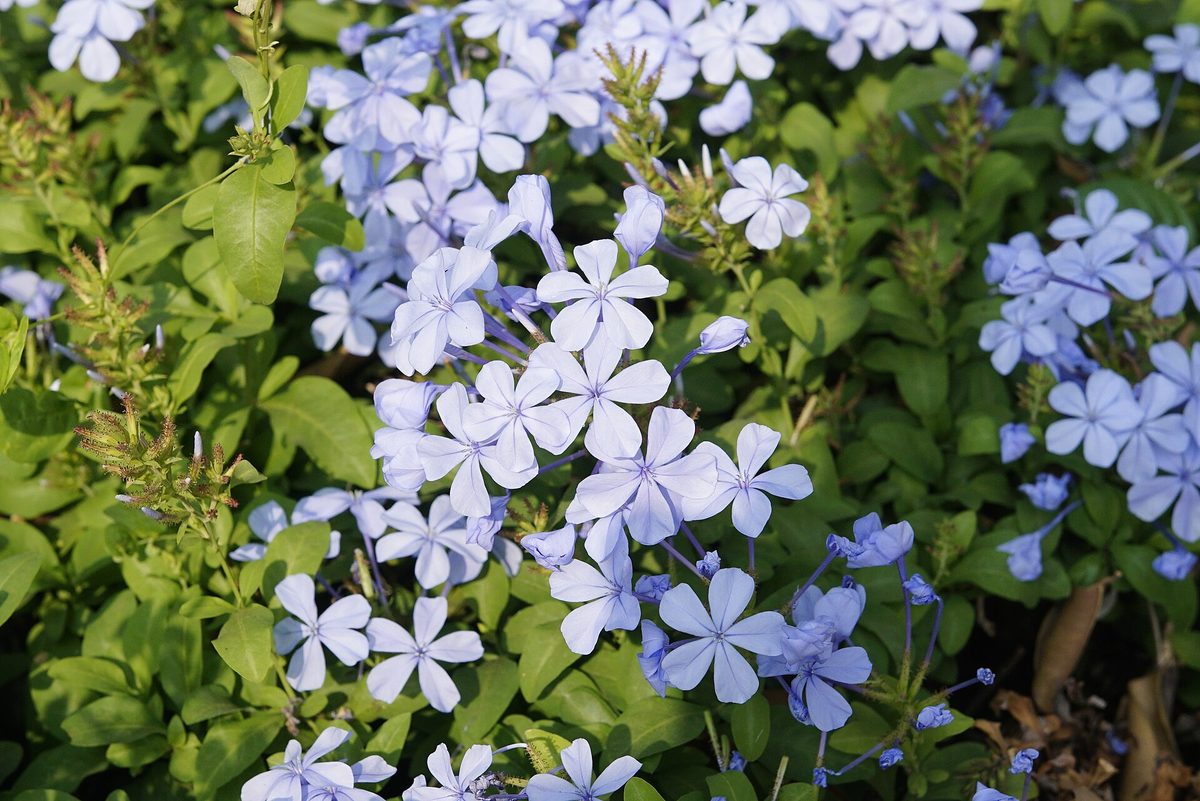
Photo: Vengolis, CC BY-SA 4.0 via Wikimedia Commons

Quick facts
| Light: | Full sun and part shade (full sun preferred)12 |
|---|---|
| Soil: | Well drained12 |
| Hardiness: | Zones 9a–11b12 |
| Size: | 6–10 ft (1.83–3.05 m) × 6–10 ft (1.83–3.05 m)211 source |
| Growth rate: | Moderate1122 |
| Bloom: | May–Oct, White, blue and pink411 source |
| Cats: | Not documented by major sources |
| Dogs: | Not documented by major sources |
| Native range: | CPP, MOZ, NAT, OFS, TVL5 |
| Family: | Plumbaginaceae |
How much light does a Cape Leadwort need?
Cape leadwort prefers full sun, which means six or more hours of direct sunlight a day. It also grows in part shade, although full sun is the preferred exposure. The two outdoor light levels listed are full sun and part shade.
Best soil for a Cape Leadwort
Cape leadwort grows in any fertile soil that drains well. Good drainage is the soil condition listed for this shrub, and no other drainage class is recorded. A preferred soil pH range is not documented for this page. Fertile and well-drained are the two soil qualities named for this plant.
Hardiness and temperature
Cape leadwort is listed for USDA hardiness zones 9a through 11b. That range runs from zone 9 through zone 11, and it covers both the a and b halves of each. Zones colder than 9a fall outside the listed range. No minimum temperature is documented for this page. Humidity is not documented either.
Pruning a Cape Leadwort
Light shaping is the pruning listed for Cape leadwort. Excessive growth can be removed at any time of year. Although technically a shrub, it can be trained to perform like a vine with a little assistance. Its mature height is 6 to 10 ft (1.83 to 3.05 m).
- Pruning: Light shaping3
How to plant a Cape Leadwort
Zones 9a through 11b are the USDA hardiness zones listed for Cape leadwort. Give each plant room for a spread of 6 to 10 ft (1.83 to 3.05 m). Mature height is also 6 to 10 ft (1.83 to 3.05 m). Choose a spot with full sun or part shade and fertile, well-drained soil. A planting depth is not documented for this page.
Winter care
Cape leadwort is a broadleaf evergreen. Its listed hardiness zones run from 9a to 11b. Gardeners in zones colder than 9a are outside the listed range. Check your own USDA zone against that range before you plan on leaving it outdoors. A minimum temperature is not documented for this page. Cold protection methods, such as mulch or covers, are not documented either.
How to propagate a Cape Leadwort
Cape leadwort, Plumbago auriculata, can be propagated by seed, by stem cuttings or by division. Those are the three propagation methods recorded for this shrub, and the list names no others. No single method is marked as preferred. Details such as timing, rooting medium and seed treatment are not documented for this page.
Common problems
No diseases are of major concern for Cape leadwort. The disease record for this shrub is empty, and no specific disease is named here. Common pests are not documented for this page. That means the page cannot name an insect problem to look for. A gap in the pest list is a gap in the record, not a sign that none exist.
- Common diseases: 3
Is Cape Leadwort toxic to cats and dogs?
Recommended supplies
- Soil: a free-draining mix, and a pot with a drainage hole.
Questions and answers
- How much sun does Cape leadwort need?
- It prefers full sun, which means six or more hours of direct sunlight a day. It also grows in part shade. Both exposures are listed for outdoor growing.
- Which USDA zones suit Cape leadwort?
- It is listed for USDA hardiness zones 9a through 11b. Zones colder than 9a fall outside that range. A minimum temperature is not documented for this page.
- How big does Cape leadwort get?
- Its mature height is 6 to 10 ft (1.83 to 3.05 m). Its mature spread is also 6 to 10 ft (1.83 to 3.05 m). It is technically a shrub, but it can be trained to perform like a vine.
Sources
- NC State Extension Gardener Plant Toolbox. https://plants.ces.ncsu.edu/plants/plumbago-auriculata/. Accessed 14 October 2026.
- University of Florida IFAS Extension (EDIS). https://ask.ifas.ufl.edu/publication/FP487. Accessed 14 October 2026.
- University of Florida IFAS Extension (EDIS). https://ask.ifas.ufl.edu/fp487. Accessed 21 October 2026.
- Chicago Botanic Garden. https://www.chicagobotanic.org/plant-information/plant-finder/plumbago-auriculata-imperial-blue-imperial-blue-plumbago. Accessed 27 October 2026.
- Royal Botanic Gardens, Kew (World Checklist of Vascular Plants). https://sftp.kew.org/pub/data-repositories/WCVP/wcvp.zip. Accessed 4 June 2026.
How this page was made
- Written with AI assistance from the sources listed on this page. AI is never the source of a fact.