Stickywilly (Galium aparine)
Formerly Rubia aparine, Asterophyllum aparine, Galium segetum
Stickywilly, Galium aparine, is an annual. It prefers full sun but is also listed for part shade and full shade. Growth is rapid. Plants can reach up to 6 ft (1.83 m). The flowers are white and green. The stems are weak and cannot stand up alone. Watering needs and toxicity to cats and dogs are not documented on this page.
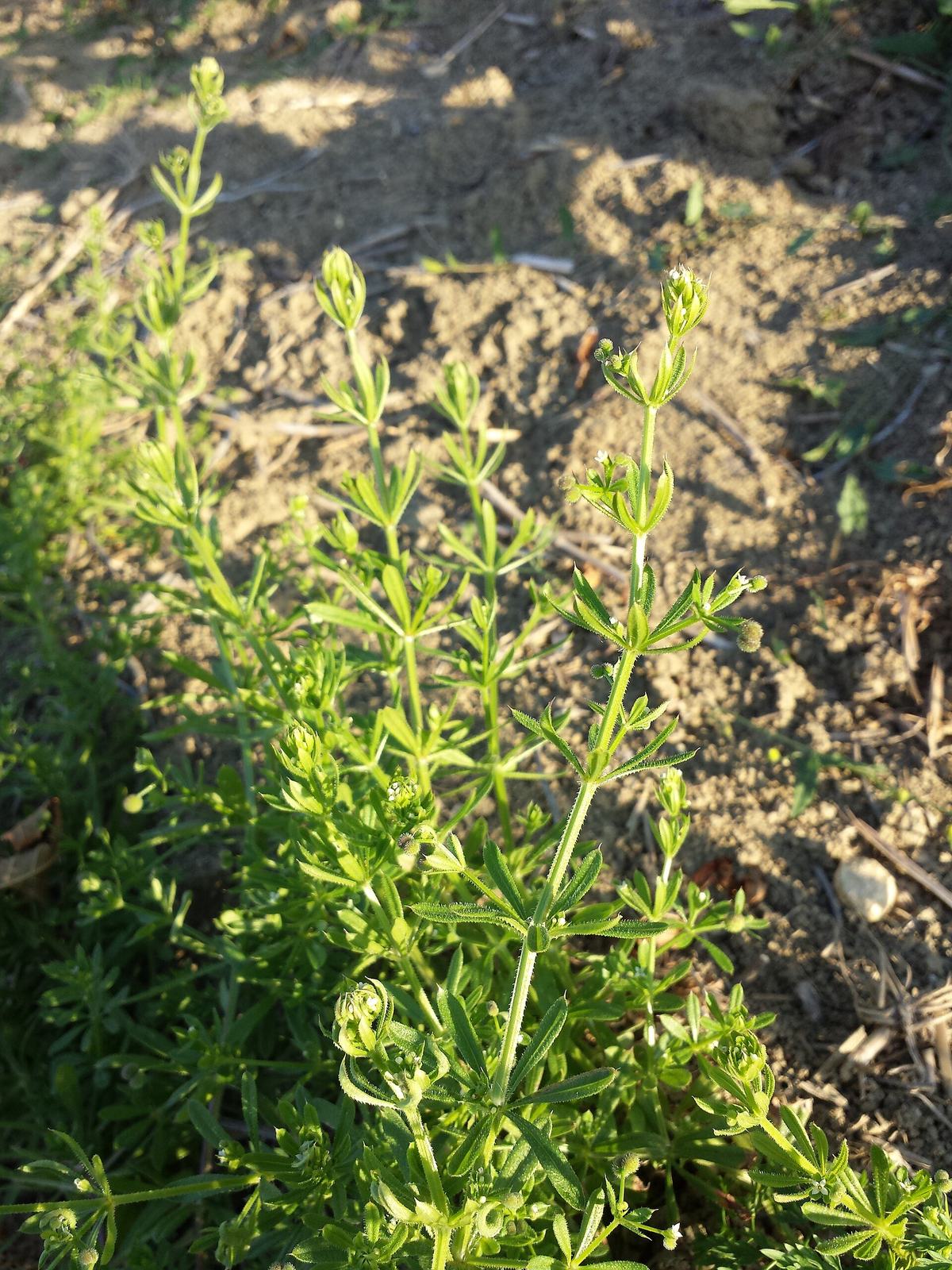
Photo: Stefan.lefnaer, CC BY-SA 4.0 via Wikimedia Commons

Quick facts
| Light: | Full sun, part shade and full shade (full sun preferred)11 source |
|---|---|
| Soil: | Moist and poorly drained; pH 6–811 source |
| Size: | 6 ft (1.83 m) × Sources differ: University of Wisconsin-Madison Division of Extension (Wisconsin Horticulture)13 |
| Growth rate: | Rapid4441 source |
| Bloom: | Apr, White and green5131 source |
| Cats: | Not documented by major sources |
| Dogs: | Not documented by major sources |
| Native range: | AFG, ALB, ALG, ALT, AUT, AZO, BAL, BGM, BLR, BLT, BRY, BUL, CHC, CHM, CHN, CHS, CHT, CNY, COR, CTA, CYP, CZE, DEN, EAI, EHM, FIN, FRA, GER, GRB, GRC, GST, HUN, IRE, IRK, IRN, IRQ, ITA, KGZ, KOR, KRA, KRI, KRY, LBS, LBY, MDR, MON, MOR, NEP, NET, NOR, OMA, PAK, PAL, POL, POR, ROM, RUC, RUE, RUN, RUS, RUW, SAR, SAU, SEL, SIC, SPA, SWE, SWI, TUE, TUN, TUR, TVA, TZK, UKR, UZB, VIE, WHM, WSB, YAK, YUG6 |
| Family: | Rubiaceae |
How much light does a Stickywilly need?
Outdoors, stickywilly prefers full sun over the shadier conditions listed for it. Part shade and full shade are both listed as conditions it takes. Partial shade is described as direct sunlight for only part of the day, between 2 and 6 hours. That makes the three listed light conditions full sun, part shade and full shade.
- Light: Full sun, part shade and full shade (full sun preferred)1
Best soil for a Stickywilly
A pH range of 6 to 8 is listed for stickywilly, and it is described as neutral. The listed drainage conditions are moist and poorly drained soil. Moist and poorly drained are listed as separate entries, and both are recorded as conditions for this plant. The pH figure is a range from 6.0 to 8.0, not a single value. No soil texture or amendment is documented on this page, so only pH and drainage are stated.
How to propagate a Stickywilly
Propagation of this annual plant is by seed. Seed is the recommended propagation strategy, and it is the only method recorded. No cuttings, division or other methods are recorded for this plant. Seed depth, sowing time and germination details are not documented on this page.
Common problems
The recorded pests are spittlebugs, hawk moth caterpillars, spider mites and stem nematode. Two diseases are recorded as well: tomato spotted wilt virus and tomato chlorosis virus. These are names only, and the page gives no damage descriptions, symptoms or treatments for any of them. Four pests and two diseases are recorded in total.
| Problem | Kind |
|---|---|
| Spittlebugs | Pest |
| Hawk moth caterpillars | Pest |
| Spider mites | Pest |
| Stem nematode | Pest |
| Tomato spotted wilt virus | Disease |
| Tomato chlorosis virus | Disease |
Is Stickywilly toxic to cats and dogs?
Recommended supplies
- Soil: a mix that holds moisture without staying wet.
Questions and answers
- How tall does stickywilly grow?
- Plants can grow up to 6 ft (1.83 m), which is a maximum rather than a typical height. The stem is weak, and the plant cannot stand up on its own. Growth is recorded as rapid.
- Is stickywilly native to the United States?
- Its native status is listed as native in both Alaska and the lower 48 states. It is recorded as an annual plant.
- What color are the flowers, and when do they bloom?
- The flowers are white and green. Light green to white is another way the bloom color is described. The recorded bloom time is April.
Sources
- NC State Extension Gardener Plant Toolbox. https://plants.ces.ncsu.edu/plants/galium-aparine/. Accessed 31 October 2026.
- EPPO Global Database. https://gd.eppo.int/taxon/GALAP/pests. Accessed 14 October 2026.
- University of Wisconsin-Madison Division of Extension (Wisconsin Horticulture). https://hort.extension.wisc.edu/articles/catchweed-bedstraw-galium-aparine/. Accessed 15 October 2026.
- USDA Forest Service Fire Effects Information System. https://www.fs.usda.gov/database/feis/plants/forb/galapa/all.html. Accessed 14 October 2026.
- Lady Bird Johnson Wildflower Center (Native Plant Database). https://www.wildflower.org/plants/result.php?id_plant=gaap2. Accessed 27 October 2026.
- Royal Botanic Gardens, Kew (World Checklist of Vascular Plants). https://sftp.kew.org/pub/data-repositories/WCVP/wcvp.zip. Accessed 4 June 2026.
How this page was made
- Written with AI assistance from the sources listed on this page. AI is never the source of a fact.