Annual Ragweed (Ambrosia artemisiifolia)
Formerly Ambrosia elatior, Ambrosia elata, Iva monophylla
Give annual ragweed (Ambrosia artemisiifolia) full sun, which is its preferred light, and expect it to want dry soil. It also tolerates part shade and full shade. Its soil moisture is listed as dry, and it tolerates drought. Toxicity to cats and to dogs is not documented on this page.
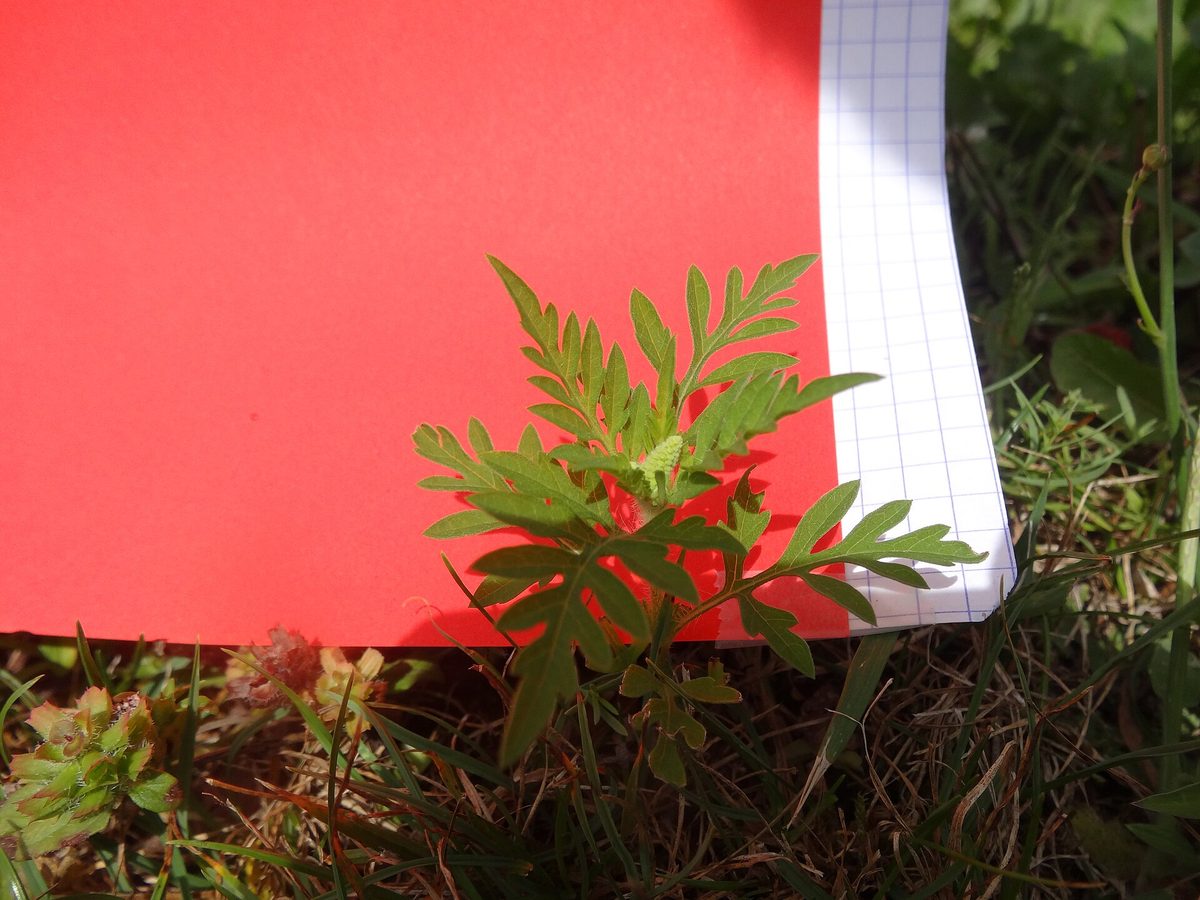
Photo: Jpve, CC BY-SA 4.0 via Wikimedia Commons

Quick facts
| Light: | Full sun, part shade and full shade (full sun preferred)1233 |
|---|---|
| Water: | Dry13 |
| Soil: | Well drained and occasionally dry31 source |
| Size: | 4–6 ft (1.22–1.83 m) × 3–4 ft (0.91–1.22 m)2531 source |
| Growth rate: | Rapid23 |
| Bloom: | Jun–Nov, Green, brown and yellow311 source |
| Cats: | Not documented by major sources |
| Dogs: | Not documented by major sources |
| Native range: | ABT, ALA, ARI, ARK, ASK, BRC, CAL, CNT, COL, DEL, FLA, GEO, IDA, ILL, INI, IOW, KAN, KTY, LOU, MAI, MAN, MAS, MIC, MIN, MNT, MRY, MSI, MSO, NBR, NCA, NDA, NEB, NEV, NSC, NWH, NWJ, NWM, NWT, NWY, OHI, OKL, ONT, ORE, PEI, PEN, QUE, RHO, SAS, SCA, TEN, TEX, UTA, VER, VRG, WAS, WDC, WIS, WVA, WYO6 |
| Family: | Asteraceae |
How much light does an Annual Ragweed need?
Annual ragweed tolerates a full range of light, from full sun through part shade to full shade. Full sun is the preferred setting for this plant. Common ragweed grows in full sun and in a wide range of soil conditions. The Lady Bird Johnson Wildflower Center lists its light requirement as sun, part shade and shade.
How often to water an Annual Ragweed
Annual ragweed is listed for dry soil moisture. The Lady Bird Johnson Wildflower Center records dry as its soil moisture, and the record gives dry as both the lowest and the highest level. NC State Extension describes the plant as drought tolerant and poor soil tolerant. Soil that drains well and is occasionally dry also matches the drainage listed for this plant.
Best soil for an Annual Ragweed
Good drainage and occasionally dry conditions are the soil traits listed for annual ragweed. Its drainage listing has two parts: well drained, and occasionally dry. NC State Extension describes the plant as drought and poor soil tolerant. Common ragweed grows in a wide range of soil conditions. The water record for this species also lists dry soil moisture. No soil pH range is documented for this plant. The facts on file name no other soil trait.
How to propagate an Annual Ragweed
You propagate annual ragweed (Ambrosia artemisiifolia) from seed, and seed is the only propagation method listed for this plant. The NC State Extension Gardener Plant Toolbox names seed under propagation. The propagation record for this species contains one entry, which is seed. No other method appears in it.
- Propagation: Seed3
Common problems
The pests listed for annual ragweed include Corythucha marmorata, Cuerna costalis, Diabrotica virgifera zeae and Euwallacea kuroshio. Lepyronia quadrangularis, Oncometopia nigricans, Oncometopia orbona, Phenacoccus miruku and Ditylenchus dipsaci are also listed. Three diseases are listed as well: Phymatotrichopsis omnivora, Xylella fastidiosa and Orthotospovirus tomatomaculae.
- Common pests: corythucha marmorata, cuerna costalis, diabrotica virgifera zeae, euwallacea kuroshio, lepyronia quadrangularis, oncometopia nigricans, oncometopia orbona, phenacoccus miruku and ditylenchus dipsaci4
- Common diseases: phymatotrichopsis omnivora, xylella fastidiosa and orthotospovirus tomatomaculae4
| Problem | Kind |
|---|---|
| Corythucha marmorata | Pest |
| Cuerna costalis | Pest |
| Diabrotica virgifera zeae | Pest |
| Euwallacea kuroshio | Pest |
| Lepyronia quadrangularis | Pest |
| Oncometopia nigricans | Pest |
| Oncometopia orbona | Pest |
| Phenacoccus miruku | Pest |
| Ditylenchus dipsaci | Pest |
| Phymatotrichopsis omnivora | Disease |
| Xylella fastidiosa | Disease |
| Orthotospovirus tomatomaculae | Disease |
Is Annual Ragweed toxic to cats and dogs?
Recommended supplies
- Soil: a free-draining mix, and a pot with a drainage hole.
Questions and answers
- How tall does annual ragweed grow?
- Annual ragweed reaches about 4 to 6 ft (1.22–1.83 m) tall, with a spread of 3 to 4 ft (0.91–1.22 m). Clemson Cooperative Extension says it can reach four to six feet tall. Its growth rate is rapid.
- What color are annual ragweed flowers, and when do they bloom?
- The flowers are green, brown and yellow. NC State Extension describes each small flower as green, turning yellow-green and then brown as it matures. The bloom season in the listing runs from June to November.
- Is annual ragweed native to the United States?
- Annual ragweed is native in the lower 48 US states and introduced in Hawaii. Its native range is recorded as a list of region codes, from ABT to WYO.
Sources
- Lady Bird Johnson Wildflower Center. https://www.wildflower.org/plants/result.php?id_plant=amar2. Accessed 14 October 2026.
- Clemson Cooperative Extension HGIC. https://hgic.clemson.edu/weed-of-the-month-common-ragweed/. Accessed 14 October 2026.
- NC State Extension Gardener Plant Toolbox. https://plants.ces.ncsu.edu/plants/ambrosia-artemisiifolia/. Accessed 14 October 2026.
- EPPO Global Database. https://gd.eppo.int/taxon/AMBEL/pests. Accessed 14 October 2026.
- Clemson Cooperative Extension HGIC. https://hgic.clemson.edu/factsheet/goldenrod-ragweed/. Accessed 14 October 2026.
- Royal Botanic Gardens, Kew (World Checklist of Vascular Plants). https://sftp.kew.org/pub/data-repositories/WCVP/wcvp.zip. Accessed 4 June 2026.
How this page was made
- Written with AI assistance from the sources listed on this page. AI is never the source of a fact.