Paperplant (Fatsia japonica)
Formerly Aralia sieboldii, Aralia japonica, Aralia brownii
Grow paperplant outdoors in part shade to full shade, favoring part shade, and give it medium water. It is an evergreen shrub or small tree that can reach 6 to 19.5 ft (1.83-5.94 m) tall. The ASPCA lists paperplant as non-toxic to cats and non-toxic to dogs.
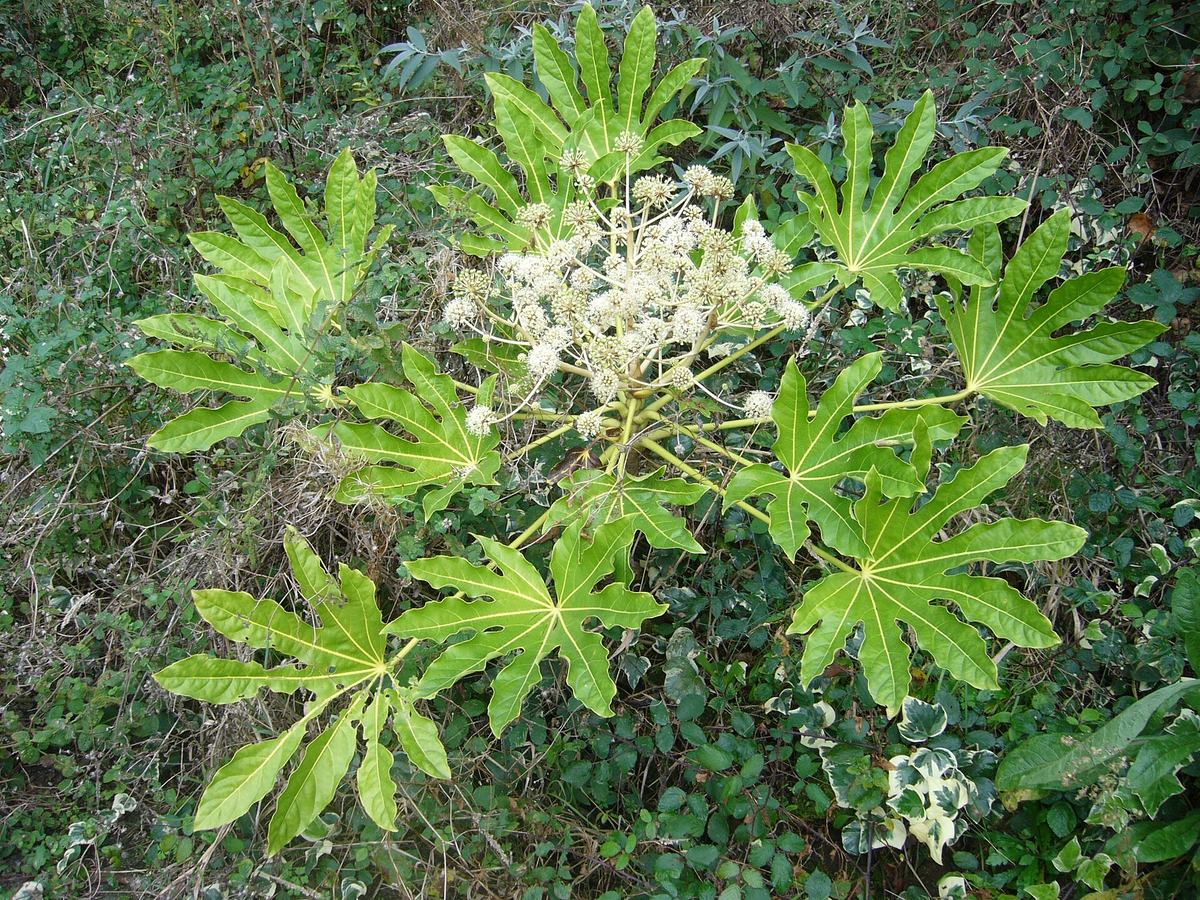
Photo: Fernando Losada Rodríguez, CC BY-SA 4.0 via Wikimedia Commons

Quick facts
| Light: | Part shade and full shade (part shade preferred)11 source |
|---|---|
| Water: | Medium21 source |
| Soil: | Well drained and moist31 source |
| Hardiness: | Zones 7b–10b11 source |
| Size: | 6–19.5 ft (1.83–5.94 m) × 4–6 ft (1.22–1.83 m)11 source |
| Bloom: | White11 source |
| Cats: | Non-toxic to cats 41 |
| Dogs: | Non-toxic to dogs 41 |
| Family: | Araliaceae |
How much light does a Paperplant need?
Part shade is the best light for paperplant outdoors, giving it direct sun for only part of the day, somewhere between two and six hours. It also tolerates full shade outdoors, a setting with almost no direct sun reaching it at any point in the day.
- Light: Part shade and full shade (part shade preferred)1
How often to water a Paperplant
Medium water suits paperplant outdoors, providing regular, moderate watering along with good drainage. This medium level is the only water rating given for paperplant, with no separate minimum or maximum listed. The soil should stay moist but still drain well between waterings. Too much moisture in the soil can cause root rot, one of the diseases recorded for this plant.
- Water: Medium2
Best soil for a Paperplant
Moist soil that still drains well is what paperplant needs outdoors. The plant's water needs are also described as requiring good drainage, which closely matches this preference for well-drained soil. A planting site with poorly drained conditions can let Phytophthora infect paperplant's roots, leading to root rot. Soil that holds too much moisture also carries this same root rot risk.
- Soil drainage: Well drained and moist3
Hardiness and temperature
USDA hardiness zones 7b through 10b mark where paperplant grows outdoors. It also keeps its leaves year-round as a semi-dense, broadleaf, evergreen shrub or small tree with a tropical look. This hardiness range, from 7b to 10b, is the main cold-tolerance detail recorded for paperplant on this page.
- Hardiness: Zones 7b–10b1
Fertilizing a Paperplant
A light yearly feeding is all paperplant needs outdoors, applied in spring once the last frost has passed. A single light application in spring is enough, since this plant does not need repeated or heavy feeding through the rest of that growing season.
- Fertilizer: Light, once a year3
Pruning a Paperplant
Hard renewal cuts are the main pruning method for paperplant outdoors, cutting back all the stems by several feet in late winter before new growth begins. You can also use light shaping cuts at other times to keep its form tidy between these harder renewal prunings.
- Pruning: Hard renewal pruning and Light shaping3
How to plant a Paperplant
Zones 7b through 10b are where you can plant paperplant outdoors. Give it room to grow, since it can reach 6 to 19.5 ft (1.83-5.94 m) tall and 4 to 6 ft (1.22-1.83 m) wide at maturity. Choose a planting spot in part shade or full shade, since that is the light level it grows best in outdoors.
- Hardiness: Zones 7b–10b1
Winter care
Late winter is when paperplant gets its hard renewal pruning, cutting all of its stems back by several feet before any new growth begins. Paperplant survives winters outdoors only within USDA hardiness zones 7b through 10b, the range recorded for this plant on this page.
- Hardiness: Zones 7b–10b1
How to propagate a Paperplant
Fresh seed is one way to propagate paperplant outdoors, but you need to remove the fleshy black fruit wall surrounding the seed first. Stem cuttings are another option outdoors, and these are taken in mid to late summer, after the wood on the stem has firmed up. These are the only two propagation methods recorded for paperplant on this page.
Common problems
Aphids, mealybugs, spider mites, scale and thrips are also the occasional pests recorded for paperplant growing outdoors. Root rot is the main disease recorded for paperplant outdoors, and it is most often linked to poorly drained or overly wet soil.
| Problem | Kind |
|---|---|
| Aphids | Pest |
| Mealybugs | Pest |
| Spider mites | Pest |
| Scale insects | Pest |
| Thrips | Pest |
| Root rot | Disease |
Is Paperplant toxic to cats and dogs?
The ASPCA lists paperplant as non-toxic to cats, and it is also listed as non-toxic to dogs. NC State Extension's plant database also lists it as non-toxic for both cats and dogs. No part of paperplant is listed as toxic to cats in either of these records. The same is true for dogs: no cited listing names paperplant as toxic to them.
Recommended supplies
- Soil: a free-draining mix, and a pot with a drainage hole.
Questions and answers
- Is paperplant toxic to cats or dogs?
- The ASPCA lists paperplant as non-toxic to cats and non-toxic to dogs, and NC State Extension's plant database records the same non-toxic status for both.
- What kind of light does paperplant need outdoors?
- Outdoors, paperplant grows best in part shade, getting direct sun for only part of the day, and it also tolerates full shade with almost no direct sun.
- What pests and diseases affect paperplant?
- Outdoors, watch for aphids, mealybugs, spider mites, scale and thrips, and keep an eye out for root rot, which is often linked to poorly drained or overly wet soil.
Sources
- NC State Extension Gardener Plant Toolbox. https://plants.ces.ncsu.edu/plants/fatsia-japonica/. Accessed 15 November 2026.
- UC Statewide Integrated Pest Management Program. https://ipm.ucanr.edu/home-and-landscape/aralia/. Accessed 15 November 2026.
- Clemson Cooperative Extension Home & Garden Information Center. https://hgic.clemson.edu/factsheet/fatsia/. Accessed 15 November 2026.
- ASPCA Animal Poison Control Center. https://www.aspca.org/pet-care/aspca-poison-control/toxic-and-non-toxic-plants/japanese-aralia. Accessed 16 November 2026.
How this page was made
- Written with AI assistance from the sources listed on this page. AI is never the source of a fact.