Japanese Cheesewood (Pittosporum tobira)
Formerly Euonymus tobira, Pittosporum makinoi, Pittosporum chinense
Give Japanese cheesewood full sun for the best growth, though it also tolerates part shade and even full shade outdoors. Keep the soil somewhere between dry and medium moisture. The ASPCA and Pet Poison Helpline both list this plant as non-toxic to cats and non-toxic to dogs.
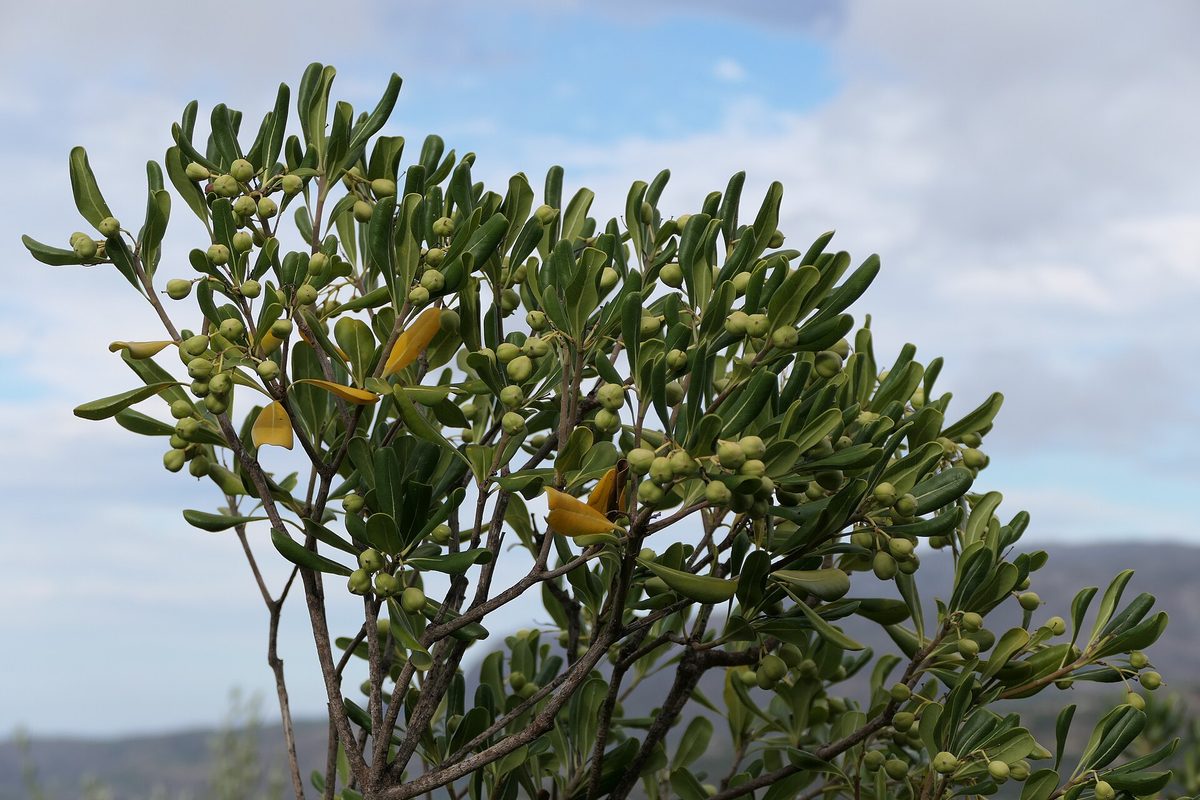
Photo: Petro Stelte, CC BY-SA 4.0 via Wikimedia Commons

Quick facts
| Light: | Full sun, part shade and full shade (full sun preferred)12 |
|---|---|
| Water: | Dry to medium21 source |
| Soil: | Well drained, moist and occasionally dry12 |
| Hardiness: | Zones 8a–10b11 source |
| Size: | 8–13 ft (2.44–3.96 m) × 4–8 ft (1.22–2.44 m)11 source |
| Growth rate: | Rapid12 |
| Bloom: | Apr–May, White and yellow11 source |
| Cats: | Non-toxic to cats 34 |
| Dogs: | Non-toxic to dogs 34 |
| Family: | Pittosporaceae |
How much light does a Japanese Cheesewood need?
This shrub does best outdoors in full sun, the light level it is most suited to. It also tolerates part shade and full shade, so it adapts to light levels from full sun down to deep shade. That range means it works outdoors whether the spot gets strong sun or heavy shade.
How often to water a Japanese Cheesewood
Water Japanese cheesewood (Pittosporum tobira) enough to keep the soil somewhere between dry and medium, which is the range this shrub tolerates. Good drainage paired with soil that stays moist or occasionally dries out also suits this shrub well outdoors, within the dry-to-medium range given above.
- Water: Dry to medium2
Best soil for a Japanese Cheesewood
Good drainage matters most when choosing soil for Japanese cheesewood outdoors, since this shrub is described as needing well-drained ground. It also tolerates soil that stays moist or that occasionally turns dry, as long as the ground drains well overall. Sandy, loamy and clay soils are all listed as suitable for this shrub outdoors, provided the soil itself is well-drained.
Hardiness and temperature
USDA hardiness zones 8a through 10b mark the outdoor range where Japanese cheesewood is listed as hardy year-round. That means gardeners anywhere from USDA zone 8a through zone 10b are within the outdoor range this plant is suited to. This USDA rating is the only hardiness information documented for Japanese cheesewood on this page.
- Hardiness: Zones 8a–10b1
How to plant a Japanese Cheesewood
Choose an outdoor spot that fits this shrub's eventual size. At maturity it typically reaches 8 to 13 ft (2.44-3.96 m) tall and spreads 4 to 8 ft (1.22-2.44 m) wide. Plant it only where winters stay within USDA hardiness zones 8a through 10b, the range it is rated hardy in.
- Hardiness: Zones 8a–10b1
Winter care
Because Japanese cheesewood is evergreen, it keeps its leaves through winter rather than losing them seasonally. That means its winter appearance looks much like the rest of the year. This evergreen habit holds true within USDA hardiness zones 8a through 10b, the range where this shrub is rated hardy outdoors.
- Hardiness: Zones 8a–10b1
How to propagate a Japanese Cheesewood
Propagate Japanese cheesewood from semi-hardwood stem cuttings, the method documented for this shrub. These cuttings are typically taken from mid-July to September and treated with a root-promoting compound before they are set to root. Stem cuttings are the only propagation method documented for this shrub.
- Propagation: Stem cuttings2
Common problems
Watch for aphids, scale, mealybugs, root-knot nematodes, whiteflies and pittosporum psyllid, which are the pests documented for this shrub. No serious insect or disease problems are reported overall, despite that list. Documented diseases include root rot, leaf spot, bacterial blight and foamy canker, and root rot can be lethal in soil that drains poorly.
| Problem | Kind |
|---|---|
| Aphids | Pest |
| Scale insects | Pest |
| Mealybugs | Pest |
| Root knot nematodes | Pest |
| Whiteflies | Pest |
| Pittosporum psyllid | Pest |
| Root rot | Disease |
| Leaf spot | Disease |
| Bacterial blight | Disease |
| Foamy canker | Disease |
Is Japanese Cheesewood toxic to cats and dogs?
The ASPCA lists Japanese cheesewood as non-toxic to cats. The same ASPCA listing also names it non-toxic to dogs. Pet Poison Helpline also lists Pittosporum tobira, commonly called mock orange, as a non-toxic plant for cats and dogs. The ASPCA's listing for this plant additionally names horses as non-toxic, though this site covers only cats and dogs. No severity level is documented for this plant's non-toxic rating.
Recommended supplies
- Soil: a free-draining mix, and a pot with a drainage hole.
Questions and answers
- Is Japanese cheesewood toxic to cats or dogs?
- Japanese cheesewood is listed as non-toxic to cats by the ASPCA, and the same listing also names it non-toxic to dogs. Pet Poison Helpline lists it as non-toxic as well.
- How much light does Japanese cheesewood need outdoors?
- This shrub grows best outdoors in full sun, though it is also described as tolerating part shade and full shade. That means it can grow in a full-sun bed or in a shadier part of the yard outdoors.
- What USDA zones can Japanese cheesewood grow in outdoors?
- Japanese cheesewood is rated hardy for outdoor growing in USDA zones 8a through 10b. Gardeners in zone 8a and anywhere warmer, up through zone 10b, are within the range this shrub is suited to.
Sources
- NC State Extension Gardener Plant Toolbox. https://plants.ces.ncsu.edu/plants/pittosporum-tobira/. Accessed 15 November 2026.
- Clemson Cooperative Extension HGIC. https://hgic.clemson.edu/factsheet/pittosporum/. Accessed 15 November 2026.
- ASPCA Animal Poison Control Center. https://www.aspca.org/pet-care/aspca-poison-control/toxic-and-non-toxic-plants/japanese-pittosporum. Accessed 15 November 2026.
- Pet Poison Helpline. https://www.petpoisonhelpline.com/poison/mock-orange/. Accessed 15 November 2026.
How this page was made
- Written with AI assistance from the sources listed on this page. AI is never the source of a fact.