Thimbleberry (Rubus parviflorus)
Formerly Rubus nutkanus, Rubus lacer, Bossekia nutkana
To keep thimbleberry (Rubus parviflorus) alive, give this deciduous shrub full sun, though it also takes part shade and full shade. Its water needs run from dry to medium. Toxicity to cats and dogs is not documented on this page, so no position is given for either animal.
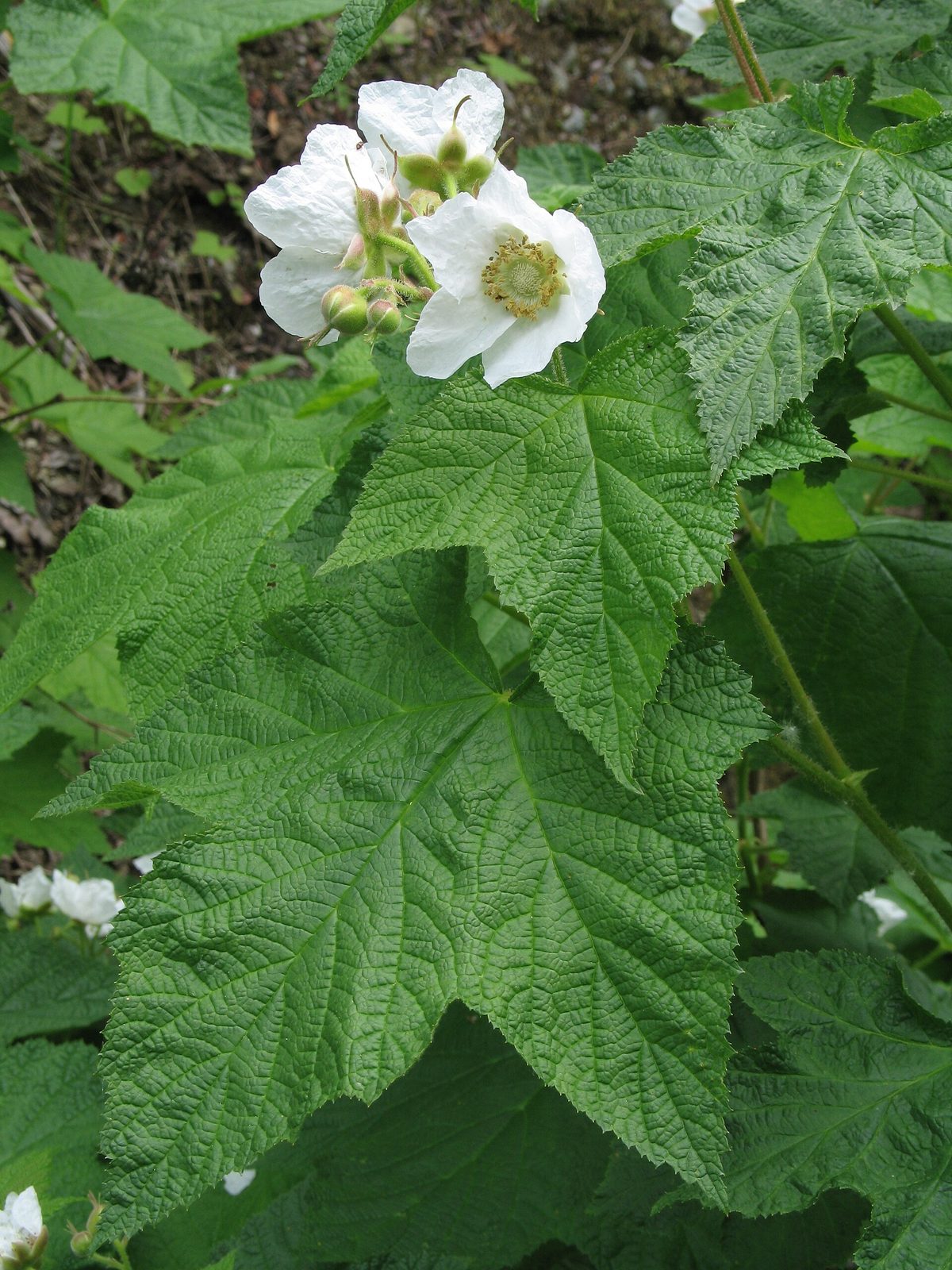
Photo: Robert Flogaus-Faust, CC BY 4.0 via Wikimedia Commons

Quick facts
| Light: | Full sun, part shade and full shade (full sun preferred)11 source |
|---|---|
| Water: | Dry to medium11 source |
| Size: | 9.8 ft (3 m)41 source |
| Bloom: | May–Aug, White151 source |
| Cats: | Not documented by major sources |
| Dogs: | Not documented by major sources |
| Native range: | ABT, ARI, ASK, BRC, CAL, COL, IDA, ILL, IOW, MIC, MIN, MNT, MXE, MXN, NEV, NWM, ONT, ORE, SDA, UTA, WAS, WIS, WYO6 |
| Family: | Rosaceae |
How much light does a Thimbleberry need?
Full sun is the preferred exposure for thimbleberry. The plant is listed for sun, part shade and shade, so all three fall within what it tolerates. If you have a choice of spots, pick the sunniest one and keep part shade or full shade as the fallback. Light is described only by these three exposures, with no hours of sun given.
- Light: Full sun, part shade and full shade (full sun preferred)1
How often to water a Thimbleberry
Water needs for thimbleberry run from dry to medium. That range is described with the words dry and moist. Dry is the low end of what it tolerates, and medium is the high end. No watering schedule in days or weeks is documented for this plant, so none is given here.
- Water: Dry to medium1
How to propagate a Thimbleberry
You can propagate thimbleberry by division, seed or stem cuttings. Three methods are listed in total. For cuttings, the type listed is softwood. For division, the listing names root division. Seed is also a listed method, alongside the other two. No sowing dates, rooting hormone, germination steps or timing for division are documented, so none are given here.
- Propagation: Division, seed and stem cuttings1
Common problems
Raspberry bushy dwarf virus is the disease recorded for thimbleberry. A publication reports its occurrence in native thimbleberry in British Columbia. No pests are recorded for this plant in the facts on file. No symptoms, treatments or prevention steps are documented, so none are given here.
| Problem | Kind |
|---|---|
| Raspberry crown borer | Pest |
| Raspberry bushy dwarf virus | Disease |
Is Thimbleberry toxic to cats and dogs?
Questions and answers
- Can thimbleberry grow in shade?
- Thimbleberry prefers full sun, so choose the sunniest spot you have if you can. It is also listed for part shade and full shade, so both fall within what it tolerates. No results for flowering or fruiting in shade are documented.
- What color are thimbleberry flowers, and when do they bloom?
- The flowers are white, sometimes pink-tinged, and they grow in terminal clusters. The bloom season runs from May–Aug. The plant is a deciduous shrub.
- Where is thimbleberry native?
- Thimbleberry has native status in both Alaska and the lower 48 states of the United States. Its native range is recorded as a list of region codes, among them ABT, BRC, CAL, MXE and WAS.
Sources
- Lady Bird Johnson Wildflower Center. https://www.wildflower.org/plants/result.php?id_plant=RUPA. Accessed 14 October 2026.
- Utah State University Extension. https://extension.usu.edu/planthealth/ipm/notes_ag/fruit-rasp-crown-borer. Accessed 11 October 2026.
- EPPO Global Database. https://gd.eppo.int/taxon/RUBPA/pests. Accessed 14 October 2026.
- USDA Forest Service Fire Effects Information System. https://www.fs.usda.gov/database/feis/plants/shrub/rubpar/all.html. Accessed 31 October 2026.
- Oregon State University Extension Service. https://extension.oregonstate.edu/catalog/ec-1306-growing-raspberries-your-home-garden. Accessed 28 October 2026.
- Royal Botanic Gardens, Kew (World Checklist of Vascular Plants). https://sftp.kew.org/pub/data-repositories/WCVP/wcvp.zip. Accessed 4 June 2026.
How this page was made
- Written with AI assistance from the sources listed on this page. AI is never the source of a fact.