Salmonberry (Rubus spectabilis)
Formerly Parmena spectabilis, Rubus franciscanus, Rubus spectabilis var. frondosus
Salmonberry, Rubus spectabilis, is a deciduous shrub. It prefers full sun, though it also grows in part shade and full shade. Its water need is medium. It reaches 6.6–13.1 ft (2–4 m) tall. It is listed for hardiness zones 5a–10a. The flowers are red, pink and purple. Toxicity to cats and dogs is not documented on this page.
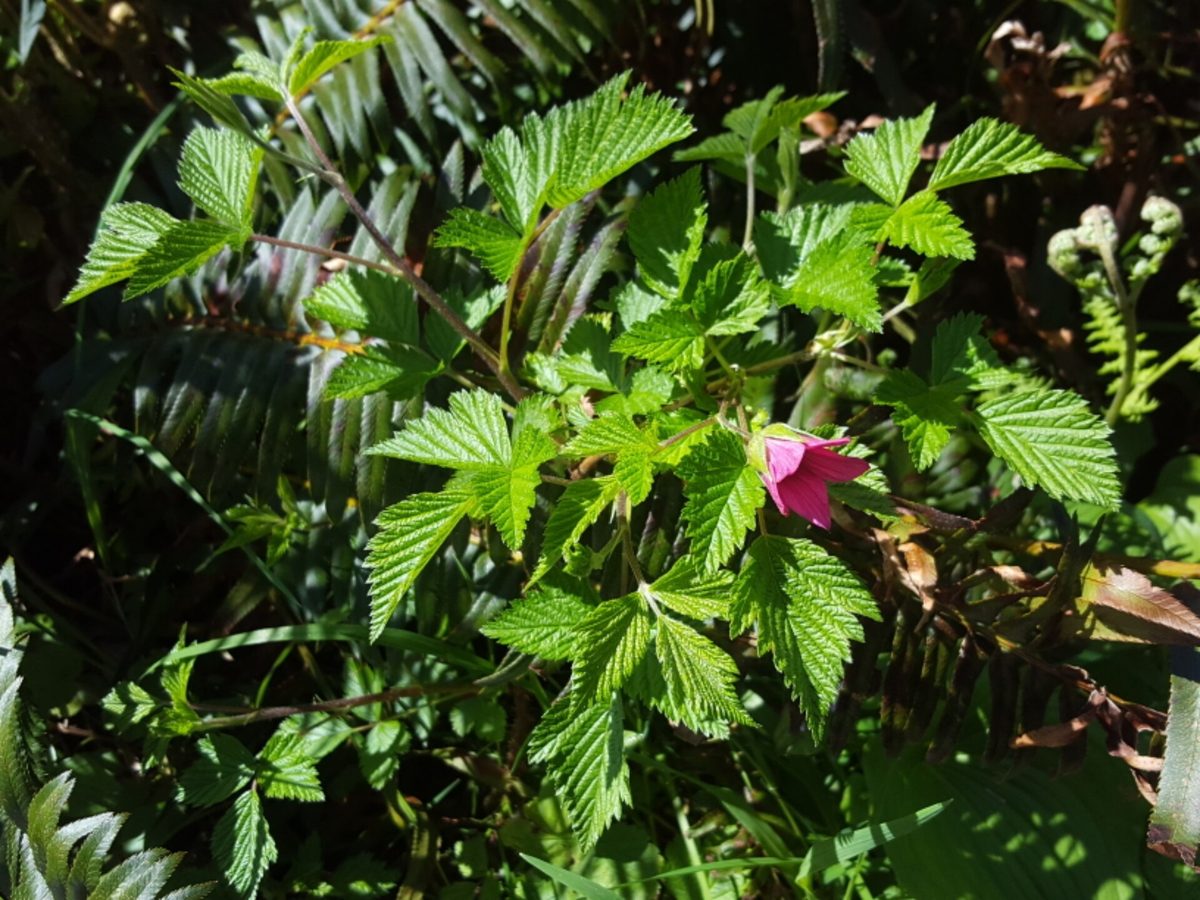
Photo: Alex Abair, CC BY 4.0 via Wikimedia Commons

Quick facts
| Light: | Full sun, part shade and full shade (full sun preferred)12 |
|---|---|
| Water: | Medium11 source |
| Soil: | Moist and occasionally dry123 |
| Hardiness: | Zones 5a–10a31 source |
| Size: | 6.6–13.1 ft (2–4 m)61 source |
| Growth rate: | Moderate3367 |
| Bloom: | Mar–Jun, Red, pink and purple21 |
| Cats: | Not documented by major sources |
| Dogs: | Not documented by major sources |
| Native range: | ASK, BRC, CAL, IDA, ORE, WAS8 |
| Family: | Rosaceae |
How much light does a Salmonberry need?
Salmonberry grows in full sun, part shade or full shade, and full sun is the preferred setting. One source describes the deepest shade as less than 2 hours to no direct sunlight. Choose full sun when you can. Fall back to part shade or full shade where the site is dim.
How often to water a Salmonberry
Salmonberry has a medium water need. Aim for medium watering rather than heavy or very light watering. Its sites are described as moist to dry, from sun to shade. Its soil drainage is recorded as moist and occasionally dry. Let the condition of the soil guide you, because the listing covers both moist and occasionally dry soil.
- Water: Medium1
Best soil for a Salmonberry
Salmonberry grows in moist soil and in soil that is occasionally dry. One source describes this as moist to drier soils. Another lists moist to dry sites in sun to shade. Its water need is medium. Moist and occasionally dry are the two drainage conditions listed. Drier soils are listed as well as moist ones. No cited source records a soil pH range, so that value is not documented.
Hardiness and temperature
Salmonberry is listed for USDA hardiness zones 5a–10a. That listing covers zone numbers 5 through 10. Zones 6, 7, 8 and 9 all sit inside it. Zone 5a is the first zone listed, and zone 10a is the last. A garden in zone 5a is at the edge of the listing on the cold side. A garden in zone 10a is at the edge on the warm side. No cited source records a minimum temperature, so that figure is not documented.
- Hardiness: Zones 5a–10a3
How to plant a Salmonberry
Choose a planting site in USDA hardiness zones 5a–10a. Full sun is the preferred setting, and part shade and full shade are also listed. The site can be moist or occasionally dry. Mature plants reach 6.6–13.1 ft (2–4 m) tall. Salmonberry is a deciduous shrub with a moderate growth rate. Its native range is recorded as ASK, BRC, CAL, IDA, ORE and WAS.
- Hardiness: Zones 5a–10a3
Winter care
Salmonberry is a deciduous shrub. A garden in zone 5a sits at the cold end of its listed range. A garden in zone 10a sits at the warm end. Gardens in zone 4 and colder fall outside the listed range. Gardens in zone 11 and warmer also fall outside it. Its hardiness zones are listed as 5a to 10a. No cited source records a minimum temperature, so a lowest safe figure is not documented.
- Hardiness: Zones 5a–10a3
How to propagate a Salmonberry
You can propagate salmonberry by seed, division, stem cuttings, root cuttings or layering. One source says propagation is easiest by cuttings or layering. The same source says that increasing it from seed is not as easy, but it is possible. Salmonberry can also be grown from cuttings, and its growth rate is moderate.
- Propagation: Seed, division, stem cuttings, root cuttings and layering1
Common problems
Three pests are recorded for salmonberry. They are the rednecked cane borer, the raspberry cane borer and the spotted wing drosophila. The spotted wing drosophila has the scientific name Drosophila suzukii. Each pest on this list is recorded as a common pest of this species. The list has three entries. Two of them are cane borers. No cited source lists diseases for this species.
| Problem | Kind |
|---|---|
| Rednecked cane borer | Pest |
| Raspberry cane borer | Pest |
| Spotted wing drosophila | Pest |
| Phytophthora ramorum | Disease |
Is Salmonberry toxic to cats and dogs?
Recommended supplies
- Soil: a mix that holds moisture without staying wet.
Questions and answers
- When does salmonberry bloom?
- Salmonberry blooms from March to June. The flowers are listed as red, pink and purple, and one source describes them as magenta-pink with 5 petals, up to 1.5 inches (3.8 cm) across.
- How tall does salmonberry grow?
- Salmonberry typically grows 6.6–13.1 ft (2–4 m) tall. It is a deciduous shrub with a moderate growth rate. It is listed for hardiness zones 5a–10a.
- Where is salmonberry native?
- Its native range is recorded as ASK, BRC, CAL, IDA, ORE and WAS. In the United States, it has native status in both Alaska and the lower 48 states. It is a shrub.
Sources
- Lady Bird Johnson Wildflower Center. https://www.wildflower.org/plants/result.php?id_plant=rusp. Accessed 14 October 2026.
- NC State Extension Gardener Plant Toolbox. https://plants.ces.ncsu.edu/plants/rubus-spectabilis/. Accessed 14 October 2026.
- Oregon State University Extension Service. https://extension.oregonstate.edu/catalog/em-9391-shrubs-trees-bees. Accessed 14 October 2026.
- EPPO Global Database. https://gd.eppo.int/taxon/RUBSP/pests. Accessed 14 October 2026.
- EPPO Global Database. https://gd.eppo.int/taxon/PHYTRA/hosts. Accessed 11 October 2026.
- USDA Forest Service Fire Effects Information System. https://www.fs.usda.gov/database/feis/plants/shrub/rubspe/all.html. Accessed 14 October 2026.
- Oregon State University Extension Service. https://extension.oregonstate.edu/pub/em-9391. Accessed 30 October 2026.
- Royal Botanic Gardens, Kew (World Checklist of Vascular Plants). https://sftp.kew.org/pub/data-repositories/WCVP/wcvp.zip. Accessed 4 June 2026.
How this page was made
- Written with AI assistance from the sources listed on this page. AI is never the source of a fact.