Sacred Thorn-apple (Datura wrightii)
Formerly Datura metel var. quinquecuspidata, Datura innoxia subsp. quinquecuspidata
Give sacred thorn-apple (Datura wrightii) full sun, with part shade also accepted, and water that runs from dry to medium. It is toxic to cats and toxic to dogs, so keep it away from both. It is an herbaceous perennial that reaches about 6 ft (1.83 m) tall and is listed for zones 9a to 11b.
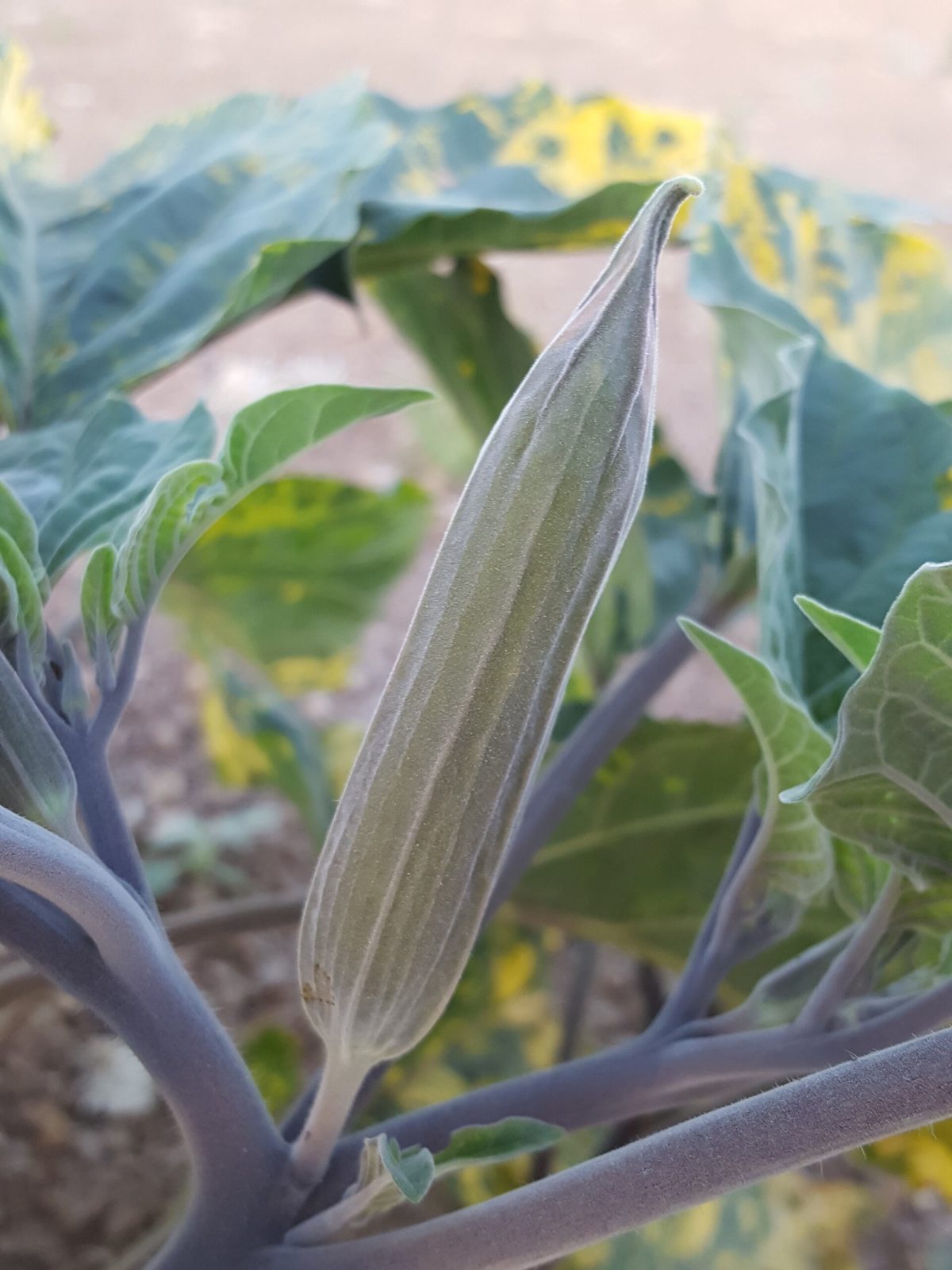
Photo: Alex Abair, CC BY 4.0 via Wikimedia Commons

Quick facts
| Light: | Full sun and part shade (full sun preferred)12 |
|---|---|
| Water: | Dry to medium111 source |
| Soil: | Well drained and occasionally dry11 source |
| Hardiness: | Zones 9a–11b21 source |
| Size: | 6 ft (1.83 m) × 3–6 ft (0.91–1.83 m)121 source |
| Growth rate: | Moderate221 source |
| Bloom: | May–Nov, White and purple24 |
| Cats: | Toxic to cats (1 source) 2 |
| Dogs: | Toxic to dogs (1 source) 2 |
| Native range: | MXE, MXN, NWM, TEX5 |
| Family: | Solanaceae |
How much light does a Sacred Thorn-apple need?
Sacred thorn-apple (Datura wrightii) does best in full sun, which one source defines as 6 or more hours of direct sunlight a day. It also accepts part shade. Full sun is the preferred exposure, and part shade is the second listed option. The light facts on file name only these two exposures: full sun and part shade.
How often to water a Sacred Thorn-apple
Water needs for this plant are listed as running from dry to medium. In other words, it is recorded in both dry and medium conditions. The soil drainage on file is well drained and occasionally dry. The same source names loam, sand and clay as soil types that are well drained. The range covers both the dry end and the medium end, and nothing wetter is listed.
Best soil for a Sacred Thorn-apple
Well drained soil conditions are listed for sacred thorn-apple (Datura wrightii). The second drainage description recorded for it is occasionally dry. The soil types named are loam, sand and clay. Both drainage descriptions are part of the record. Dry to medium water needs are listed alongside these soil conditions. No soil pH range is documented for this plant. It is classed as an herbaceous perennial.
- Soil drainage: Well drained and occasionally dry1
Hardiness and temperature
Hardiness zones 9a to 11b are listed for sacred thorn-apple. That range covers zones 9a, 9b, 10a, 10b, 11a and 11b. Its native range is recorded with the region codes MXE, MXN, NWM and TEX. In the lower 48 US states and in Puerto Rico, the plant has native status.
- Hardiness: Zones 9a–11b2
How to plant a Sacred Thorn-apple
Plan on USDA zones 9a to 11b when you choose a spot for this plant. Plan for a mature spread of 3 to 6 ft (0.91 to 1.83 m). It reaches a mature height of about 6 ft (1.83 m). Choose a site with full sun, or part shade if needed. The site should have well drained soil. Its growth rate is moderate. Maintenance is rated medium.
- Hardiness: Zones 9a–11b2
Winter care
Winter hardiness is recorded as USDA zones 9a to 11b. The warmest zones on that list are 11a and 11b. The coolest zone on that list is 9a. It is classed as an herbaceous perennial. No minimum temperature is documented for this plant. Zones outside 9a to 11b are not listed for this plant. If you garden in a colder zone than 9a, this plant falls outside its listed range.
- Hardiness: Zones 9a–11b2
How to propagate a Sacred Thorn-apple
Seed is the propagation method recorded for sacred thorn-apple. No other propagation method is listed for this plant. Seed started about three months ahead is described as making nice 4-inch (10 cm) pots. Start from seed rather than from cuttings or division, as those methods are not listed.
- Propagation: Seed1
Common problems
Pests recorded for sacred thorn-apple include tomato russet mite, whitefly, 28 spotted ladybird beetle, thrips and spiral nematode. Two diseases are recorded: xylella fastidiosa and tomato spotted wilt virus. Whitefly and thrips are two of the five pests on that list. The plant is reported as resistant to damage by deer.
| Problem | Kind |
|---|---|
| Tomato russet mite | Pest |
| Whitefly | Pest |
| 28 spotted ladybird beetle | Pest |
| Thrips | Pest |
| Spiral nematode | Pest |
| Xylella fastidiosa | Disease |
| Tomato spotted wilt virus | Disease |
Is Sacred Thorn-apple toxic to cats and dogs?
For cats, the recorded toxicity position is toxic. For dogs, the recorded toxicity position is also toxic. A cited extension source states that all parts of this plant are toxic if ingested. The same source advises keeping the plant out of reach of children and pets. Place it where cats and dogs cannot reach it. Both cats and dogs are covered by the same recorded value. No severity level is documented for cats or dogs.
Pet-safe alternatives
Recommended supplies
- Soil: a free-draining mix, and a pot with a drainage hole.
Questions and answers
- Is sacred thorn-apple toxic to pets?
- It is recorded as toxic to cats and toxic to dogs. A cited source states that all parts of this plant are toxic if ingested. The same source advises keeping it out of reach of children and pets.
- How much sun does sacred thorn-apple need?
- It does best in full sun and also accepts part shade. Full sun is the preferred exposure. Its water needs are listed as dry to medium.
- Which zones suit sacred thorn-apple?
- It is listed for USDA zones 9a to 11b. It is an herbaceous perennial that reaches about 6 ft (1.83 m) tall. Its spread is 3 to 6 ft (0.91 to 1.83 m).
Sources
- Lady Bird Johnson Wildflower Center (Native Plant Database). https://www.wildflower.org/plants/result.php?id_plant=DAWR2. Accessed 14 October 2026.
- NC State Extension Gardener Plant Toolbox. https://plants.ces.ncsu.edu/plants/datura-wrightii/. Accessed 14 October 2026.
- EPPO Global Database. https://gd.eppo.int/taxon/DATWR/pests. Accessed 14 October 2026.
- Lady Bird Johnson Wildflower Center (Native Plant Database). https://www.wildflower.org/plants/result.php?id_plant=dawr2. Accessed 21 October 2026.
- Royal Botanic Gardens, Kew (World Checklist of Vascular Plants). https://sftp.kew.org/pub/data-repositories/WCVP/wcvp.zip. Accessed 4 June 2026.
How this page was made
- Written with AI assistance from the sources listed on this page. AI is never the source of a fact.