Jimsonweed (Datura stramonium)
Formerly Datura lurida, Datura tatula, Datura hybrida
Give jimsonweed full sun and soil that drains well, and it grows rapidly. Its water need runs from dry to medium. It is an annual with white and purple flowers. Cats and dogs are both listed as having a problem with this plant.
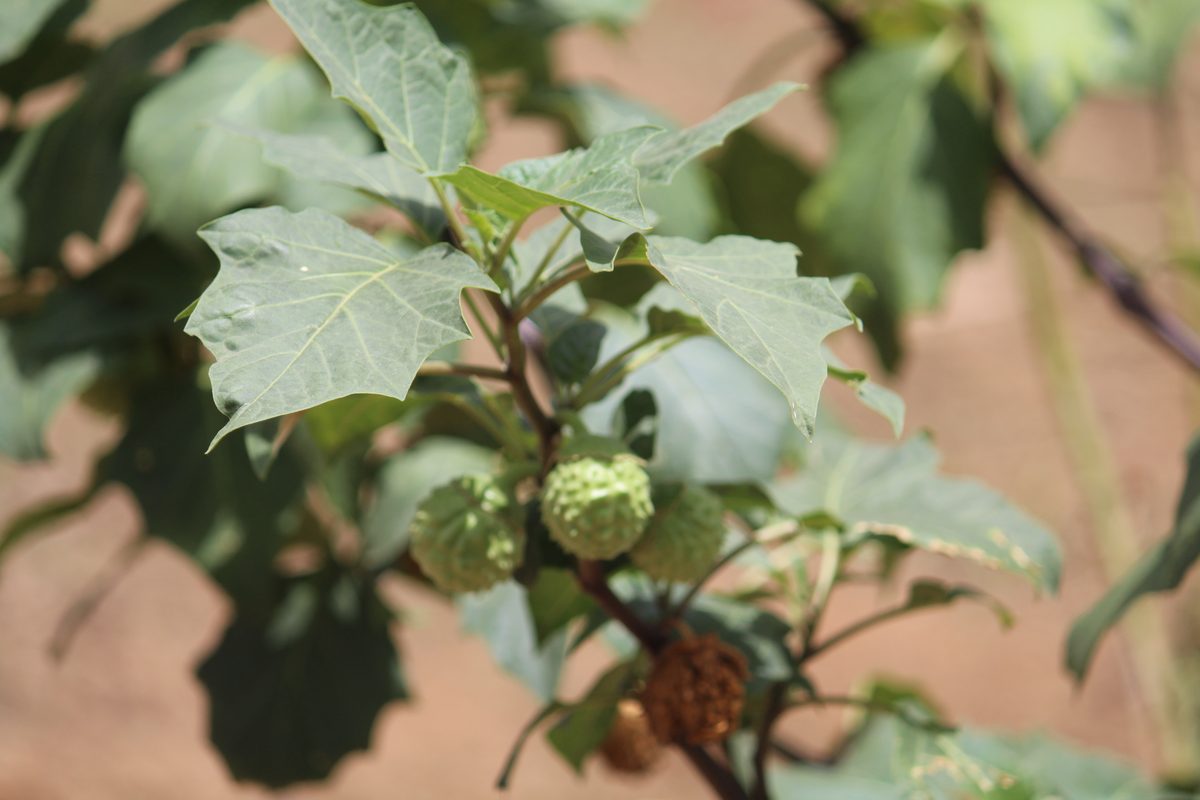
Photo: Danjuma Anthony, CC0 via Wikimedia Commons

Quick facts
| Light: | Full sun and part shade (full sun preferred)12 |
|---|---|
| Water: | Dry to medium11 source |
| Soil: | Well drained and moist; Tolerates acid, neutral and alkaline soil (NC State lists all three pH categories as suited)12 |
| Hardiness: | Zones 7a–9b11 source |
| Size: | 1.7–4 ft (0.53–1.22 m) × 1.7–4 ft (0.53–1.22 m)41 source |
| Growth rate: | Rapid144141 |
| Bloom: | Jul–Sep, White and purple121 source |
| Cats: | Toxic to cats (1 source) 1 |
| Dogs: | Toxic to dogs (1 source) 1 |
| Native range: | MXC, MXE, MXG, MXN, MXS, MXT5 |
| Family: | Solanaceae |
How much light does a Jimsonweed need?
Jimsonweed does best in full sun, which means six or more hours of direct sunlight a day. It will also grow in part shade. In partial shade the plant becomes leggier and has fewer flowers. The flowers are white and purple, and they appear from July to September.
How often to water a Jimsonweed
The water need of jimsonweed runs from dry to medium. The source describes the plant as drought-tolerant. It also says the plant thrives in moist, well-drained soils of almost any type. Good drainage is part of the picture, since the plant is listed for well drained and moist soil. The same source calls it a fast-growing plant.
- Water: Dry to medium1
Best soil for a Jimsonweed
Jimsonweed grows in soil that is listed as well drained and moist. The source says it thrives in moist, well-drained soils of almost any type. It adds that the plant prefers humus-rich soil. Datura is grown in full sun and well-drained soil, according to a university extension guide. No cited source records a preferred soil pH, so this page gives none.
Hardiness and temperature
Jimsonweed is listed for USDA hardiness zones 7a to 9b. The source names six zones: 7a, 7b, 8a, 8b, 9a and 9b. Zone 7a is the cold end of that range. Zone 9b is the warm end. The plant is recorded as an annual. It flowers from July to September. No cited source records a minimum temperature or a humidity preference for this plant.
- Hardiness: Zones 7a–9b1
How to plant a Jimsonweed
Choose a spot in full sun with well-drained soil. Allow room for a spread of 1.7 to 4 ft (0.53 to 1.22 m). Plants are erect and reach 1.7 to 4 ft (0.53 to 1.22 m) tall at maturity. The listed hardiness zones for this plant are 7a to 9b. Propagation is by seed. The US native status register records it as introduced in the lower 48 states, Hawaii and Puerto Rico. Its native range is recorded under the codes MXC, MXE, MXG, MXN, MXS and MXT.
- Hardiness: Zones 7a–9b1
Winter care
The hardiness listing for this plant runs from zone 7a to zone 9b. Its recorded plant type is annual. Seed is the listed propagation method. Blooms are recorded from July to September. Growth is rated as rapid. No cited source gives a frost threshold or a minimum temperature. The flowers are white and purple.
- Hardiness: Zones 7a–9b1
How to propagate a Jimsonweed
You propagate jimsonweed from seed. Seed is the only propagation method recorded for this plant. The plant is recorded as an annual. Its growth rate is rated as rapid. The flowers are white and purple, and they appear from July to September. Plants reach 1.7 to 4 ft (0.53 to 1.22 m) tall at maturity.
- Propagation: Seed1
Common problems
Spider mites, whiteflies, corn earworm, yellowstriped armyworm and tomato russet mite are recorded as common pests of jimsonweed. Cotton root rot is the disease recorded for this plant. Five pests and one disease make up the recorded problems.
| Problem | Kind |
|---|---|
| Spider mites | Pest |
| Whiteflies | Pest |
| Corn earworm | Pest |
| Yellowstriped armyworm | Pest |
| Tomato russet mite | Pest |
| Cotton root rot | Disease |
Is Jimsonweed toxic to cats and dogs?
Jimsonweed is listed as toxic to cats. It is also listed as toxic to dogs. The source phrases this as a problem for cats and a problem for dogs. The record on this page names no toxic parts and no severity for either animal. In the lower 48 states, Hawaii and Puerto Rico, the plant is recorded as introduced. Cats and dogs share the same toxic listing in this record. Its recorded plant type is annual.
Pet-safe alternatives
Recommended supplies
- Soil: a free-draining mix, and a pot with a drainage hole.
Questions and answers
- Is jimsonweed toxic to cats and dogs?
- Jimsonweed is listed as toxic to both cats and dogs. The source describes it as a problem for cats and a problem for dogs. Both animals carry the same listing.
- How much sun does jimsonweed need?
- Full sun is preferred, which means six or more hours of direct sunlight a day. It grows in part shade too, but the plants become leggier and have fewer flowers.
- Which hardiness zones suit jimsonweed?
- It is listed for USDA zones 7a to 9b. It is an annual that grows rapidly. Plants reach 1.7 to 4 ft (0.53 to 1.22 m) tall.
Sources
- NC State Extension Gardener Plant Toolbox. https://plants.ces.ncsu.edu/plants/datura-stramonium/. Accessed 6 October 2026.
- University of Wisconsin-Madison Division of Extension (Wisconsin Horticulture). https://hort.extension.wisc.edu/articles/datura/. Accessed 6 October 2026.
- EPPO Global Database. https://gd.eppo.int/taxon/DATST/pests. Accessed 23 September 2026.
- Utah State University Extension. https://extension.usu.edu/rangeplants/forbs-herbaceous/jimsonweed. Accessed 31 October 2026.
- Royal Botanic Gardens, Kew (World Checklist of Vascular Plants). https://sftp.kew.org/pub/data-repositories/WCVP/wcvp.zip. Accessed 4 June 2026.
How this page was made
- Written with AI assistance from the sources listed on this page. AI is never the source of a fact.