Pricklyburr (Datura metel)
Formerly Datura fastuosa, Datura chlorantha, Stramonium metel
Pricklyburr, Datura metel, grows in full sun to part shade, with full sun preferred. It is listed for USDA zones 8a to 11b. It reaches 2–3 ft (0.61–0.91 m) tall and 2–3 ft (0.61–0.91 m) wide. Its growth rate is slow. Its flowers are white, purple and yellow. It is toxic to both cats and dogs.
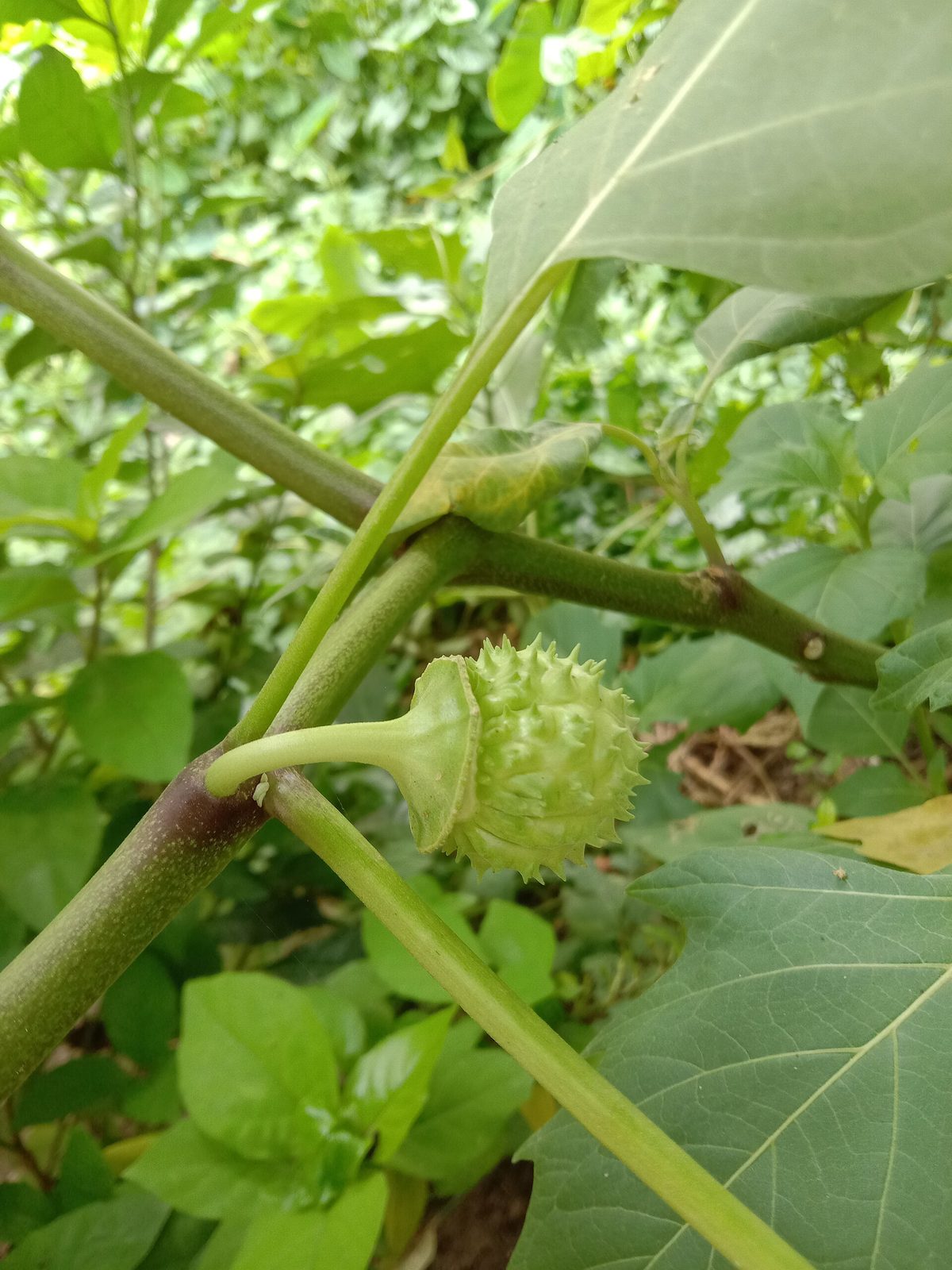
Photo: Billjones94, CC BY-SA 4.0 via Wikimedia Commons

Quick facts
| Size: | 2–3 ft (0.61–0.91 m) × 2–3 ft (0.61–0.91 m)41 source |
|---|---|
| Growth rate: | Slow121 source |
| Bloom: | May–Jun, Jul–Aug and Sep–Oct, White, purple and yellow5121 source |
| Cats: | Toxic to cats (1 source) 2 |
| Dogs: | Toxic to dogs (1 source) 2 |
| Native range: | MXC, MXS, MXT6 |
| Family: | Solanaceae |
How to propagate a Pricklyburr
The only propagation method on file for pricklyburr is seed. Seeds can be started indoors about 6 to 8 weeks before the last spring frost in your area. The plant type is recorded as annual. Its native range is recorded with the region codes MXC, MXS and MXT. Its listed hardiness range runs from zone 8a to zone 11b.
- Propagation: Seed1
Common problems
Watch for whiteflies, mealybugs and spider mites on this plant. Thrips and tomato russet mite are also recorded among its common pests. The common diseases on record are tomato spotted wilt virus, tobacco ringspot virus and Colombian datura virus. Three viruses are on record as common diseases of this plant.
| Problem | Kind |
|---|---|
| Whiteflies | Pest |
| Mealybugs | Pest |
| Spider mites | Pest |
| Thrips | Pest |
| Tomato russet mite | Pest |
| Tomato spotted wilt virus | Disease |
| Tobacco ringspot virus | Disease |
| Colombian datura virus | Disease |
Is Pricklyburr toxic to cats and dogs?
Pricklyburr, Datura metel, is toxic to cats. It is also toxic to dogs. The cited record lists it as a problem for cats. The cited record lists it as a problem for dogs as well. The recorded position for cats is toxic, and the recorded position for dogs is toxic. For both cats and dogs, the recorded position is toxic. The toxic parts, the severity and the clinical signs are not documented for either animal on this page.
Pet-safe alternatives
Questions and answers
- Is pricklyburr toxic to cats and dogs?
- Datura metel is listed as toxic to cats and toxic to dogs. It is recorded as a problem for cats and a problem for dogs. The listing covers both cats and dogs.
- How big does pricklyburr get?
- It grows 2–3 ft (0.61–0.91 m) tall and 2–3 ft (0.61–0.91 m) wide. Its habit is recorded as erect, spreading and mounding. Its growth rate is slow. The plant type is recorded as annual.
- What sun and zones suit pricklyburr?
- Full sun is preferred, and part shade is also listed. USDA zones 8a through 11b are listed for it. Its flowers are white, purple and yellow.
Sources
- NC State Extension Gardener Plant Toolbox. https://plants.ces.ncsu.edu/plants/datura-metel/common-name/devils-trumpet/. Accessed 14 October 2026.
- NC State Extension. https://plants.ces.ncsu.edu/plants/datura-metel/. Accessed 14 October 2026.
- EPPO Global Database. https://gd.eppo.int/taxon/DATME/pests. Accessed 14 October 2026.
- University of Wisconsin-Madison Division of Extension (Wisconsin Horticulture). https://hort.extension.wisc.edu/articles/datura/. Accessed 14 October 2026.
- Chicago Botanic Garden Plant Finder. https://www.chicagobotanic.org/plant-information/plant-finder/datura-metel-ballerina-purple-ballerina-purple-angels-trumpet. Accessed 21 October 2026.
- Royal Botanic Gardens, Kew (World Checklist of Vascular Plants). https://sftp.kew.org/pub/data-repositories/WCVP/wcvp.zip. Accessed 4 June 2026.
How this page was made
- Written with AI assistance from the sources listed on this page. AI is never the source of a fact.