Sago Palm (Cycas revoluta)
Formerly Cycas aurea, Cycas miquelii, Epicycas miquelii
Give your sago palm full sun or part shade, and keep the soil moist and well drained. Its water need runs from dry to medium. Sago palm is listed as toxic to both cats and dogs. It is hardy in zones 9a–12b.
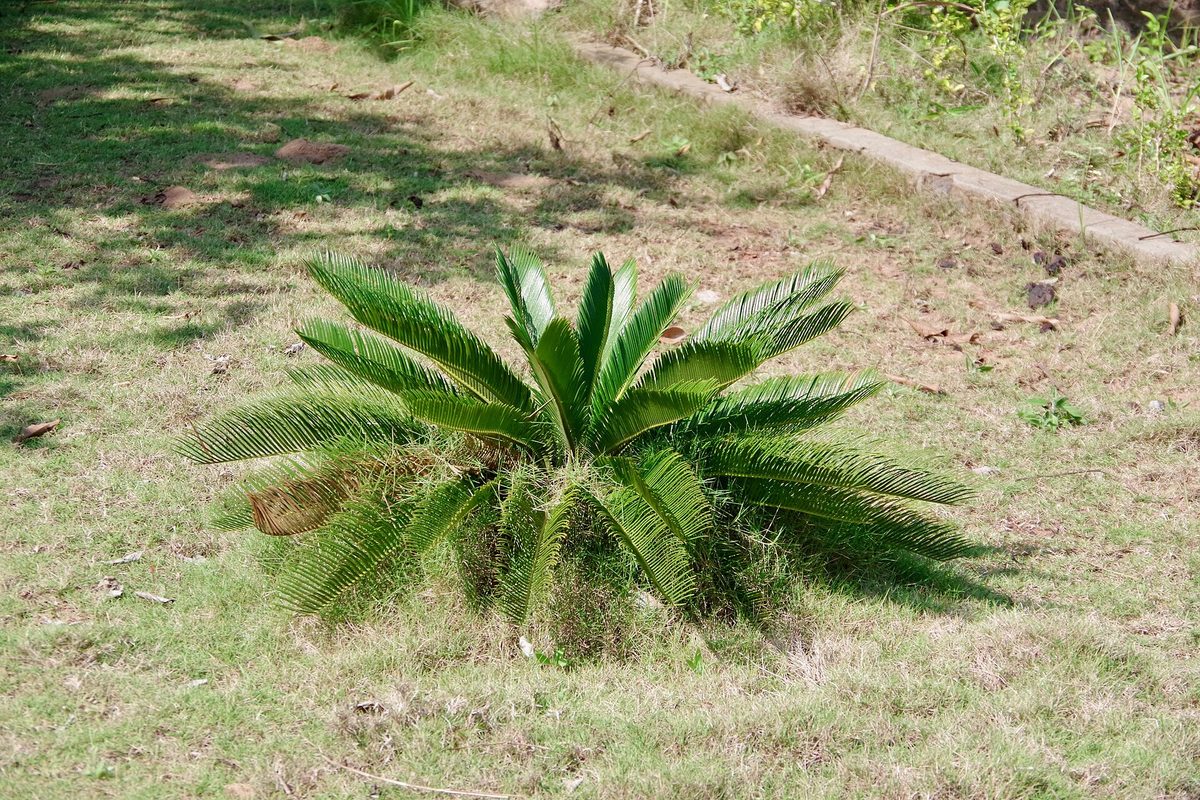
Photo: Fawaz.tairou, CC BY 4.0 via Wikimedia Commons

Quick facts
| Light: | Full sun and part shade (full sun preferred)11 source |
|---|---|
| Water: | Dry to medium21 source |
| Soil: | Well drained and moist21 source |
| Hardiness: | Zones 9a–12b21 source |
| Size: | 15 ft (4.57 m) × 3–10 ft (0.91–3.05 m)121 source |
| Growth rate: | Slow2312 |
| Cats: | Toxic to cats 72 |
| Dogs: | Toxic to dogs 78 |
| Native range: | CHS, JAP, NNS, TAI9 |
| Family: | Cycadaceae |
How much light does a Sago Palm need?
Outdoors, sago palm grows well in full sun or partial shade, and full sun is the preferred exposure. Its leaves grow larger in more shaded situations. Indoors, it does best in bright, indirect light, and it tolerates medium light. Filtered sunlight for 4 to 6 hours per day is recommended for a plant grown indoors.
- Light: Full sun and part shade (full sun preferred)1
How often to water a Sago Palm
Water needs for sago palm run from dry to medium. Aim for soil that is moist and well drained. No cited fact on this page gives a watering schedule in days. Check how moist the soil is and whether it drains well, rather than following the calendar.
- Water: Dry to medium2
Best soil for a Sago Palm
Sago palm grows best in soil that is both well drained and moist, according to its listed soil drainage. Good drainage is the specific quality named for the soil of this plant. The water need for the same plant is listed as dry to medium, which is a range rather than a single setting. Soil that is moist and well drained is the description to match when you check your bed or pot.
- Soil drainage: Well drained and moist2
Hardiness and temperature
The hardiness range for sago palm runs from zone 9a to zone 12b. The plant will not survive if the temperature drops below 15.8 °F (-9 °C). Winter lows below that figure fall outside what the plant is recorded to survive. If your zone is colder than 9a, the plant is outside its listed hardiness range.
Pruning a Sago Palm
The pruning type recorded for sago palm is to remove dead growth only. Only remove leaves that are completely dead and loose, along with badly damaged or diseased leaves and fruit. This page records no other pruning type, such as shaping or cutting back.
- Pruning: Remove dead growth only3
How to plant a Sago Palm
Plant sago palm outdoors in zones 9a to 12b. Full sun or partial shade both suit it outdoors. Pick a spot with soil that is well drained. Leave room for a spread of 3 to 10 ft (0.91 to 3.05 m). The plant can reach up to 15 ft (4.57 m) in height in 50 years. Its growth rate is slow, and it is evergreen.
- Hardiness: Zones 9a–12b2
Winter care
The hardiness range for sago palm runs from zone 9a to zone 12b. The plant will not survive if the temperature drops below 15.8 °F (-9 °C). Winter lows below that figure fall outside what the plant is recorded to survive. The plant is evergreen, and its growth rate is slow. If your zone is colder than 9a, the plant is outside its listed hardiness range.
Common problems
Recorded pests of sago palm are mealybugs, cycad aulacaspis scale, cycad scale and oleander scale. The recorded disease is phytophthora root and crown rot. That makes four pests, three of them scales by name, and one disease on record for this plant.
| Problem | Kind |
|---|---|
| Mealybugs | Pest |
| Cycad aulacaspis scale | Pest |
| Cycad scale | Pest |
| Oleander scale | Pest |
| Phytophthora root crown rot | Disease |
Is Sago Palm toxic to cats and dogs?
Sago palm is listed as toxic to cats. The ASPCA lists it as toxic to cats, and NC State Extension describes the plant as having high severity poison characteristics. Sago palm is also listed as toxic to dogs. The ASPCA lists it as toxic to dogs, and Pet Poison Helpline says it contains cycasin, a highly toxic plant chemical.
Pet-safe alternatives
Recommended supplies
- Soil: a free-draining mix, and a pot with a drainage hole.
Questions and answers
- Is sago palm toxic to cats and dogs?
- Sago palm is listed as toxic to both cats and dogs by the ASPCA. Pet Poison Helpline says it contains cycasin, a highly toxic plant chemical. NC State Extension describes the plant as having high severity poison characteristics.
- How much light does a sago palm need?
- Outdoors, sago palm grows well in full sun or partial shade. Its leaves grow larger in more shaded situations. Indoors, bright, indirect light suits it, and it tolerates medium light.
- How cold can a sago palm get?
- The plant will not survive if the temperature drops below 15.8 °F (-9 °C). It is listed for hardiness zones 9a to 12b. In a colder zone, it is outside its listed hardiness range.
Sources
- UF/IFAS Extension (EDIS). https://ask.ifas.ufl.edu/publication/FR316. Accessed 14 October 2026.
- NC State Extension Gardener Plant Toolbox. https://plants.ces.ncsu.edu/plants/cycas-revoluta/. Accessed 14 October 2026.
- Clemson Cooperative Extension Home & Garden Information Center. https://hgic.clemson.edu/factsheet/palms-cycads/. Accessed 21 October 2026.
- UC Statewide Integrated Pest Management Program. https://ipm.ucanr.edu/home-and-landscape/sago-palm/. Accessed 14 October 2026.
- EPPO Global Database. https://gd.eppo.int/taxon/CCYRE/pests. Accessed 14 October 2026.
- UC Statewide Integrated Pest Management Program. https://ipm.ucanr.edu/PMG/GARDEN/PLANTS/sagopalm.html. Accessed 14 October 2026.
- ASPCA Animal Poison Control Center. https://www.aspca.org/pet-care/aspca-poison-control/toxic-and-non-toxic-plants/sago-palm. Accessed 14 October 2026.
- Pet Poison Helpline. https://www.petpoisonhelpline.com/poison/sago-palm/. Accessed 14 October 2026.
- Royal Botanic Gardens, Kew (World Checklist of Vascular Plants). https://sftp.kew.org/pub/data-repositories/WCVP/wcvp.zip. Accessed 4 June 2026.
How this page was made
- Written with AI assistance from the sources listed on this page. AI is never the source of a fact.