Black Baneberry (Actaea racemosa)
Formerly Cimicifuga racemosa, Macrotrys racemosa, Thalictrodes racemosa
Grow black baneberry in part shade, though full shade is also listed, and give it medium water. It is listed as toxic to both cats and dogs. Pet Poison Helpline says eating baneberry causes mouth and stomach irritation in pet animals. It grows 4–7 ft (1.22–2.13 m) tall.
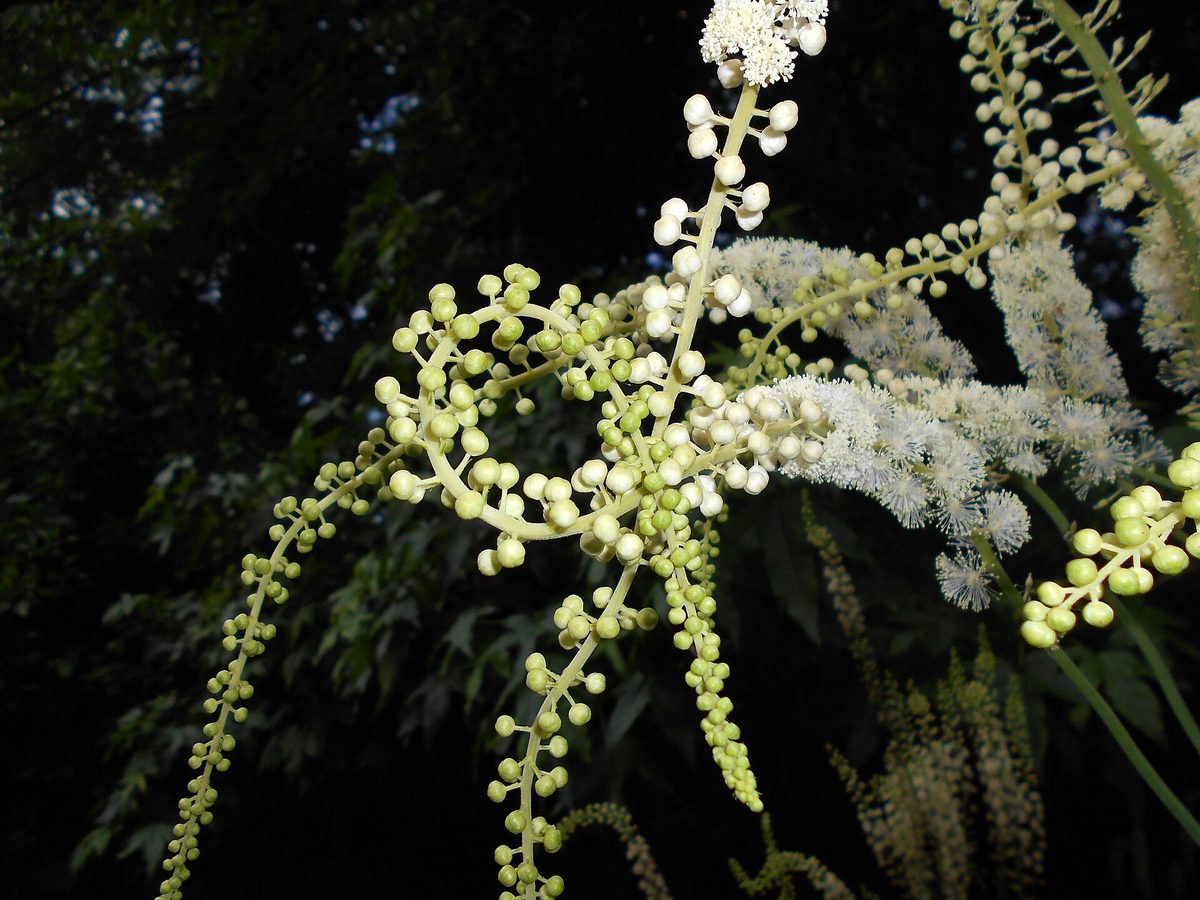
Photo: Salicyna, CC BY-SA 4.0 via Wikimedia Commons

Quick facts
| Light: | Part shade and full shade (part shade preferred)123433 |
|---|---|
| Water: | Medium21 source |
| Soil: | Well drained and moist1536 |
| Hardiness: | Zones 3a–8b131 source |
| Size: | 4–7 ft (1.22–2.13 m) × 2–4 ft (0.61–1.22 m)1351 source |
| Growth rate: | Moderate131 source |
| Bloom: | May–Aug, White123 |
| Cats: | Toxic to cats (1 source) 9 |
| Dogs: | Toxic to dogs (1 source) 9 |
| Family: | Ranunculaceae |
How much light does a Black Baneberry need?
Black baneberry prefers part shade outdoors. Full shade is also listed as suitable. Part shade means direct sunlight for only part of the day, about 2 to 6 hours. The plant ideally wants 2 to 3 hours of morning sun. The minimum listed is 2 hours of sun a day.
How often to water a Black Baneberry
Black baneberry is listed with a medium water use rating. Both the lowest and the highest water need on file are medium. The soil listed for this plant is moist and well drained. Good drainage is named in that soil description, and so is moisture. Those two soil traits, moist and well drained, are listed together.
- Water: Medium2
Best soil for a Black Baneberry
Black baneberry is listed for moist, well drained soil. Good drainage is named in the listing, and so is moisture. Well drained comes first in the list, with moist as the second trait. Its water use is rated medium, which is the only moisture rating on file. No soil pH range is documented for this plant. Planting in a spot that stays moist and drains well matches the listing. Those two traits describe the soil, and the listing names no others.
Hardiness and temperature
Black baneberry is listed for USDA hardiness zones 3a through 8b. The listing names each half zone from 3a and 3b up through 8a and 8b. Zone 3a is the coldest end of that range. Zone 8b is the warmest end of that range. No cited source records a minimum temperature for this plant. Zones 3a to 8b cover 12 half-zone steps. A site in zone 9 or warmer falls outside the listed range.
Pruning a Black Baneberry
The pruning type listed for black baneberry is removing dead growth only. The fruits are toxic, and last year's dried stalks stay in the garden the following spring if the plants are not cut back in winter. Cutting the plants back in winter clears those dried stalks.
- Pruning: Remove dead growth only7
How to plant a Black Baneberry
Plant it in USDA zones 3a through 8b, the range listed for the species. Allow for a spread of 2–4 ft (0.61–1.22 m) when spacing plants. Expect a mature height of 4–7 ft (1.22–2.13 m). Choose a spot in part shade or full shade. The soil should be moist and well drained. The plant has an erect habit.
Winter care
Winter care depends on your zone, and the listed range runs from 3a to 8b. No cited source records a minimum temperature for black baneberry. Plants that are not cut back in winter keep the previous year's dried stalks into the following spring. Cutting the plants back in winter removes those dried stalks before spring. Zone 3a is the coldest zone in the listed range. Zone 8b is the warmest zone in that range. The listed hardiness range spans 12 half-zone steps.
How to propagate a Black Baneberry
Black baneberry can be propagated by seed or by division. Division is listed as a root division method. Seeds are the other listed method. Those two methods are the only ones on file. Dividing an existing plant and sowing seed are the two listed ways to make more plants. Seed and division appear together in the propagation listing. No timing, depth or temperature is documented for either method.
Common problems
Rust and leaf spot are listed as occasional problems for black baneberry. Both of the disease entries are described as occasional. The pest listed for this plant is the root-knot nematode. The listing gives the name Meloidogyne chitwoodi for it. Rust and leaf spot are the only diseases listed.
| Problem | Kind |
|---|---|
| Root knot nematode | Pest |
| Rust | Disease |
| Leaf spot | Disease |
Is Black Baneberry toxic to cats and dogs?
Black baneberry is listed as toxic to cats. Pet Poison Helpline says eating baneberry causes mouth and gastrointestinal irritation in pet animals. It is also listed as toxic to dogs. Pet Poison Helpline says all parts of the baneberry plant contain glycoside phytotoxins. The fruits are toxic too. Cats and dogs are both listed as toxic, with the same position for each. No severity grade is recorded for either animal in the facts on file.
Pet-safe alternatives
Recommended supplies
- Soil: a free-draining mix, and a pot with a drainage hole.
Questions and answers
- Is black baneberry toxic to cats and dogs?
- It is listed as toxic to both cats and dogs. Pet Poison Helpline says all parts of the baneberry plant contain glycoside phytotoxins. Eating baneberry causes mouth and gastrointestinal irritation in pet animals.
- How much light does black baneberry need?
- It prefers part shade, and full shade is also listed. The minimum listed is 2 hours of sun a day. Ideally it wants 2 to 3 hours of morning sun.
- How big does black baneberry get?
- It reaches 4–7 ft (1.22–2.13 m) tall. Its spread is 2–4 ft (0.61–1.22 m) at maturity. Its habit is erect and its growth rate is moderate. That height and spread are listed for mature plants.
Sources
- NC State Extension Gardener Plant Toolbox. https://plants.ces.ncsu.edu/plants/actaea-racemosa/common-name/black-cohosh/. Accessed 25 October 2026.
- Lady Bird Johnson Wildflower Center. https://www.wildflower.org/plants/result.php?id_plant=ACRAR. Accessed 25 October 2026.
- NC State Extension Gardener Plant Toolbox. https://plants.ces.ncsu.edu/plants/actaea-racemosa/. Accessed 25 October 2026.
- Penn State Extension. https://extension.psu.edu/programs/master-gardener/counties/york/native-plants/fact-sheets/native-plants-for-mid-atlantic-landscapes-shade-to-part-shade-wet-to-moist-soil. Accessed 25 October 2026.
- University of Minnesota Extension. https://extension.umn.edu/garden-and-home/yard-and-garden/gardening-in-minnesota/gardening-in-the-shade. Accessed 25 October 2026.
- University of Illinois Extension. https://web.extension.illinois.edu/hortanswers/plantdetail.cfm?PlantID=715&PlantTypeID=2. Accessed 25 October 2026.
- Chicago Botanic Garden. https://www.chicagobotanic.org/plant-collections/plant-finder/actaea-racemosa-black-cohosh. Accessed 30 October 2026.
- EPPO Global Database. https://gd.eppo.int/taxon/AATRA/pests. Accessed 27 October 2026.
- Pet Poison Helpline. https://www.petpoisonhelpline.com/poison/baneberry/. Accessed 25 October 2026.
How this page was made
- Written with AI assistance from the sources listed on this page. AI is never the source of a fact.