New England Aster (Symphyotrichum novae-angliae)
Formerly Aster novae-angliae, Aster spurius, Lasallea novae-angliae
Keep New England aster in full sun, which is its preferred light. Part shade is also listed. Water needs run from medium to wet. It grows 3–6 ft (0.91–1.83 m) tall. Blooms appear from August to October. Its flowers are purple, yellow, blue and white. No toxicity position for cats or dogs is documented here.
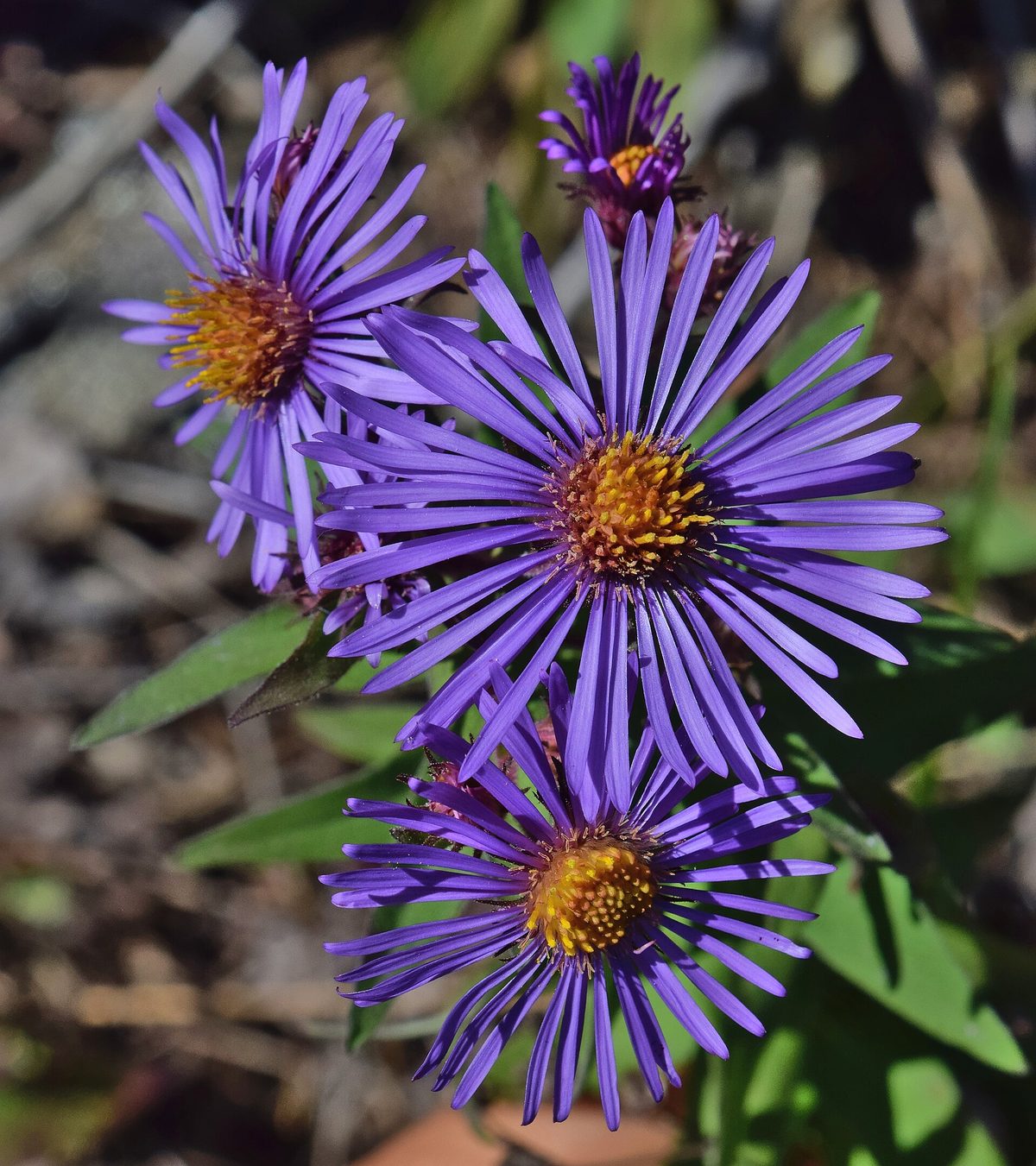
Photo: The Cosmonaut, CC BY-SA 2.5 via Wikimedia Commons

Quick facts
| Light: | Full sun and part shade (full sun preferred)12345 |
|---|---|
| Water: | Medium to wet61 source |
| Soil: | Well drained and moist34 |
| Hardiness: | Zones 4a–8b11 source |
| Size: | 3–6 ft (0.91–1.83 m) × 1–3 ft (0.3–0.91 m)351 |
| Growth rate: | Moderate11 source |
| Bloom: | Aug–Oct, Purple, yellow, blue and white124 |
| Cats: | Not documented by major sources |
| Dogs: | Not documented by major sources |
| Family: | Asteraceae |
How much light does a New England Aster need?
Full sun, defined as 6 or more hours of direct sunlight a day, is the preferred exposure for New England aster. Part shade is also listed as an exposure for this plant. Part shade means direct sunlight for only part of the day, roughly 2 to 6 hours. The minimum on file is 2 hours of direct sun a day.
How often to water a New England Aster
Medium to wet is the moisture range listed for New England aster. The soil it grows in should be both well drained and moist. Wet conditions mark the top of that range, and medium moisture marks the bottom. No watering schedule in days is documented for this plant at this time. Because the sources give a range of conditions and no fixed number of days, this section sticks to that range. A reader checking the bed can compare it against the medium-to-wet range and the well drained, moist soil described above. That is everything the verified facts say about watering this aster.
- Water: Medium to wet6
Best soil for a New England Aster
Soil for New England aster should be well drained and moist. Both conditions appear in the drainage listing, with well drained named first and moist second. The moisture range on file for the plant itself runs from medium to wet. Wet sits at the top of that range, and medium sits at the bottom. Soil that is well drained to moist is the guidance given for asters in general.
Hardiness and temperature
The listed hardiness range for New England aster is Zones 4a–8b. Every half-zone from 4a through 8b is named: 4a, 4b, 5a, 5b, 6a, 6b, 7a, 7b, 8a and 8b. Zone 4a is the coldest of these and 8b is the warmest. Half-zones such as 4a and 4b are listed separately rather than combined.
- Hardiness: Zones 4a–8b1
Pruning a New England Aster
Pruning for New England aster is limited to light shaping. Pinching back should stop ahead of the fall blooms. Blooms open from August to October. The plant has an erect habit and reaches 3–6 ft (0.91–1.83 m) tall. Its width at maturity is 1–3 ft (0.3–0.91 m).
- Pruning: Light shaping3
How to plant a New England Aster
Zones 4a–8b are listed for New England aster. Full sun is preferred, and part shade is also listed. The soil should be well drained and moist. A mature plant is 3–6 ft (0.91–1.83 m) tall and 1–3 ft (0.3–0.91 m) wide. Its habit is erect, and its growth rate is moderate. Resistance to deer browse is reported, and one listing calls it moderate.
- Hardiness: Zones 4a–8b1
Winter care
Zones 4a–8b are the hardiness zones listed for New England aster. Zone 4a is the coldest zone in that listing. Zone 8b is the warmest zone in that listing. The zones run in half-steps, from 4a, 4b and 5a up through 8a and 8b. This listing covers ten half-zones in all.
- Hardiness: Zones 4a–8b1
How to propagate a New England Aster
Seed and division are the two propagation methods listed for New England aster. The roots should be divided every several years to keep the plant growing vigorously. Seed is the other listed method. A mature plant is 1–3 ft (0.3–0.91 m) wide. Its listed growth rate is moderate. Its height at maturity is 3–6 ft (0.91–1.83 m).
Common problems
Insect problems named for New England aster are aphids, spider mites and leaf miners. These are listed as pests that are sometimes a problem. The plant can be susceptible to powdery mildew. Deer resistance is reported, with the plant described as resistant to deer browse.
| Problem | Kind |
|---|---|
| Aphids | Pest |
| Spider mites | Pest |
| Leaf miners | Pest |
| Powdery mildew | Disease |
Is New England Aster toxic to cats and dogs?
Recommended supplies
- Soil: a free-draining mix, and a pot with a drainage hole.
Questions and answers
- How much sun does New England aster need?
- Full sun is preferred, meaning 6 or more hours of direct sunlight a day. Part shade is also listed, with direct sun for only part of the day, roughly 2 to 6 hours.
- When does New England aster bloom?
- It blooms from August to October. One listing describes up to 100 purple rays around many yellow disc flowers, and another says the color varies from lavender to blue to white.
- How tall does New England aster grow?
- It reaches 3–6 ft (0.91–1.83 m) tall and 1–3 ft (0.3–0.91 m) wide. Its habit is erect, and its growth rate is moderate.
Sources
- NC State Extension Gardener Plant Toolbox. https://plants.ces.ncsu.edu/plants/symphyotrichum-novae-angliae/. Accessed 25 October 2026.
- University of Minnesota Extension. https://extension.umn.edu/garden-and-home/yard-and-garden/lawns-and-landscapes-in-minnesota/rain-gardens. Accessed 25 October 2026.
- Clemson Cooperative Extension HGIC. https://hgic.clemson.edu/new-england-asters-symphyotrichum-novae-angliae-how-to-grow-and-care-for-new-england-asters/. Accessed 25 October 2026.
- Lady Bird Johnson Wildflower Center. https://www.wildflower.org/plants/result.php?id_plant=syno2. Accessed 25 October 2026.
- Penn State Extension. https://extension.psu.edu/rain-garden-plants-new-england-aster. Accessed 25 October 2026.
- University of Illinois Extension (HortAnswers). https://web.extension.illinois.edu/hortanswers/plantdetail.cfm?PlantID=814&PlantTypeID=14. Accessed 25 October 2026.
How this page was made
- Written with AI assistance from the sources listed on this page. AI is never the source of a fact.