Withania (Withania somnifera)
Formerly Physalis somnifera, Physaloides somnifera, Physalis alpini
To keep withania alive, give it full sun and water it only when the soil dries out. Its watering range is dry to medium. It does not like wet feet. It is a small shrub or herb about 3 ft (0.91 m) tall. Its growth rate is rapid. It is listed for USDA zones 8a to 12b. Toxicity to cats and dogs is not documented here.
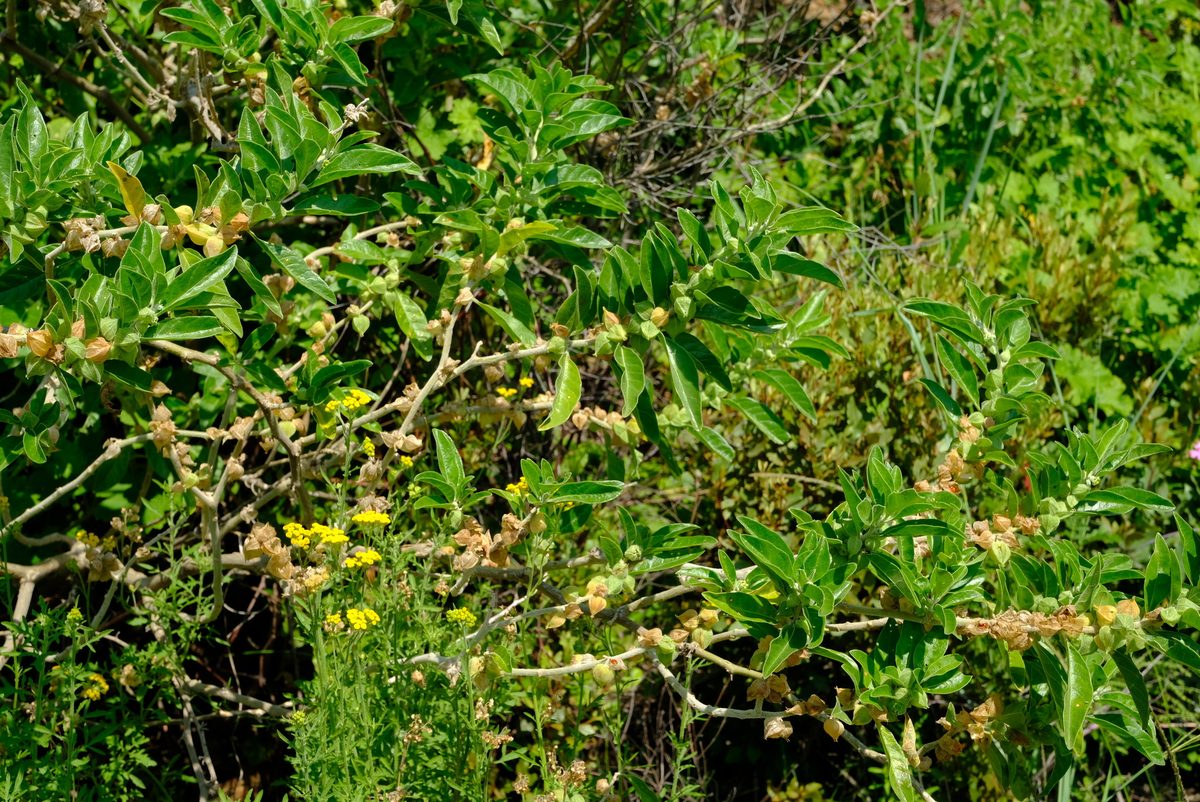
Photo: botaneek, CC BY-SA 4.0 via Wikimedia Commons

Quick facts
| Light: | Full sun11 source |
|---|---|
| Water: | Dry to medium11 source |
| Soil: | Well drained, moist and occasionally dry21 source |
| Hardiness: | Zones 8a–12b11 source |
| Size: | 3 ft (0.91 m)21 source |
| Growth rate: | Rapid114331 source |
| Bloom: | Green131 source |
| Cats: | Not documented by major sources |
| Dogs: | Not documented by major sources |
| Native range: | AFG, ALG, ANG, ASS, BAN, BOT, BUR, CHA, CHC, CHN, CMN, CNY, CPP, CVI, CYP, DJI, EAI, EGY, ERI, ETH, GRC, GST, IND, IRN, KEN, KRI, LBS, LBY, LES, MLI, MLW, MOR, MOZ, MTN, MYA, NAM, NAT, NGA, NGR, OFS, OMA, PAK, PAL, RWA, SAR, SAU, SIC, SIN, SOM, SPA, SRL, SUD, SWZ, TAN, TUN, TUR, TVL, UGA, WHM, YEM, ZAI, ZAM, ZIM5 |
| Family: | Solanaceae |
How much light does a Withania need?
Full sun is the outdoor light listed for this plant, which the source defines as six or more hours of direct sunlight a day. Full sun is also the only outdoor value listed. Indoors, the record also lists direct sun. No shade tolerance is listed for indoor growing, and full sun is the only outdoor value. A spot with six or more hours of direct sunlight matches both entries.
- Light: Full sun1
How often to water a Withania
Wait until the soil dries out before you water this plant. The listed range runs from dry to medium moisture. The source adds that it does not like wet feet. Check whether the soil has dried out before you water, rather than following a fixed schedule. The soil entry lists well drained, moist and occasionally dry conditions.
- Water: Dry to medium1
Best soil for a Withania
The source says it prefers well-drained, sandy to rocky soil. The pH it names is acidic to neutral, and no number is given. The drainage entry lists three conditions: well drained, moist and occasionally dry. Sandy to rocky is a texture range, and acidic to neutral is a pH range. Water needs run from dry to medium, and the plant does not like wet feet. Wet feet are the condition the source says the plant dislikes.
- Soil drainage: Well drained, moist and occasionally dry2
Hardiness and temperature
Zones 8a to 12b make up the hardiness range recorded for this plant. The source lists ten sub-zones in all, from 8a up to 12b. The range runs from zone 8a at the cold end to 12b at the warm end. In zones colder than 8 it is grown as an annual. It is described as a small shrub or herb.
- Hardiness: Zones 8a–12b1
How to plant a Withania
Plant it where you can give full sun, meaning six or more hours of direct sunlight a day. It is listed for zones 8a to 12b. In zones colder than 8 it is grown as an annual. Expect an upright plant about 3 ft (0.91 m) tall. Its growth rate is rapid. Choose well-drained, sandy to rocky soil with acidic to neutral pH. Its flowers are pale green.
- Hardiness: Zones 8a–12b1
Winter care
Zone 8a is the coldest zone listed for this plant. Where winters fall in a colder zone than 8, the plant is grown as an annual. It is described as a small shrub or herb. The listed zone range continues up to 12b. Its water entry says to water only when the soil dries out.
- Hardiness: Zones 8a–12b1
How to propagate a Withania
Seed and stem cuttings are the two propagation methods listed for this plant. You can start new plants from seed. You can also take stem cuttings. The plant is a small shrub or herb, and in zones colder than 8 it is grown as an annual. It is rated for rapid growth.
Common problems
Two diseases are recorded for this plant: stem rot and root rot. The source states that stem and root rot can affect it. Its watering entry says it does not like wet feet. The listed watering range runs from dry to medium.
- Common diseases: stem rot and root rot1
| Problem | Kind |
|---|---|
| Stem rot | Disease |
| Root rot | Disease |
Is Withania toxic to cats and dogs?
Recommended supplies
- Soil: a free-draining mix, and a pot with a drainage hole.
Questions and answers
- How much sun does withania need?
- Full sun is listed, which the source defines as six or more hours of direct sunlight a day. Indoors, the record also lists direct sun. No shade tolerance is listed for indoor growing.
- How often should I water withania?
- The source gives a condition rather than a schedule: water only when the soil dries out. The listed range is dry to medium, and the plant does not like wet feet. Its soil entry lists well drained, moist and occasionally dry conditions.
- Which zones can withania grow in?
- Zones 8a to 12b are listed for it. In zones colder than 8 it is grown as an annual. It is described as a small shrub or herb. It grows upright to about 3 ft (0.91 m).
Sources
- NC State Extension Gardener Plant Toolbox. https://plants.ces.ncsu.edu/plants/withania-somnifera/. Accessed 23 September 2026.
- Oregon State University Extension Service. https://extension.oregonstate.edu/catalog/em-9349-medicinal-herb-production-pacific-northwest. Accessed 12 October 2026.
- NC State Extension Gardener Plant Toolbox. https://plants.ces.ncsu.edu/plants/withania-somnifera/common-name/ashwagandha/. Accessed 13 October 2026.
- NC State Extension Gardener Plant Toolbox. https://plants.ces.ncsu.edu/plants/withania-somnifera/common-name/indian-ginseng/. Accessed 13 October 2026.
- Royal Botanic Gardens, Kew (World Checklist of Vascular Plants). https://sftp.kew.org/pub/data-repositories/WCVP/wcvp.zip. Accessed 4 June 2026.
How this page was made
- Written with AI assistance from the sources listed on this page. AI is never the source of a fact.