Garden Tomato (Solanum lycopersicum)
Formerly Lycopersicon esculentum, Lycopersicon lycopersicum, Amatula flava
Full sun suits tomato plants best outdoors, with at least six to eight hours of direct light a day. Water consistently, keeping the soil at a medium to medium-wet level. Letting it swing between dry and soaked leads to blossom end rot and split fruit. The plant is toxic to both cats and dogs.
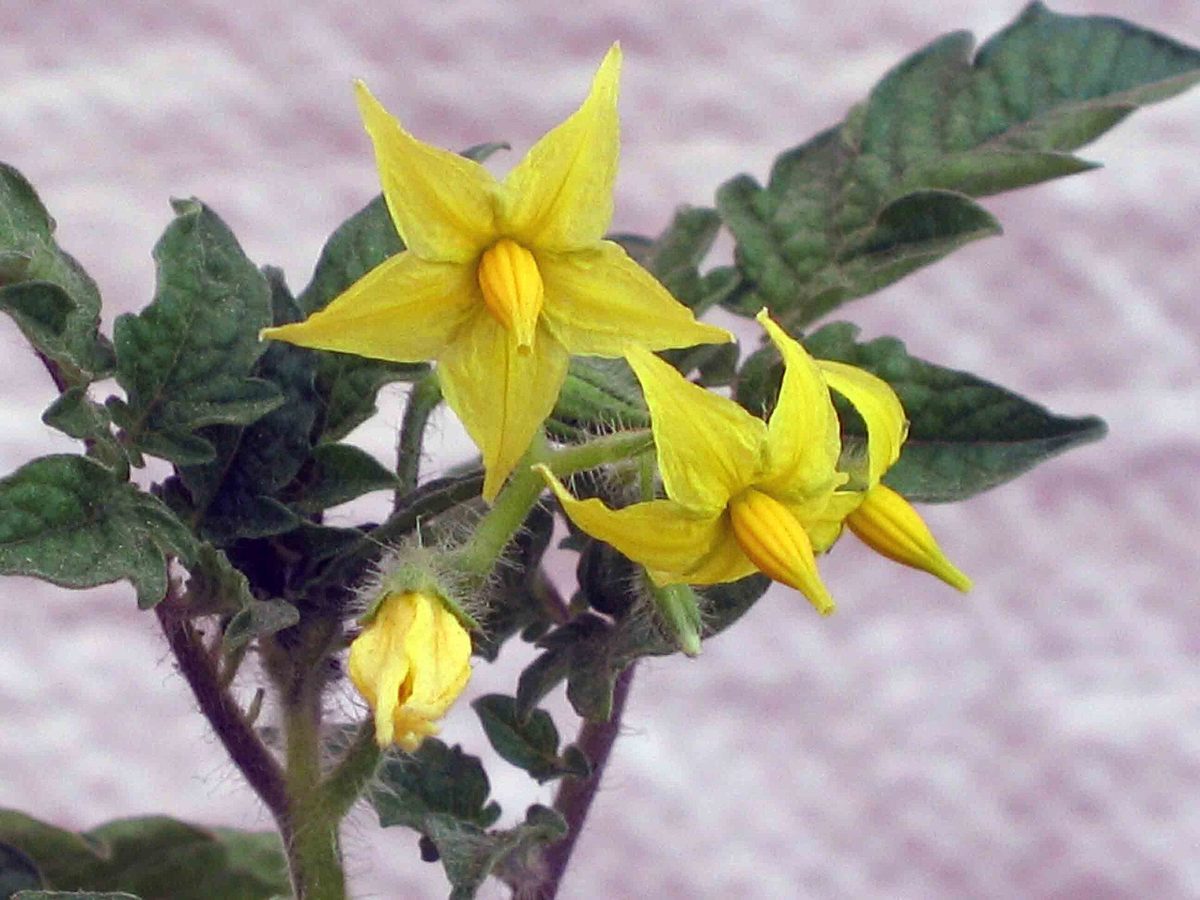
Photo: 阿橋 HQ, CC BY-SA 2.0 via Wikimedia Commons

Quick facts
| Light: | Full sun12 |
|---|---|
| Water: | Medium to wet31 source |
| Soil: | Well drained and moist; pH 6–6.8345 |
| Size: | 1–10 ft (0.3–3.05 m) × 1–4 ft (0.3–1.22 m)31 source |
| Growth rate: | Rapid31 source |
| Bloom: | Yellow31 source |
| Cats: | Toxic to cats (1 source) 10 |
| Dogs: | Toxic to dogs (1 source) 10 |
| Native range: | PER11 |
| Family: | Solanaceae |
How much light does a Garden Tomato need?
Give your tomato plants full sun outdoors, with at least six to eight hours of direct sunlight every day. Indoors, set them where they get direct, high light, ideally on a sunny, south-facing windowsill. Without a bright window like that, add supplemental grow lights. The plant needs at least six hours of direct sun a day for the best yields.
How often to water a Garden Tomato
Keep soil moisture at a medium to medium-wet level for this plant, not soggy and not dry. Water on a consistent schedule, because letting the soil swing from dry to soaked is what causes blossom end rot and splits the fruit. Keeping that level steady, instead of letting it swing between dry and wet, is what avoids both problems in the fruit.
- Water: Medium to wet3
Best soil for a Garden Tomato
Well-drained soil that still holds some moisture suits tomato plants best, neither bone dry nor waterlogged. Choose a planting site where no tomatoes, peppers, eggplant, or potatoes have been grown within at least the past three years. Aim for a slightly acidic soil, with a pH between 6.0 and 6.8, though the plant can also grow in soil that leans slightly alkaline.
Pruning a Garden Tomato
Pruning for this plant is light and simple, rather than a heavy cutback. The usual method is to prune the plant down to one or two main stems. That light, simple shaping, rather than a heavy cutback, is the pruning style recommended for this plant.
- Pruning: Light shaping4
When to plant Garden Tomato
Sow tomato seeds indoors approximately five to six weeks before your region's last expected spring frost date. Transplant seedlings outdoors around that same last-frost date, but only once the soil temperature has warmed to at least 55°F (12.8°C).
| Step | When |
|---|---|
| Start indoors | 5–6 weeks before last frost |
| Transplant | at last spring frost, soil at least 55 °F (12.8 °C) |
When and how to harvest Garden Tomato
Expect tomato fruit to reach full maturity about 65 to 90 days after you transplant it into the garden. Harvest the fruit once it is fully colored but still firm to the touch. Picking at that fully vine-ripened, firm stage is when the flavor is best.
How to propagate a Garden Tomato
You can start new tomato plants from seed. You can also propagate them from stem cuttings, since the stem roots along its whole length. To root a cutting, bury the lower part of the stem deep in the hole, since that buried section is where new roots form. Both seed starting and stem cuttings are recognized ways to grow new tomato plants.
Common problems
A number of pests commonly affect tomato plants, including aphids, cutworms, tomato hornworms, stink bugs, cabbage loopers, Colorado potato beetle and flea beetles. They are also prone to several diseases, among them early blight, late blight, fusarium wilt, verticillium wilt, tobacco mosaic virus, anthracnose and blossom end rot.
| Problem | Kind |
|---|---|
| Aphids | Pest |
| Cutworms | Pest |
| Tomato hornworms | Pest |
| Stink bugs | Pest |
| Cabbage loopers | Pest |
| Colorado potato beetle | Pest |
| Flea beetles | Pest |
| Early blight | Disease |
| Late blight | Disease |
| Fusarium wilt | Disease |
| Verticillium wilt | Disease |
| Tobacco mosaic virus | Disease |
| Anthracnose | Disease |
| Blossom end rot | Symptom |
Is Garden Tomato toxic to cats and dogs?
The ASPCA's Animal Poison Control Center lists the tomato plant as toxic to cats. The same listing also records the plant as toxic to dogs. Both cats and dogs are named as toxic-risk pets for this plant in that same ASPCA listing. This toxic classification applies to the tomato plant generally, exactly as the ASPCA records it for both cats and dogs.
Pet-safe alternatives
Recommended supplies
- Soil: a free-draining mix, and a pot with a drainage hole.
Questions and answers
- Is it possible to grow a new tomato plant from seed instead of starting with a stem cutting?
- Tomato plants grow well from seed, and they can also be propagated from stem cuttings, since the stem roots along its length.
- About how many days does it take for a tomato plant to reach maturity after you transplant it into the garden?
- Tomato plants generally reach maturity 65 to 90 days after transplanting, and you should harvest the fruit once it is fully colored but still firm.
- If you have cats or dogs at home, is the tomato plant something you should be concerned about for their safety?
- The ASPCA's listing names the tomato plant as toxic for cats and dogs alike.
Sources
- Ohio State University Extension (Ohioline). https://ohioline.osu.edu/factsheet/HYG-1624. Accessed 14 October 2026.
- University of Minnesota Extension. https://extension.umn.edu/garden-and-home/yard-and-garden/gardening-in-minnesota/growing-tomatoes. Accessed 14 October 2026.
- NC State Extension Plant Toolbox. https://plants.ces.ncsu.edu/plants/solanum-lycopersicum/. Accessed 14 October 2026.
- Clemson Cooperative Extension HGIC. https://hgic.clemson.edu/factsheet/tomato/. Accessed 14 October 2026.
- Iowa State University Extension and Outreach (Yard and Garden). https://yardandgarden.extension.iastate.edu/how-to/growing-tomatoes-home-garden. Accessed 28 October 2026.
- University of Minnesota Extension. https://extension.umn.edu/vegetables/growing-tomatoes. Accessed 14 October 2026.
- Oregon State University Extension Service. https://extension.oregonstate.edu/imported-publication/tomatoes. Accessed 28 October 2026.
- University of Maryland Extension. https://extension.umd.edu/resource/growing-tomatoes-home-garden. Accessed 14 October 2026.
- Clemson Cooperative Extension HGIC. https://hgic.clemson.edu/desuckering-and-rooting-tomatoes/. Accessed 14 October 2026.
- ASPCA Animal Poison Control Center. https://www.aspca.org/pet-care/aspca-poison-control/toxic-and-non-toxic-plants/tomato-plant. Accessed 14 October 2026.
- Royal Botanic Gardens, Kew (World Checklist of Vascular Plants). https://sftp.kew.org/pub/data-repositories/WCVP/wcvp.zip. Accessed 4 June 2026.
How this page was made
- Written with AI assistance from the sources listed on this page. AI is never the source of a fact.