Black Elderberry (Sambucus nigra)
Formerly Sambucus alba, Sambucus aurea, Sambucus hirta
Black elderberry grows in full sun to part shade and tolerates soil from dry to wet. It is a deciduous shrub or small tree with a rapid growth rate. It is listed for zones 5a–7b. Pet toxicity matters here: the plant is toxic to both cats and dogs.
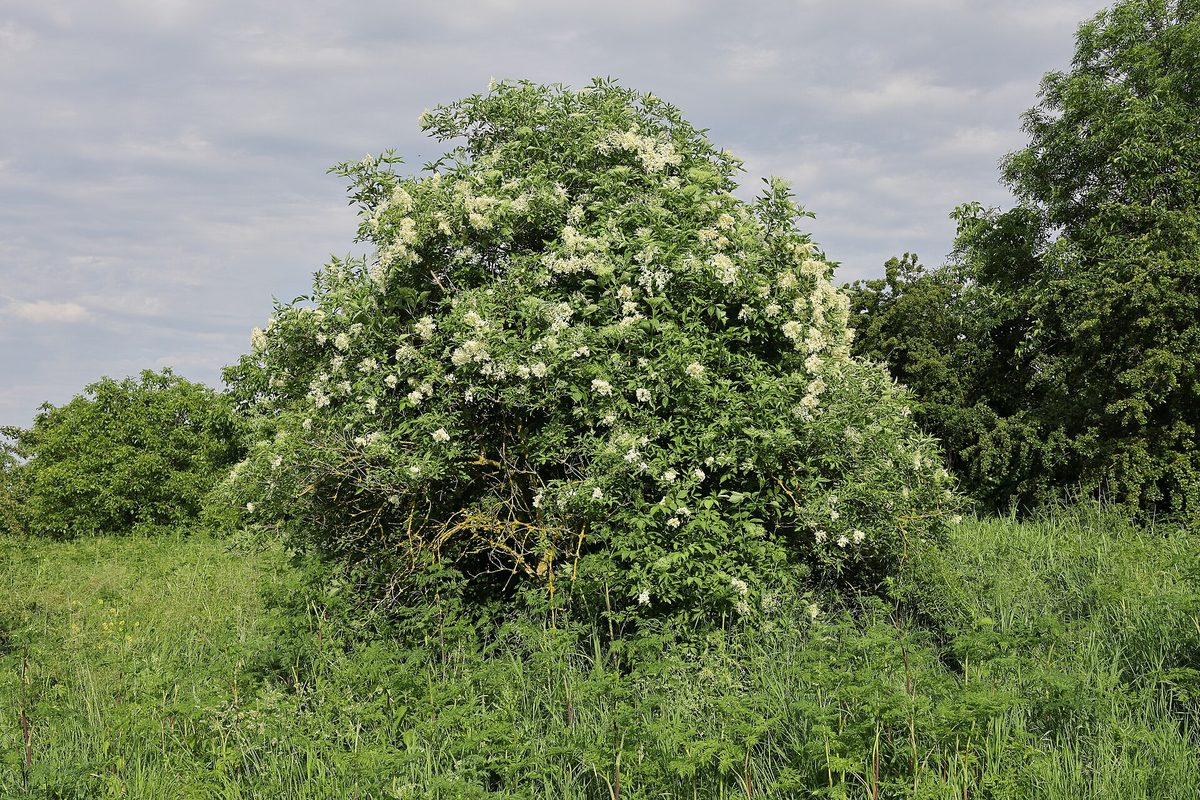
Photo: T. Kebert, CC BY-SA 4.0 via Wikimedia Commons

Quick facts
| Light: | Full sun and part shade (full sun preferred)11 source |
|---|---|
| Water: | Dry to wet21 source |
| Soil: | Well drained and moist; pH 6.8–7.2121 source |
| Hardiness: | Zones 5a–7b11 source |
| Size: | 10–20 ft (3.05–6.1 m) × 8–20 ft (2.44–6.1 m)11 source |
| Growth rate: | Rapid11 source |
| Bloom: | Mar–May, White621 source |
| Cats: | Toxic to cats (1 source) 4 |
| Dogs: | Toxic to dogs (1 source) 5 |
| Native range: | ALB, AUT, AZO, BGM, BLR, BLT, BUL, COR, CZE, DEN, FRA, GER, GRB, GRC, HUN, IRE, IRN, IRQ, ITA, KRY, LBS, NCS, NET, PAL, POL, POR, ROM, RUC, RUE, RUS, RUW, SAR, SIC, SPA, SWI, TCS, TUE, TUR, UKR, YUG7 |
| Family: | Viburnaceae |
How much light does a Black Elderberry need?
Full sun to part shade is the range listed for this shrub. Full sun is the preferred exposure. The source says the plant flowers and fruits best in full sun. The flowers are white and appear in clusters. Part shade is also listed as an acceptable setting.
- Light: Full sun and part shade (full sun preferred)1
How often to water a Black Elderberry
Soil conditions from wet to dry are tolerated by black elderberry. The recorded range runs from dry at one end to wet at the other. Its listed soil drainage is well drained and moist. NC State Extension lists good drainage for this species. That tolerance and the drainage listing are the two moisture values on record.
- Water: Dry to wet2
Best soil for a Black Elderberry
Good drainage is listed for this plant, along with moist soil. In short, the soil is described as well drained and moist. Penn State Extension gives an ideal pH range of 6.8 to 7.2. The plant also tolerates wet to dry soil conditions. A pH between 6.8 and 7.2 is the band the source calls ideal. Drainage and pH are the two soil values recorded for this species.
Hardiness and temperature
The hardiness zones listed for black elderberry are 5a through 7b. That range covers six steps, from 5a, 5b, 6a, 6b and 7a up to 7b. The source describes the plant as a large multi-stemmed deciduous shrub or small tree. It belongs to the Viburnaceae family and is native to Europe.
- Hardiness: Zones 5a–7b1
How to plant a Black Elderberry
USDA zones 5a to 7b are the listed range for planting black elderberry. Mature height is 10–20 ft (3.05–6.1 m). Mature spread is 8–20 ft (2.44–6.1 m). It is a large multi-stemmed deciduous shrub or small tree. It forms colonies easily through self-seeding. Full sun is preferred, and the plant flowers and fruits best there.
- Hardiness: Zones 5a–7b1
Winter care
Winter hardiness is listed as zones 5a through 7b. The full list reads 5a, 5b, 6a, 6b, 7a and 7b. Zone 5a is the coldest in that list, and 7b is the warmest. The plant is a deciduous shrub or small tree. NC State Extension describes it as native to Europe.
- Hardiness: Zones 5a–7b1
How to propagate a Black Elderberry
You can propagate black elderberry from stem cuttings or from seed. The source notes that the plant self-seeds and forms colonies easily. Two methods are recorded: stem cuttings and seed. The plant is a large multi-stemmed shrub or small tree with a rapid growth rate.
- Propagation: Stem cuttings and seed1
Common problems
Spotted wing drosophila and citrus longhorn beetle are the pests recorded for black elderberry. The diseases recorded are xylella fastidiosa, silver leaf disease, anthracnose and elderberry rust. EPPO Global Database lists Drosophila suzukii and Xylella fastidiosa. Two pests and four diseases are recorded in total.
| Problem | Kind |
|---|---|
| Spotted wing drosophila | Pest |
| Citrus longhorn beetle | Pest |
| Xylella fastidiosa | Disease |
| Silver leaf disease | Disease |
| Anthracnose | Disease |
| Elderberry rust | Disease |
Is Black Elderberry toxic to cats and dogs?
Black elderberry is listed as toxic to cats. Pet Poison Helpline says elderberry plants contain cyanide-containing compounds (glycosides) and irritant toxins (terpenoids). Black elderberry is also listed as toxic to dogs. That helpline publishes a list of common symptoms of elderberry toxicity. The positions for cats and for dogs match, and both are toxic.
Pet-safe alternatives
Recommended supplies
- Soil: a free-draining mix, and a pot with a drainage hole.
Questions and answers
- Is black elderberry toxic to cats and dogs?
- Black elderberry is listed as toxic to both cats and dogs. Pet Poison Helpline says elderberry plants contain cyanide-containing compounds (glycosides) and irritant toxins (terpenoids).
- How much sun does black elderberry need?
- It takes full sun to part shade. Full sun is the preferred exposure, and the plant flowers and fruits best there. The flowers are white.
- How big does black elderberry get?
- Mature height is 10–20 ft (3.05–6.1 m), and mature spread is 8–20 ft (2.44–6.1 m). The growth rate is rapid. It is a large multi-stemmed deciduous shrub or small tree.
Sources
- NC State Extension Gardener Plant Toolbox. https://plants.ces.ncsu.edu/plants/sambucus-nigra/. Accessed 14 October 2026.
- Penn State Extension. https://extension.psu.edu/elderberry-in-the-garden-and-the-kitchen. Accessed 15 October 2026.
- EPPO Global Database. https://gd.eppo.int/taxon/SAMNI/pests. Accessed 14 October 2026.
- Pet Poison Helpline. https://www.petpoisonhelpline.com/poison/elderberry/. Accessed 21 October 2026.
- Pet Poison Helpline. https://www.petpoisonhelpline.com/pet-tips/is-elderberry-safe-for-dogs/. Accessed 15 October 2026.
- Lady Bird Johnson Wildflower Center (Native Plant Database). https://www.wildflower.org/plants/result.php?id_plant=SANI4. Accessed 21 October 2026.
- Royal Botanic Gardens, Kew (World Checklist of Vascular Plants). https://sftp.kew.org/pub/data-repositories/WCVP/wcvp.zip. Accessed 4 June 2026.
How this page was made
- Written with AI assistance from the sources listed on this page. AI is never the source of a fact.