Common Buckthorn (Rhamnus cathartica)
Formerly Cervispina cathartica, Rhamnus wihhor, Rhamnus wicklia
Give common buckthorn full sun, and it also tolerates part shade. It is listed as toxic to both cats and dogs. This deciduous shrub or small tree is listed for USDA hardiness zones 3a through 7b.
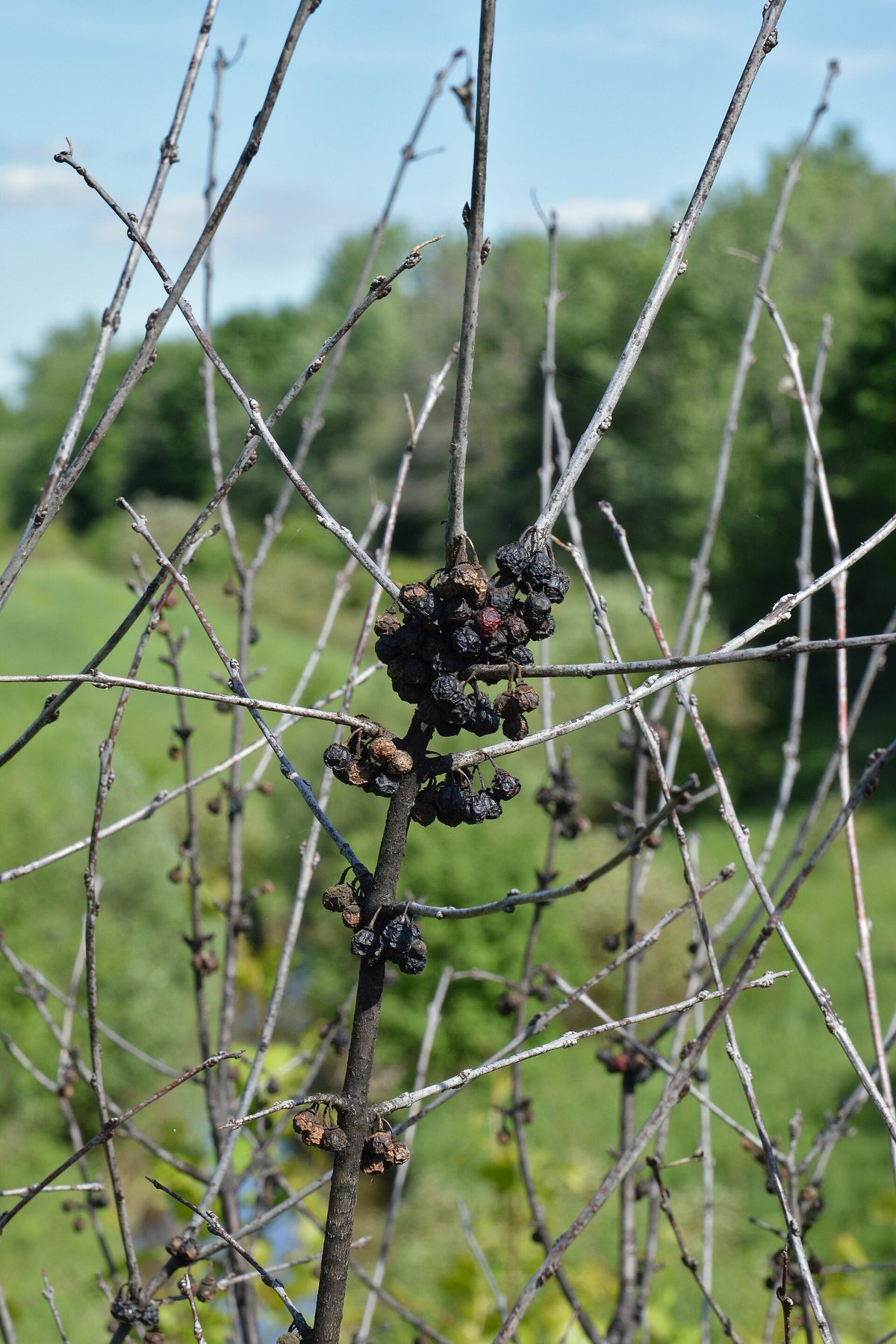
Photo: Ryan Hodnett, CC BY-SA 4.0 via Wikimedia Commons

Quick facts
| Light: | Full sun and part shade (full sun preferred)12 |
|---|---|
| Soil: | Well drained, moist, occasionally dry and occasionally wet; pH 5–8132 |
| Hardiness: | Zones 3a–7b11 source |
| Size: | 18–30 ft (5.49–9.14 m) × 15–25 ft (4.57–7.62 m)4121 source |
| Growth rate: | Rapid111 source |
| Bloom: | May–Jun31 source |
| Cats: | Toxic to cats (1 source) 1 |
| Dogs: | Toxic to dogs (1 source) 1 |
| Native range: | ALB, ALG, ALT, AUT, BGM, BLR, BLT, BUL, CHX, CZE, DEN, FIN, FRA, GER, GRB, GRC, HUN, IRE, IRN, ITA, KAZ, KGZ, KRY, LBS, MOR, NCS, NET, NOR, POL, POR, ROM, RUC, RUE, RUN, RUS, SIC, SPA, SWE, SWI, TCS, TUR, TZK, UKR, UZB, WSB, YUG5 |
| Family: | Rhamnaceae |
How much light does a Common Buckthorn need?
Common buckthorn grows in full sun, and full sun is the preferred exposure. The plant also tolerates part shade. Aim for six or more hours of direct sunlight a day where you can, and treat part shade as the fallback.
Best soil for a Common Buckthorn
Common buckthorn is listed for well drained, moist, occasionally dry and occasionally wet soil. A university extension source says it thrives on well-drained soils. Drainage is described as good, with moist conditions and occasional dry or wet spells also listed. The listed soil pH range is 5 to 8. It can tolerate acid to alkaline soil across that pH 5.0 to 8.0 range.
Hardiness and temperature
Common buckthorn is listed for USDA hardiness zones 3a through 7b, which covers ten half-zone steps. The full listing runs through 3a, 3b, 4a, 4b, 5a, 5b, 6a, 6b, 7a and 7b. Compare your own USDA hardiness zone with that range before you choose a planting spot for it in your yard.
- Hardiness: Zones 3a–7b1
How to plant a Common Buckthorn
Check that your site falls within USDA zones 3a to 7b before planting. Allow room for a mature height of 18 to 30 ft (5.49 to 9.14 m). The mature spread is listed as 15 to 25 ft (4.57 to 7.62 m). Full sun is the preferred exposure for the planting spot. The growth rate is listed as rapid. Its native status in the lower 48 US states is listed as introduced.
- Hardiness: Zones 3a–7b1
Winter care
Common buckthorn is a deciduous shrub or small tree. It is listed for USDA zones 3a through 7b. Zone 3a is the coldest listed zone, and 7b is the warmest. Compare your own USDA hardiness zone with that range to judge whether the plant is listed for your winters.
- Hardiness: Zones 3a–7b1
How to propagate a Common Buckthorn
Common buckthorn is propagated by seed. The University of Minnesota Extension notes 3 to 4 seeds that are viable for 1 to 2 years in the soil. Seed is the only propagation method recorded for this plant, and the page records no cuttings, division or layering. Birds eat the fruits and disperse the seeds.
- Propagation: Seed3
Common problems
Aphids and scales are the pests listed for common buckthorn. Its listed diseases are leaf spot, rust and powdery mildew. Two pests and three diseases are listed in all. No other pests or diseases are recorded for this plant on this page. Keep an eye out for any of the five when you look over your plant.
| Problem | Kind |
|---|---|
| Aphids | Pest |
| Scales | Pest |
| Leaf spot | Disease |
| Rust | Disease |
| Powdery mildew | Disease |
Is Common Buckthorn toxic to cats and dogs?
Common buckthorn is listed as toxic to cats. It is also listed as toxic to dogs. The listing applies to cats and dogs separately, and both entries read toxic. The source describes the plant as mildly toxic to humans and mammals. That same source notes that birds eat the fruits and disperse the seeds. The plant is also labelled as poisonous in its plant type entry. Which parts are toxic and which signs to expect are not documented on this page.
Pet-safe alternatives
Recommended supplies
- Soil: a free-draining mix, and a pot with a drainage hole.
Questions and answers
- Is common buckthorn toxic to cats and dogs?
- Common buckthorn is listed as toxic to both cats and dogs. The source describes it as mildly toxic to humans and mammals. Birds eat the fruits and disperse the seeds.
- How much sun does common buckthorn need?
- Full sun is preferred, which means six or more hours of direct sunlight a day. The plant also tolerates part shade. Its listed hardiness range is USDA zones 3a to 7b.
- What size does common buckthorn reach?
- The mature height is listed at 18 to 30 ft (5.49 to 9.14 m). The mature spread is listed at 15 to 25 ft (4.57 to 7.62 m). Its growth rate is listed as rapid.
Sources
- NC State Extension Gardener Plant Toolbox. https://plants.ces.ncsu.edu/plants/rhamnus-cathartica/. Accessed 14 October 2026.
- Cornell University CALS Woody Plants Database. https://woodyplants.cals.cornell.edu/plant/211. Accessed 14 October 2026.
- University of Minnesota Extension. https://extension.umn.edu/natural-resources/forestry-and-wildlife/invasive-species/common-buckthorn. Accessed 21 October 2026.
- NC State Extension Gardener Plant Toolbox. https://plants.ces.ncsu.edu/plants/rhamnus-cathartica/common-name/european-buckthorn/. Accessed 31 October 2026.
- Royal Botanic Gardens, Kew (World Checklist of Vascular Plants). https://sftp.kew.org/pub/data-repositories/WCVP/wcvp.zip. Accessed 4 June 2026.
How this page was made
- Written with AI assistance from the sources listed on this page. AI is never the source of a fact.