Mountain Laurel (Kalmia latifolia)
Formerly Chamaedaphne latifolia, Kalmia nitida, Kalmia serotina
Keep a mountain laurel alive by matching it to zones 4a to 9b, with well drained, moist soil and light anywhere from full sun to full shade. Sources say it grows best in partial shade. The ASPCA lists it as toxic to both cats and dogs.
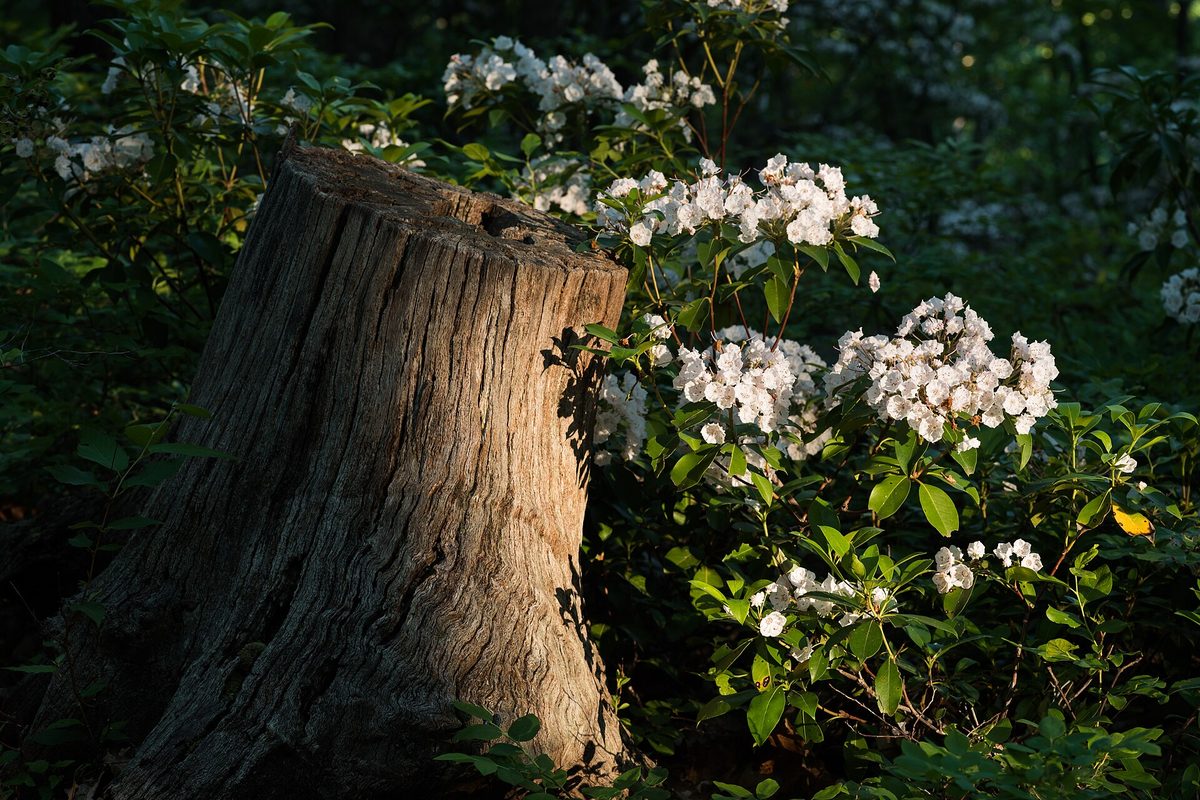
Photo: Juliancolton, CC BY-SA 4.0 via Wikimedia Commons

Quick facts
| Light: | Full sun, part shade and full shade (full sun preferred)123 |
|---|---|
| Soil: | Well drained and moist41 source |
| Hardiness: | Zones 4a–9b11 source |
| Size: | 7–14 ft (2.13–4.27 m) × 4–8 ft (1.22–2.44 m)411 source |
| Growth rate: | Slow1611 |
| Bloom: | Apr–Jul, White, pink and purple151 source |
| Cats: | Toxic to cats (1 source) 7 |
| Dogs: | Toxic to dogs (1 source) 7 |
| Native range: | ALA, CNT, DEL, FLA, GEO, INI, KTY, LOU, MAI, MAS, MRY, MSI, NCA, NWH, NWJ, NWY, OHI, PEN, RHO, SCA, TEN, VER, VRG, WVA8 |
| Family: | Ericaceae |
How much light does a Mountain Laurel need?
Light conditions from full sun to full shade are all listed for this shrub. The NC State Extension Gardener Plant Toolbox says it grows best in partial shade. The Brooklyn Botanic Garden says it will grow from deep shade to full sun, but does best in moderate to partial shade. Both descriptions point to partial shade as the best exposure, with the wider range as a tolerance.
Best soil for a Mountain Laurel
Soil for this shrub should be well drained and moist. Clemson Cooperative Extension describes the right site as acidic soil, well drained, and somewhat moist, in a cool location. The record lists both drainage conditions together, so you look for soil that is well drained and moist at once. No cited source on this page gives a pH number, so the acidity is described only in general terms.
- Soil drainage: Well drained and moist4
Hardiness and temperature
Hardiness zones 4a through 9b cover the range listed for this shrub. The listing runs through every half-zone step: 4a, 4b, 5a, 5b, 6a, 6b, 7a, 7b, 8a, 8b, 9a and 9b. The Brooklyn Botanic Garden names a narrower span, zones 5 to 9. No cited source records a minimum temperature or a humidity preference, so this page gives neither.
- Hardiness: Zones 4a–9b1
How to plant a Mountain Laurel
Choose a planting site within USDA zones 4a to 9b. Leave room for a mature height of 7–14 ft (2.13–4.27 m) and a spread of 4–8 ft (1.22–2.44 m). The growth rate is slow, less than 12 in (30 cm) a year, according to Clemson. This is a shrub with native status in the lower 48 US states. Its native range is listed across 24 regions, from Maine and Massachusetts to Alabama and Louisiana.
- Hardiness: Zones 4a–9b1
Winter care
Cold hardiness is listed from zone 4a up to zone 9b. The NC State Extension Gardener Plant Toolbox calls it a broadleaf evergreen shrub or small tree. No cited source records a minimum temperature, so this page gives no lowest-temperature figure. Winter protection and mulching are not documented either.
- Hardiness: Zones 4a–9b1
How to propagate a Mountain Laurel
Growing new plants from seed is the one method recorded for this shrub. The Lady Bird Johnson Wildflower Center says germination is enhanced by cold, moist stratification. No cited source on this page records cuttings, layering or division. Sowing depth, temperature and timing are not documented here either.
- Propagation: Seed5
Common problems
Scale insects, lace bugs, whitefly and borers are the pests recorded for this shrub. Clemson says it is susceptible to all of them. Cercospora leaf spot and phytophthora root rot are the diseases recorded. Clemson adds that cercospora leaf spot is found on almost all mountain laurels. No treatments are documented on this page.
| Problem | Kind |
|---|---|
| Scale insects | Pest |
| Lace bugs | Pest |
| Whitefly | Pest |
| Borers | Pest |
| Cercospora leaf spot | Disease |
| Phytophthora root rot | Disease |
Is Mountain Laurel toxic to cats and dogs?
The ASPCA lists mountain laurel as toxic to cats. It lists the plant as toxic to dogs as well. The entry reads 'Toxicity: Toxic to Dogs, Toxic to Cats', so the position is the same for both animals. No cited source on this page names which parts of the plant are toxic, how severe the effects are, or what signs to watch for. This site covers cats and dogs only, so other animals are not discussed here. Treat mountain laurel as a plant to keep away from both cats and dogs.
Pet-safe alternatives
Recommended supplies
- Soil: a free-draining mix, and a pot with a drainage hole.
Questions and answers
- Is mountain laurel toxic to cats and dogs?
- The ASPCA lists mountain laurel as toxic to cats and as toxic to dogs. No cited source on this page names the toxic parts or the severity of the effects. Treat it as a plant to keep away from both animals.
- How large does a mountain laurel grow?
- Clemson gives a mature height of 7–14 ft (2.13–4.27 m). The NC State Extension Gardener Plant Toolbox gives a spread of 4–8 ft (1.22–2.44 m). Growth is slow, at less than 12 in (30 cm) a year.
- What color are mountain laurel flowers?
- The flowers are listed as white, pink and purple. The NC State Extension Gardener Plant Toolbox says they typically cover the shrub for several weeks. The plant is a broadleaf evergreen shrub.
Sources
- NC State Extension Gardener Plant Toolbox. https://plants.ces.ncsu.edu/plants/kalmia-latifolia/. Accessed 14 October 2026.
- Brooklyn Botanic Garden. https://www.bbg.org/article/mountain_laurel. Accessed 14 October 2026.
- Cornell University CALS Woody Plants Database. https://woodyplants.cals.cornell.edu/plant/129. Accessed 14 October 2026.
- Clemson Cooperative Extension Home & Garden Information Center. https://hgic.clemson.edu/mountain-laurel/. Accessed 14 October 2026.
- Lady Bird Johnson Wildflower Center. https://www.wildflower.org/plants/result.php?id_plant=KALA. Accessed 14 October 2026.
- Clemson Cooperative Extension HGIC. https://hgic.clemson.edu/factsheet/laurel/. Accessed 14 October 2026.
- ASPCA. https://www.aspca.org/pet-care/aspca-poison-control/toxic-and-non-toxic-plants/laurel. Accessed 14 October 2026.
- Royal Botanic Gardens, Kew (World Checklist of Vascular Plants). https://sftp.kew.org/pub/data-repositories/WCVP/wcvp.zip. Accessed 4 June 2026.
How this page was made
- Written with AI assistance from the sources listed on this page. AI is never the source of a fact.