Glossy Buckthorn (Frangula alnus)
Formerly Rhamnus frangula, Frangula nigra, Rhamnus baetica
Give glossy buckthorn full sun, though part shade is also listed, and water that ranges from medium to wet. Pet toxicity for cats and for dogs is not documented in the facts for this page. It is hardy in zones 2a–7b and reaches up to 25 ft (7.62 m) tall.
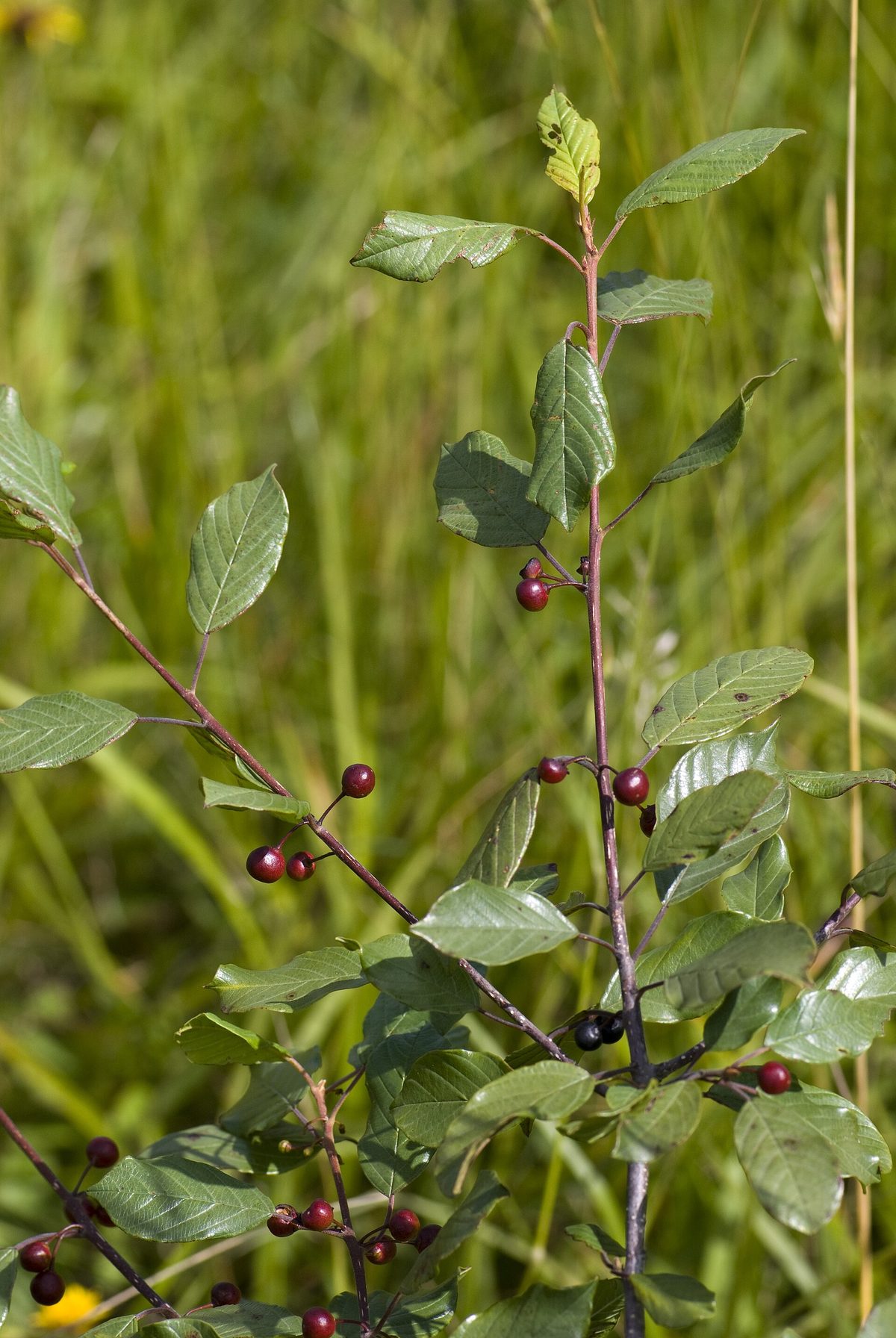
Photo: Olivier Pichard, CC BY-SA 3.0 via Wikimedia Commons

Quick facts
| Light: | Full sun and part shade (full sun preferred)12 |
|---|---|
| Water: | Medium to wet11 source |
| Soil: | Well drained and occasionally wet11 source |
| Hardiness: | Zones 2a–7b11 source |
| Size: | 25 ft (7.62 m) × 8–12 ft (2.44–3.66 m)4511 source |
| Growth rate: | Slow111 source |
| Bloom: | May–Jun, White, green, yellow and purple4121 source |
| Cats: | Not documented by major sources |
| Dogs: | Not documented by major sources |
| Native range: | ALB, ALG, ALT, AUT, BGM, BLR, BLT, BUL, CHX, COR, CZE, DEN, FIN, FRA, GER, GRB, GRC, HUN, IRE, IRN, IRQ, ITA, KAZ, KRA, KRY, LBS, MOR, NCS, NET, NOR, POL, POR, ROM, RUC, RUE, RUN, RUS, RUW, SPA, SWE, SWI, TCS, TUE, TUN, TUR, TVA, UKR, WSB, YUG6 |
| Family: | Rhamnaceae |
How much light does a Glossy Buckthorn need?
Glossy buckthorn does best in full sun, which means six or more hours of direct sunlight a day. It can also grow in part shade, and Penn State Extension says it can grow in full or partial sun. Full sun remains the preferred condition among those listed.
How often to water a Glossy Buckthorn
Water needs for this shrub run from medium to wet. It does well in most consistently moist soils that are not waterlogged. Moderately fertile soil is part of the same description. Drainage is listed as good, and the site can be occasionally wet.
- Water: Medium to wet1
Best soil for a Glossy Buckthorn
Soil drainage for glossy buckthorn is listed as well drained and occasionally wet. Good drainage is one listed condition. Occasionally wet is the other. The plant does well in most soils that are consistently moist but not waterlogged. Those soils are described as moderately fertile. Medium to wet is the documented water range for this plant. No cited source records a soil pH range for glossy buckthorn, so that value is not documented here.
Hardiness and temperature
Glossy buckthorn is rated for USDA hardiness zones 2a through 7b. The cold end of that range is zone 2a, and the warm end is zone 7b. The listing names every half-zone between them: 2a, 2b, 3a, 3b, 4a, 4b, 5a, 5b, 6a, 6b, 7a and 7b. Zones 2a–7b is the full documented range for this shrub or small tree.
- Hardiness: Zones 2a–7b1
How to plant a Glossy Buckthorn
Check that your site falls within USDA zones 2a to 7b before planting glossy buckthorn. Plan for a mature spread of 8–12 ft (2.44–3.66 m). The height reaches up to 25 ft (7.62 m). Full sun is the preferred light for this shrub. Its growth rate is slow. In the contiguous United States its status is listed as introduced.
- Hardiness: Zones 2a–7b1
Winter care
The listed hardiness for glossy buckthorn runs from zone 2a to zone 7b. Zone 2a is the coldest zone in that range. Zone 7b is the warmest zone in that range. Zones 3a through 7a lie between those two ends. Gardeners in zones colder than 2a or warmer than 7b fall outside the documented range.
- Hardiness: Zones 2a–7b1
How to propagate a Glossy Buckthorn
Glossy buckthorn can be propagated by seed, stem cuttings and layering. Layering is named directly in the Plant Toolbox listing. Those are the three methods documented for this plant. Seed is the first method on that list. Stem cuttings are the second option, and layering is the third.
- Propagation: Seed, stem cuttings and layering1
Common problems
Japanese beetles, caterpillars and scale are listed as pests that can affect this plant. Nematodes can attack the roots. Margarodes vitis is also recorded among its pests. Cankers, leaf spots and rust can be problems. Silver leaf fungus, cherry leaf roll virus and Xylella fastidiosa are also recorded as diseases.
| Problem | Kind |
|---|---|
| Japanese beetles | Pest |
| Caterpillars | Pest |
| Scale insects | Pest |
| Nematodes | Pest |
| Margarodes vitis | Pest |
| Canker | Disease |
| Leaf spot | Disease |
| Rust | Disease |
| Silver leaf fungus | Disease |
| Cherry leaf roll virus | Disease |
| Xylella fastidiosa | Disease |
Is Glossy Buckthorn toxic to cats and dogs?
Recommended supplies
- Soil: a free-draining mix, and a pot with a drainage hole.
Questions and answers
- How much sun does glossy buckthorn need?
- Full sun is preferred, which means six or more hours of direct sunlight a day. It can also grow in part shade. Penn State Extension says it can grow in full or partial sun.
- How big does glossy buckthorn get?
- It is a tall understory shrub or small tree up to 25 ft (7.62 m) high. The mature spread is 8–12 ft (2.44–3.66 m). Its growth rate is slow.
- What do the flowers of glossy buckthorn look like?
- Each flower is about ¼ inch across, with five white petals. The sepals are yellowish green to white. The flowers appear in May or June, clustered in the leaf axils.
Sources
- NC State Extension Gardener Plant Toolbox. https://plants.ces.ncsu.edu/plants/frangula-alnus/. Accessed 14 October 2026.
- Penn State Extension. https://extension.psu.edu/buckthorn-accurate-identification. Accessed 14 October 2026.
- EPPO Global Database. https://gd.eppo.int/taxon/RHAFR/pests. Accessed 14 October 2026.
- University of Minnesota Extension. https://extension.umn.edu/natural-resources/forestry-and-wildlife/invasive-species/glossy-buckthorn. Accessed 1 November 2026.
- Cornell University CALS Woody Plants Database. https://woodyplants.cals.cornell.edu/plant/212. Accessed 30 October 2026.
- Royal Botanic Gardens, Kew (World Checklist of Vascular Plants). https://sftp.kew.org/pub/data-repositories/WCVP/wcvp.zip. Accessed 4 June 2026.
How this page was made
- Written with AI assistance from the sources listed on this page. AI is never the source of a fact.