Polkadot-plant (Hypoestes phyllostachya)
Formerly Hypoestes sanguinolenta, Eranthemum sanguinolentum, Hypoestes lasiostegia var. sanguinolenta
Give this plant bright, indirect light, since it tolerates some direct sun but keeps its brightest leaf color with filtered brightness instead. It grows quickly as an herbaceous perennial or annual, reaching 1-2 ft (0.3-0.61 m) tall. It is not toxic to cats or dogs, according to ASPCA and extension listings.
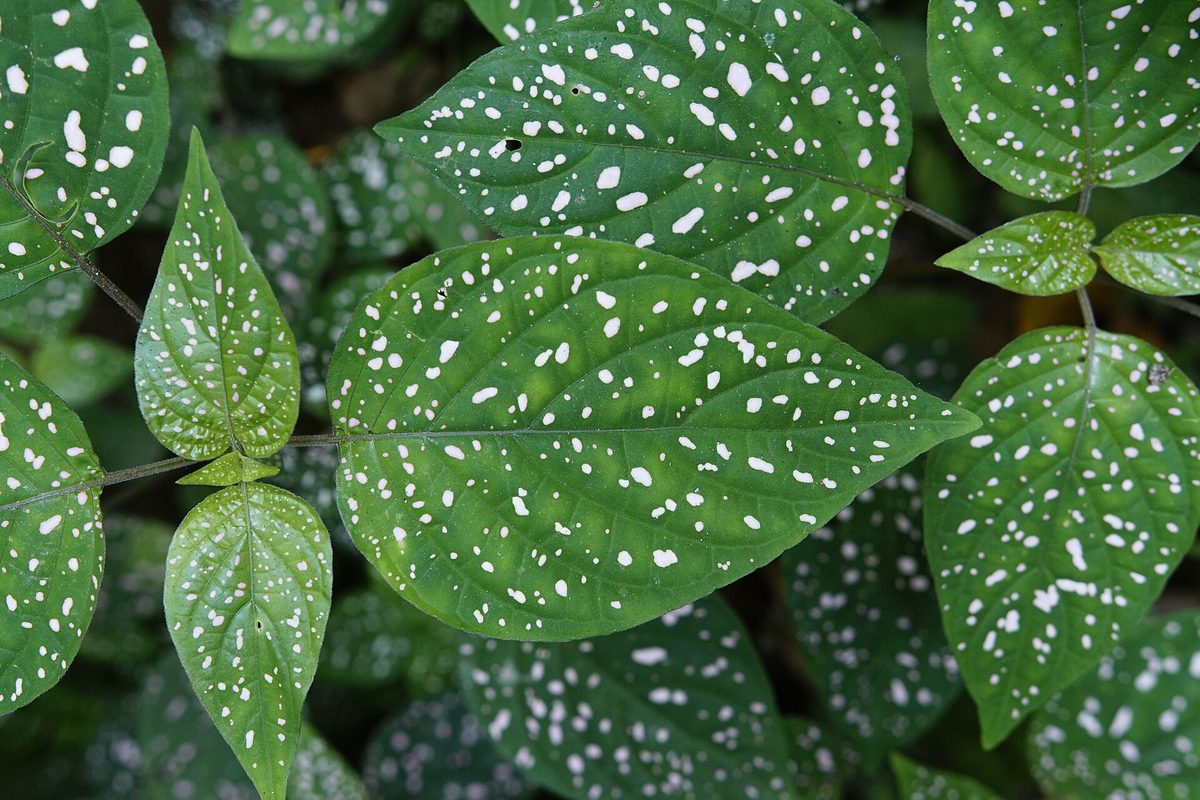
Photo: Vengolis, CC BY-SA 4.0 via Wikimedia Commons

Quick facts
| Light: | Bright, indirect light; tolerates direct sun12 |
|---|---|
| Soil: | Well drained11 source |
| Minimum temperature: | 50 °F (10 °C)21 source |
| Size: | 1–2 ft (0.3–0.61 m) × 0.7–1 ft (0.23–0.3 m)11 source |
| Growth rate: | Rapid11 source |
| Bloom: | Purple11 source |
| Cats: | Non-toxic to cats 41 |
| Dogs: | Non-toxic to dogs 41 |
| Family: | Acanthaceae |
How much light does a Polkadot-plant need?
Place this plant in bright, indirect light indoors, since that is the lighting where it grows best and keeps its most vivid leaf color. It tolerates some direct sun as well, though filtered light instead of harsh rays brings out the strongest color in its leaves.
Best soil for a Polkadot-plant
This plant performs best when it is grown in soil that offers good drainage, rather than a soil mix that stays wet. That same good drainage is what this plant needs whether you are growing it in a container indoors or in a garden bed outdoors.
- Soil drainage: Well drained1
Temperature and humidity
Wait until outdoor temperatures stay consistently above 50°F (10°C) before you plant this species outside. That minimum applies whether you are moving potted plants outdoors for summer or setting out new ones in the garden. Outdoors, this plant is hardy in USDA zones 10a through 11b.
- Minimum temperature: 50 °F (10 °C)2
Pruning a Polkadot-plant
Pinch back the stems now and then to prevent the plant from growing leggy. This light shaping is usually enough to keep it tidy, since this species only reaches about 1-2 ft (0.3-0.61 m) tall with a rapid growth rate indoors or outside.
- Pruning: Light shaping3
How to propagate a Polkadot-plant
You can propagate this plant most easily through stem cuttings, since cuttings of this species are easily rooted and will grow into new, separate plants. Seed is the other method documented for this plant, giving you a second way to start new plants besides taking a cutting from an existing one.
Common problems
Watch for aphids, mealybugs and whiteflies, which are the insect pests recorded as able to affect this plant. Root rot and powdery mildew are the diseases that can occur, even though this plant otherwise has no other significant disease problems documented.
| Problem | Kind |
|---|---|
| Aphids | Pest |
| Mealybugs | Pest |
| Whiteflies | Pest |
| Root rot | Disease |
| Powdery mildew | Disease |
Is Polkadot-plant toxic to cats and dogs?
The ASPCA's Animal Poison Control Center classifies this plant as non-toxic to cats, meaning it does not appear on that agency's list of plants toxic to them. The same listing classifies it as non-toxic to dogs as well, placing it outside the plants the agency flags as toxic to them. NC State Extension's plant database also lists the species as non-toxic for both cats and dogs.
Recommended supplies
- Light: bright, indirect light, such as near an east window; a full-spectrum grow light substitutes where no window does.
- Soil: a free-draining mix, and a pot with a drainage hole.
Questions and answers
- Is the polkadot plant toxic to cats or dogs?
- No, the ASPCA lists this plant as non-toxic to cats, and the same listing names it as non-toxic to dogs as well. NC State Extension's plant database lists it the same way for both pets.
- How much light does a polkadot plant need?
- Give it bright, indirect light, since that is where it grows best and keeps its most vivid leaf color. It also tolerates some direct sun.
- What pests and diseases affect the polkadot plant?
- Watch for aphids, mealybugs and whiteflies, which are the pests recorded on this plant. Root rot and powdery mildew are the diseases that can occur.
Sources
- NC State Extension Gardener Plant Toolbox. https://plants.ces.ncsu.edu/plants/hypoestes-phyllostachya/. Accessed 15 November 2026.
- University of Wisconsin-Madison Division of Extension. https://hort.extension.wisc.edu/articles/polka-dot-plant-hypoestes-phyllostachya/. Accessed 15 November 2026.
- University of Missouri Extension. https://extension.missouri.edu/publications/g6520. Accessed 15 November 2026.
- ASPCA Animal Poison Control Center. https://www.aspca.org/pet-care/aspca-poison-control/toxic-and-non-toxic-plants/polka-dot-plant. Accessed 15 November 2026.
How this page was made
- Written with AI assistance from the sources listed on this page. AI is never the source of a fact.