Spotted Snapweed (Impatiens balsamina)
Formerly Balsamina lacca, Balsamina mollis, Impatiens dahlii
Give spotted snapweed (Impatiens balsamina) full sun, with part shade also accepted, and keep its soil moist with good drainage. It is an annual that grows rapidly and reaches 0.5–2.5 ft (0.15–0.76 m) tall. Flowers come in white, pink, red, purple and multicoloured forms. The ASPCA lists it as non-toxic to both cats and dogs.
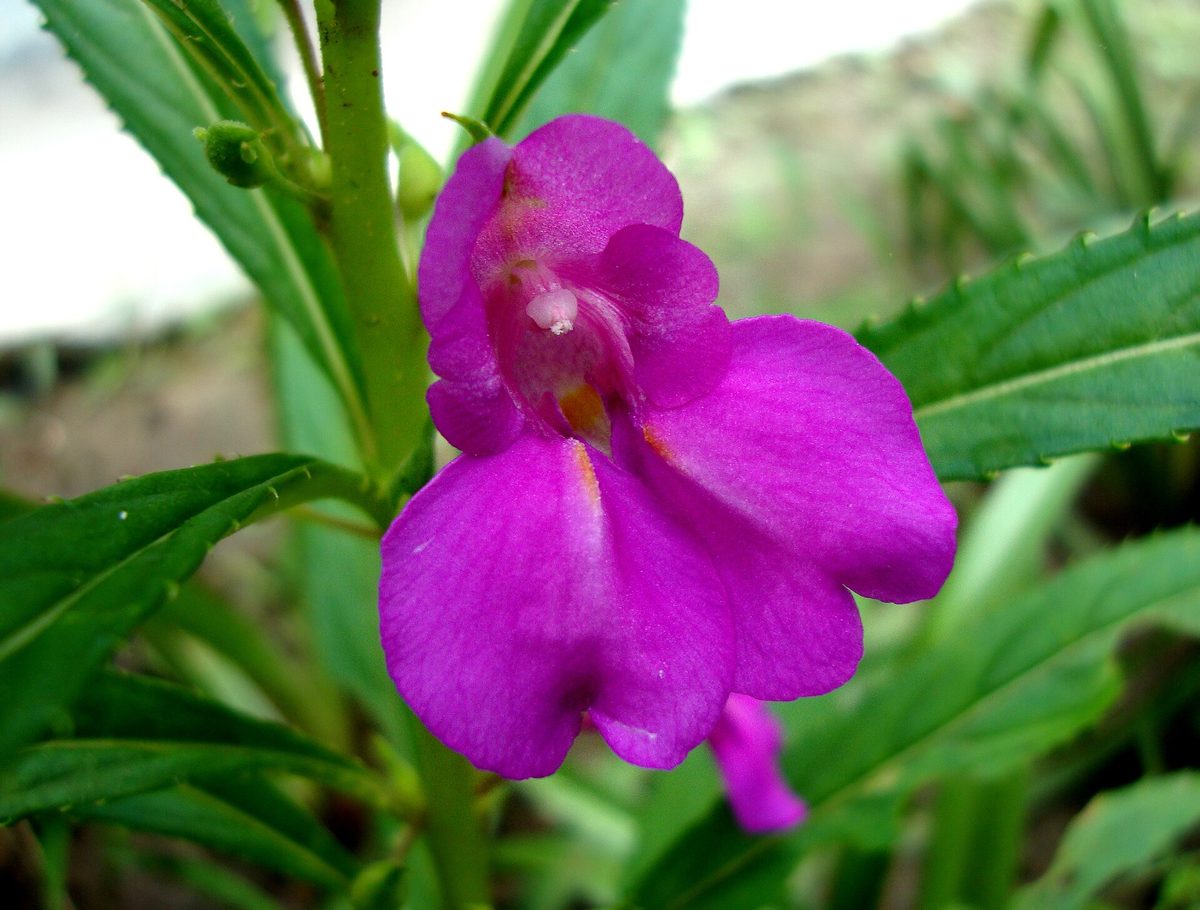
Photo: Joydeep, CC BY-SA 3.0 via Wikimedia Commons

Quick facts
| Water: | Medium to wet11 source |
|---|---|
| Soil: | Well drained and moist11 source |
| Size: | 0.5–2.5 ft (0.15–0.76 m)11 source |
| Growth rate: | Rapid11 source |
| Bloom: | White, pink, red, purple and multicoloured11 source |
| Cats: | Non-toxic to cats 13 |
| Dogs: | Non-toxic to dogs 13 |
| Native range: | IND, SRL4 |
| Family: | Balsaminaceae |
How often to water a Spotted Snapweed
Moisture needs for this annual run from medium to wet. The plant prefers a moist setting and has a low tolerance for drought conditions. Soil drainage is recorded as well drained and moist. That pairing describes the soil rather than a watering schedule, and the facts give no number of days.
- Water: Medium to wet1
Best soil for a Spotted Snapweed
Outdoors, this plant is listed for well drained and moist soil. The source's wording for drainage is good drainage. No cited source records a soil pH range, so that value is not documented here. Moisture needs are medium to wet, and the plant has a low tolerance for drought conditions. The page does not state any soil amendment, mix or planting depth, because none is documented.
- Soil drainage: Well drained and moist1
How to propagate a Spotted Snapweed
Propagate this annual from seed. Seed is the only propagation method recorded for this plant in the sources checked, and the record gives no further detail. No sowing depth, spacing, germination time or sowing season is documented, so none appears here. Its listed hardiness range is zones 2a–11b.
- Propagation: Seed1
Common problems
The recorded pests for spotted snapweed are Liriomyza huidobrensis and Meloidogyne graminicola. Recorded diseases are Plasmopara obducens, Ralstonia solanacearum, tomato spotted wilt virus, southern bacterial wilt and southern blight. The facts give names only, with no symptoms, timing or treatment, so none are described here.
| Problem | Kind |
|---|---|
| Liriomyza huidobrensis | Pest |
| Meloidogyne graminicola | Pest |
| Plasmopara obducens | Disease |
| Ralstonia solanacearum | Disease |
| Tomato spotted wilt virus | Disease |
| Southern bacterial wilt | Disease |
| Southern blight | Disease |
Is Spotted Snapweed toxic to cats and dogs?
Cats are covered by a non-toxic listing from both the ASPCA and the NC State Extension Gardener Plant Toolbox. Dogs are covered by the same non-toxic listings from both of those sources. The ASPCA wording is Non-Toxic to Dogs, Non-Toxic to Cats. This page covers cats and dogs only, and says nothing about other animals. No toxic parts or severity are listed, because the sources record none.
Recommended supplies
- Soil: a free-draining mix, and a pot with a drainage hole.
Questions and answers
- Is spotted snapweed toxic to cats or dogs?
- The ASPCA and the NC State Extension Gardener Plant Toolbox both list it as non-toxic for cats and for dogs. This page does not cover other animals. No toxic parts or severity are recorded for it.
- How much sun does spotted snapweed need?
- Full sun is preferred, meaning six or more hours of direct sunlight a day. Part shade is also listed. The plant prefers a moist setting and has a low tolerance for drought conditions.
- How tall does spotted snapweed grow, and where is it native?
- It reaches about 0.5–2.5 ft (0.15–0.76 m) tall and has an erect habit. The native range is recorded as India and Sri Lanka. In the contiguous United States and Puerto Rico it is listed as introduced.
Sources
- NC State Extension Gardener Plant Toolbox. https://plants.ces.ncsu.edu/plants/impatiens-balsamina/. Accessed 21 October 2026.
- EPPO Global Database. https://gd.eppo.int/taxon/IPABA/pests. Accessed 21 October 2026.
- ASPCA Animal Poison Control Center. https://www.aspca.org/pet-care/aspca-poison-control/toxic-and-non-toxic-plants/impatience-plant. Accessed 27 October 2026.
- Royal Botanic Gardens, Kew (World Checklist of Vascular Plants). https://sftp.kew.org/pub/data-repositories/WCVP/wcvp.zip. Accessed 4 June 2026.
How this page was made
- Written with AI assistance from the sources listed on this page. AI is never the source of a fact.