Showy Stonecrop (Hylotelephium spectabile)
Formerly Sedum spectabile, Sedum fabarium, Sedum pseudofabaria
Give showy stonecrop full sun and keep its watering low. Part shade is also acceptable. Full sun is the preferred position. It forms a mound 1 to 2 ft (0.3–0.61 m) high and wide. It suits hardiness zones 4a to 9b. Toxicity to cats and dogs is not documented here. The soil should be well drained.
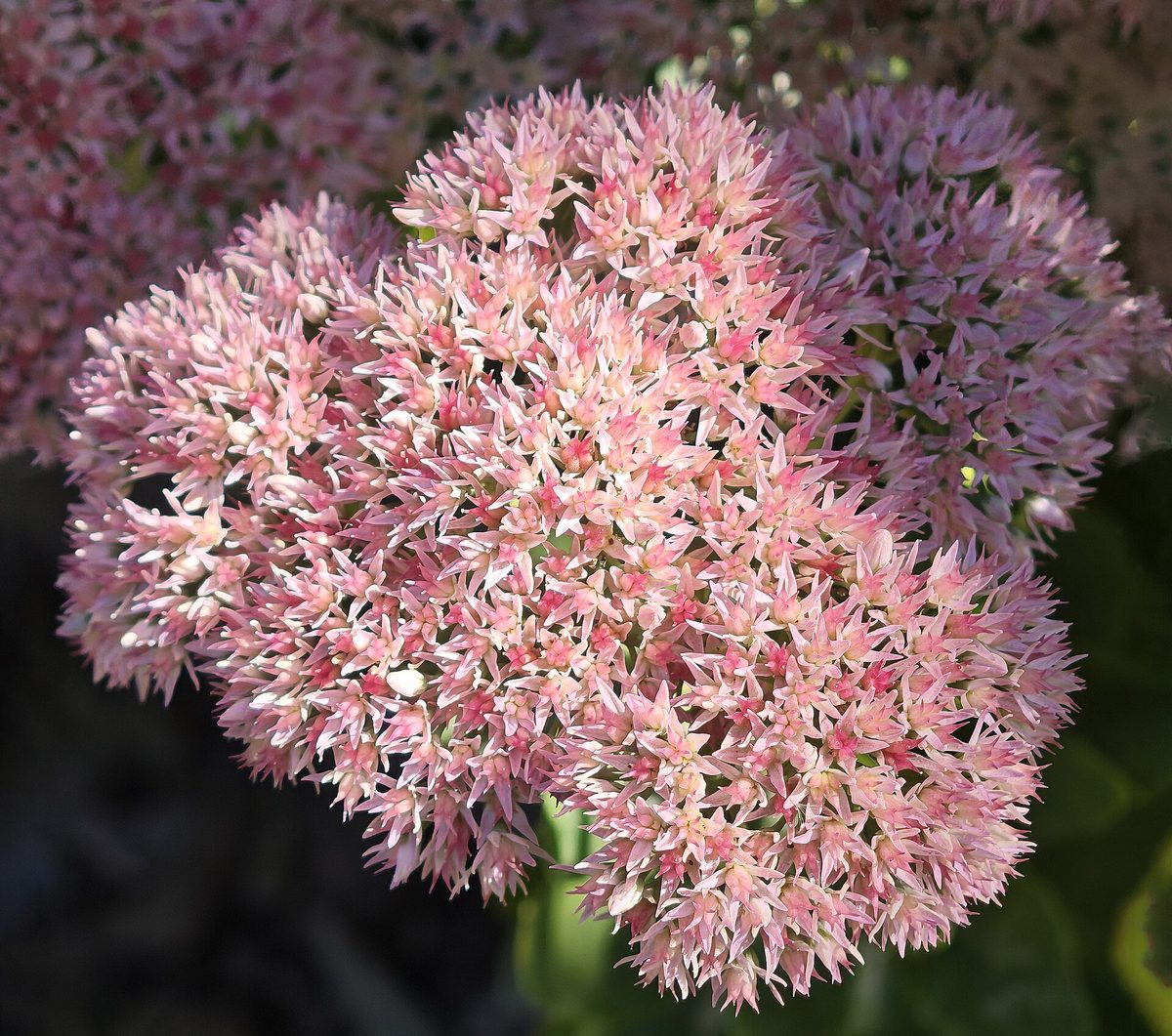
Photo: Didier Descouens, CC BY-SA 4.0 via Wikimedia Commons

Quick facts
| Light: | Full sun and part shade (full sun preferred)12 |
|---|---|
| Water: | Dry31 source |
| Soil: | Well drained and occasionally dry11 source |
| Hardiness: | Zones 4a–9b11 source |
| Size: | 1–2 ft (0.3–0.61 m) × 1–2 ft (0.3–0.61 m)11 source |
| Growth rate: | Moderate11 source |
| Bloom: | Aug–Sep, Pink, red and brown315Not documented by major sources |
| Cats: | Not documented by major sources |
| Dogs: | Not documented by major sources |
| Family: | Crassulaceae |
How much light does a Showy Stonecrop need?
Showy stonecrop grows in full sun or part shade. Of those two exposures, full sun is the one it prefers. Part shade is listed as an acceptable range alongside full sun, though it is not the preferred one. Check that your zone falls within 4a to 9b when you choose a spot. At maturity the plant reaches 1 to 2 ft (0.3–0.61 m) in both height and spread.
How often to water a Showy Stonecrop
Showy stonecrop has low water use, and its recorded water category is dry. The soil it grows in should be well drained and occasionally dry. Its listed soil is well drained or gravelly, with average to low fertility. Dry is both the lowest and the highest moisture level recorded for it. Its growth rate is moderate, and the plant spreads 1 to 2 ft (0.3–0.61 m).
- Water: Dry3
Best soil for a Showy Stonecrop
Well drained or gravelly soil with average to low fertility suits this plant. Its recorded drainage categories are well drained and occasionally dry. Occasionally dry is one of the two drainage conditions listed. The other listed condition is well drained. No cited source records a soil pH range for this plant. Its water use is low and its water category is dry. Dry is the only moisture level listed.
- Soil drainage: Well drained and occasionally dry1
Hardiness and temperature
This plant is rated for hardiness zones 4a through 9b. The coldest zone listed is 4a and the warmest is 9b. Each sub-zone is listed: 4a, 4b, 5a, 5b, 6a, 6b, 7a, 7b, 8a, 8b, 9a and 9b. Zone 4a is the cold limit of the listed range. Zone 9b is the warm limit of the listed range. A plant 1 to 2 ft (0.3–0.61 m) tall and wide is hardy in zones 4a to 9b.
- Hardiness: Zones 4a–9b1
How to plant a Showy Stonecrop
A spot in full sun, or in part shade, suits showy stonecrop. Full sun is preferred over part shade. Leave room for a plant 1 to 2 ft (0.3–0.61 m) high and wide. Choose well drained or gravelly soil with average to low fertility. Your planting site should fall within zones 4a to 9b. Its growth rate is moderate. Water use at this site should be low, as its category is dry.
- Hardiness: Zones 4a–9b1
Winter care
In zone 4a, the coldest zone listed, showy stonecrop is within its rated range. At the warm end, zone 9b is the limit of that range. Its recorded soil drainage is well drained and occasionally dry. The hardiness range spans twelve sub-zones from 4a to 9b. Low water use is recorded for the plant. Zones 4a to 9b span the range in which it is rated hardy.
- Hardiness: Zones 4a–9b1
How to propagate a Showy Stonecrop
Stem cuttings are the propagation method given for showy stonecrop. Showy stonecrop has a moderate growth rate. A mature plant forms a mound 1 to 2 ft (0.3–0.61 m) high and wide. Stem cuttings are the method listed, and the species is hardy in zones 4a to 9b. Mature height is the same as spread, 1 to 2 ft (0.3–0.61 m). The light listed for a mature plant is full sun or part shade, with full sun preferred.
- Propagation: Stem cuttings1
Common problems
Several pests can be problematic on showy stonecrop. These are aphids, mealybugs, nematodes, scale insects, slugs and weevils. Two diseases are listed: Dickeya dianthicola and Erwinia chrysanthemi. Six pest types are named in total. Aphids and mealybugs are among them, as are slugs and weevils. Nematodes and scale insects complete the pest list.
| Problem | Kind |
|---|---|
| Aphids | Pest |
| Mealybugs | Pest |
| Nematodes | Pest |
| Scale insects | Pest |
| Slugs and snails | Pest |
| Weevils | Pest |
| Dickeya dianthicola | Disease |
| Erwinia chrysanthemi | Disease |
Is Showy Stonecrop toxic to cats and dogs?
Recommended supplies
- Soil: a free-draining mix, and a pot with a drainage hole.
Questions and answers
- How much sun does showy stonecrop need?
- It grows in full sun or part shade. Full sun is the preferred exposure, and part shade is the accepted alternative. The plant forms a mound 1 to 2 ft (0.3–0.61 m) high and wide. Its growth rate is moderate.
- How often should I water showy stonecrop?
- Showy stonecrop has low water use, and dry is its recorded water category. Its soil should be well drained and occasionally dry. Gravelly soil with average to low fertility is also listed. Mature size is 1 to 2 ft (0.3–0.61 m) in height and spread.
- Which hardiness zones can grow showy stonecrop?
- It is rated for hardiness zones 4a to 9b. That covers every sub-zone from 4a up to 9b. It is a moderate grower that reaches 1 to 2 ft (0.3–0.61 m) in height. Its soil should be well drained.
Sources
- NC State Extension Gardener Plant Toolbox. https://plants.ces.ncsu.edu/plants/hylotelephium-spectabile/. Accessed 25 October 2026.
- University of Florida IFAS Extension (EDIS). https://ask.ifas.ufl.edu/publication/EP107. Accessed 25 October 2026.
- Oregon State University Extension Service. https://extension.oregonstate.edu/gallery/fire-resistant-plant-profiles-perennials. Accessed 27 October 2026.
- EPPO Global Database. https://gd.eppo.int/taxon/SEDSL/pests. Accessed 25 October 2026.
- University of Illinois Extension. https://extension.illinois.edu/blogs/flowers-fruits-and-frass/2020-09-25-sedum-reliable-fall-food-source-foraging-butterflies. Accessed 27 October 2026.
How this page was made
- Written with AI assistance from the sources listed on this page. AI is never the source of a fact.