Common Houseleek (Sempervivum tectorum)
Formerly Sempervivum arvernense, Sempervivum mettenianum, Sempervivum boutignyanum
Give common houseleek full sun and well-drained soil, and let it dry out between waterings. It also tolerates part shade. Its water range runs from dry to medium. Zones 3a to 8b suit it. Sempervivum tectorum spreads by offsets. This page does not document pet toxicity for cats or dogs.
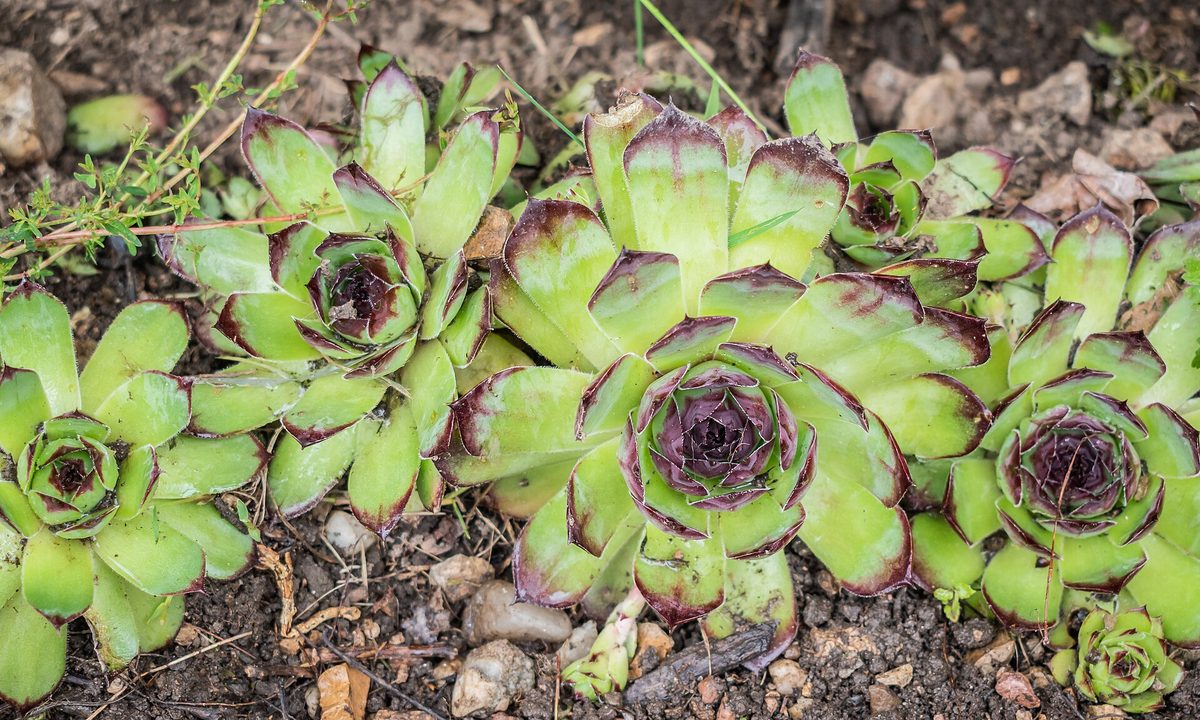
Photo: Krzysztof Golik, CC BY-SA 4.0 via Wikimedia Commons

Quick facts
| Light: | Full sun and part shade (full sun preferred)121 source |
|---|---|
| Water: | Dry to medium211 source |
| Soil: | Well drained; pH 6–83121 source |
| Hardiness: | Zones 3a–8b1221 source |
| Size: | 0.7–1 ft (0.2–0.3 m)21 source |
| Growth rate: | Moderate121 source |
| Bloom: | Yellow, purple and red121 source |
| Cats: | Not documented by major sources |
| Dogs: | Not documented by major sources |
| Family: | Crassulaceae |
How much light does a Common Houseleek need?
Common houseleek does best in full sun, which the source describes as six or more hours of direct sunlight a day. It also tolerates part shade, though full sun is the preferred exposure. Choose a spot that gets that much direct light before you plant it.
How often to water a Common Houseleek
Grow houseleek in average, dry to medium moisture soil that drains well, in full sun. Let the plants dry out between waterings. Overwatering can lead to crown rot. Check that the soil has dried before you water again, rather than following a set schedule. Medium is the wettest condition listed for this plant.
Best soil for a Common Houseleek
Houseleek needs well-drained soil. The soil pH range listed for it is 6.0 to 8.0, which the source calls neutral. Overwatering can lead to crown rot, so let the plants dry out between waterings. Dry to medium moisture is the range given for this plant, in well-drained soil. Together, the drainage and the pH range describe the soil to look for in your bed.
Hardiness and temperature
Common houseleek is listed for USDA hardiness zones 3a through 8b. Find your own zone before you plant and compare it with this range. This page does not record a minimum temperature or a humidity preference for the plant. The source names each half-zone from 3a to 8b: 3a, 3b, 4a, 4b, 5a, 5b, 6a, 6b, 7a, 7b, 8a and 8b.
Pruning a Common Houseleek
Pruning houseleek means removing dead growth only. Individual rosettes die after they bloom, and the source says to remove them from the garden at that time. Leave the living rosettes in place. The flowers bloom at the ends of thick stalks that stand 8 to 12 in (20 to 30 cm) tall.
How to plant a Common Houseleek
Plant houseleek in USDA zones 3a through 8b. Pick a site with full sun, meaning six or more hours of direct sunlight a day. Use well-drained soil with a pH between 6 and 8. The plants spread by offsets to form colonies. The flower stalks stand about 8 to 12 in (20 to 30 cm) tall. The listed bloom colors are yellow, purple and red.
Winter care
Winter care starts with your zone, since the plant is listed for zones 3a through 8b. This page records no minimum temperature for it. It grows in well-drained soil in full sun. The source links overwatering to crown rot and advises drying out between watering. Individual rosettes die after bloom and should be removed.
How to propagate a Common Houseleek
Division is the recommended way to propagate common houseleek. The plants spread by offsets and form colonies. You can also grow it from seed. Offsets, division and seed are the three methods listed for this species. Division comes first among them. Its habit is spreading, and its growth rate is moderate.
Common problems
Crown rot is the disease listed for common houseleek. Overwatering can lead to it. The advice given is to let plants dry out between watering. This page does not record any insect pests for the plant. Dry to medium moisture in well-drained soil is the range given, so aim for that rather than wet ground.
| Problem | Kind |
|---|---|
| Crown rot | Disease |
Is Common Houseleek toxic to cats and dogs?
Recommended supplies
- Soil: a free-draining mix, and a pot with a drainage hole.
Questions and answers
- How much sun does common houseleek need?
- It prefers full sun, which means six or more hours of direct sunlight a day. Part shade is also listed as a tolerated exposure. Both exposures are listed for zones 3a through 8b.
- Can I overwater houseleek?
- Overwatering can lead to crown rot, so allow the plants to dry out between waterings. Its water range runs from dry to medium, in well-drained soil. Medium is the wettest condition listed.
- How do I propagate houseleek?
- Division is the recommended strategy. The plants also spread by offsets to form colonies, and seed is listed as a method too. Offsets, division and seed are the methods recorded for this species.
Sources
- NC State Extension Gardener Plant Toolbox. https://plants.ces.ncsu.edu/plants/sempervivum-tectorum/. Accessed 25 October 2026.
- NC State Extension Gardener Plant Toolbox. https://plants.ces.ncsu.edu/plants/sempervivum-tectorum/common-name/hens-and-chicks/. Accessed 25 October 2026.
- Clemson Cooperative Extension Home & Garden Information Center. https://hgic.clemson.edu/factsheet/plants-that-tolerate-drought/. Accessed 25 October 2026.
How this page was made
- Written with AI assistance from the sources listed on this page. AI is never the source of a fact.