Indiantree Spurge (Euphorbia tirucalli)
Formerly Euphorbia media, Tirucalia tirucalli, Arthrothamnus tirucalli
Euphorbia tirucalli thrives in full sun outdoors, needing six or more hours of direct sunlight a day. Its water needs range from dry to medium, and you should let the soil dry out between waterings about every one to two weeks. This plant has a slow growth rate and an erect habit. It is toxic to both cats and dogs.
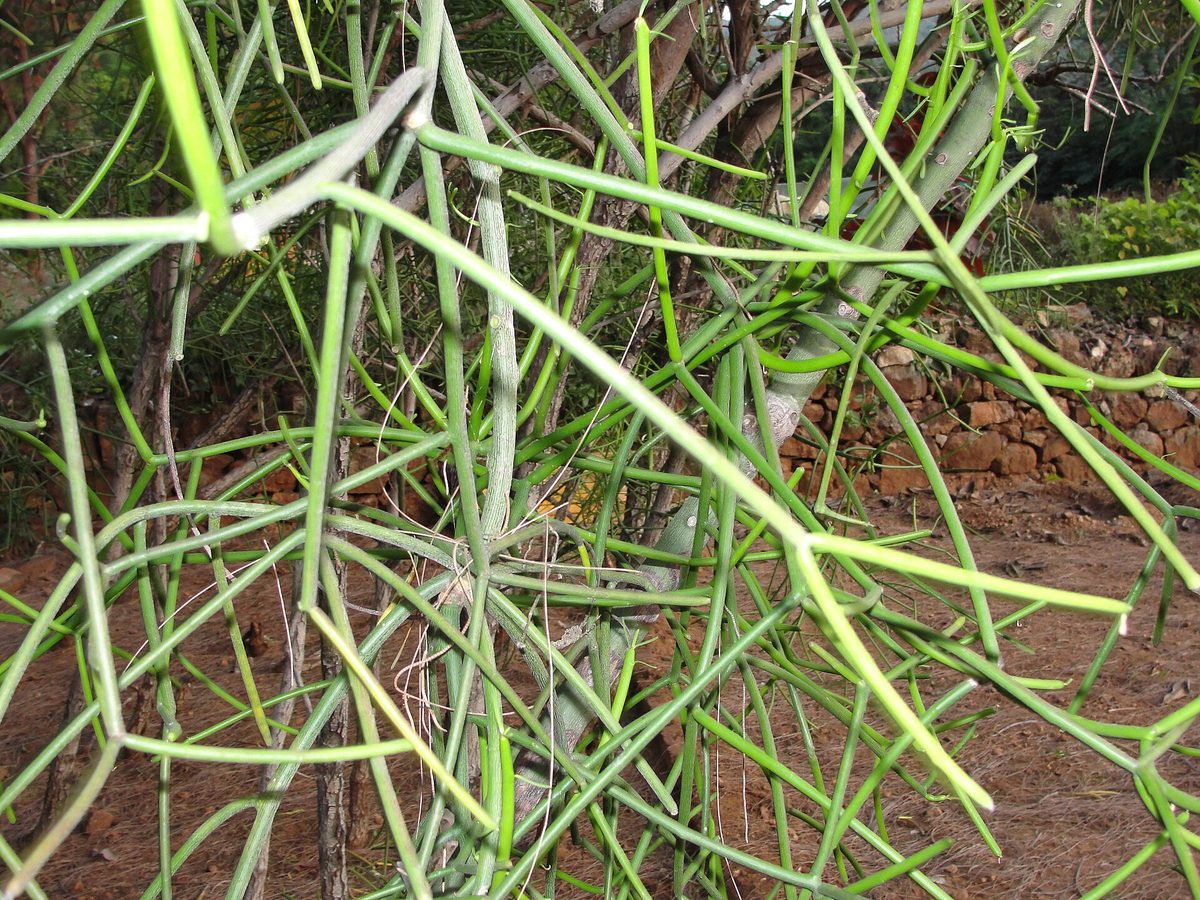
Photo: Thamizhpparithi Maari, CC BY-SA 3.0 via Wikimedia Commons

Quick facts
| Light: | Full sun11 source |
|---|---|
| Water: | Dry to medium11 source |
| Soil: | Well drained and occasionally wet11 source |
| Hardiness: | Zones 11a–12b11 source |
| Size: | 2–30 ft (0.61–9.14 m) × 1–10 ft (0.3–3.05 m)11 source |
| Growth rate: | Slow11 source |
| Bloom: | May–Jul, Yellow11 source |
| Cats: | Toxic to cats (1 source) 3 |
| Dogs: | Toxic to dogs (1 source) 3 |
| Family: | Euphorbiaceae |
How much light does an Indiantree Spurge need?
Outdoors, give Euphorbia tirucalli full sun, which means at least six hours of direct sunlight a day. Grown indoors, it does best in bright, indirect light near a window. This plant also tolerates high levels of direct light indoors. Whether outdoors in full sun or indoors near a bright window, it handles strong, direct light well.
- Light: Full sun1
How often to water an Indiantree Spurge
Water Euphorbia tirucalli about every one to two weeks, letting the soil dry out between waterings before you water it again. Its overall water need falls in the dry-to-medium range. That one-to-two-week watering interval applies as a general guide, with the soil drying out in between.
- Water: Dry to medium1
Best soil for an Indiantree Spurge
Euphorbia tirucalli needs soil with good drainage. This plant also tolerates soil that is occasionally wet, not only soil that is consistently dry. Good drainage paired with occasional wetness describes the soil conditions this species accepts, rather than one single soil type. Whether your outdoor soil leans well-drained or occasionally wet, both conditions fall within the range this plant can handle.
- Soil drainage: Well drained and occasionally wet1
Hardiness and temperature
Euphorbia tirucalli stays hardy outdoors year-round in USDA plant hardiness zones 11a to 12b. This range covers two full zones, 11 and 12, split into the a and b subdivisions. That means the coldest zone it can handle is 11a, and the warmest listed is 12b.
- Hardiness: Zones 11a–12b1
How to plant an Indiantree Spurge
You can grow Euphorbia tirucalli outdoors year-round in USDA zones 11a to 12b. Mature plants reach 2 to 30 ft (0.61 to 9.14 m) tall and 1 to 10 ft (0.3 to 3.05 m) wide. Outside zones 11a to 12b, this plant is not suited to growing outdoors through the year.
- Hardiness: Zones 11a–12b1
Winter care
This plant's documented outdoor hardiness runs from USDA zone 11a up to 12b. Gardeners in colder zones than 11a are growing it outside that documented range. In zone 12b, the warmest zone listed, outdoor conditions stay within the range this plant is documented to handle.
- Hardiness: Zones 11a–12b1
How to propagate an Indiantree Spurge
Euphorbia tirucalli can be propagated from seed or from stem cuttings, the two methods recommended for this species. Stem cuttings are the type of cutting used for this plant, rather than leaf cuttings or dividing offsets. Seed is the other recommended method listed for starting new plants of this species.
Common problems
Euphorbia tirucalli has no significant pest problems, but you should watch for nematodes, spider mites, aphids, and mealybugs. Overwatering can cause root rot in this plant. Nematodes, spider mites, aphids, mealybugs, and root rot from overwatering are the problems documented for this species.
| Problem | Kind |
|---|---|
| Nematodes | Pest |
| Spider mites | Pest |
| Aphids | Pest |
| Mealybugs | Pest |
| Root rot | Disease |
Is Indiantree Spurge toxic to cats and dogs?
The ASPCA lists Euphorbia tirucalli as toxic to cats and toxic to dogs. This means both common household pets are at risk from this plant. Cats are named specifically in this toxicity listing. Dogs are named specifically in this toxicity listing as well. This listing does not state a severity level for either animal, only that both are classified as toxic.
Pet-safe alternatives
Recommended supplies
- Soil: a free-draining mix, and a pot with a drainage hole.
Questions and answers
- Is Euphorbia tirucalli toxic to cats and dogs?
- This plant is classified as toxic to cats and toxic to dogs. Both animals are named individually in that toxicity listing, with no severity level stated.
- How much light does Euphorbia tirucalli need outdoors?
- Outdoors, it needs full sun, meaning six or more hours of direct sunlight a day. Indoors, bright indirect light suits it best, and it also tolerates direct sun.
- How often should you water Euphorbia tirucalli?
- Water it about every one to two weeks, letting the soil dry out between waterings. Its overall water need falls in the dry-to-medium range.
Sources
- NC State Extension Gardener Plant Toolbox. https://plants.ces.ncsu.edu/plants/euphorbia-tirucalli/. Accessed 15 November 2026.
- Iowa State University Extension and Outreach (Yard and Garden). https://yardandgarden.extension.iastate.edu/how-to/common-and-popular-succulent-species. Accessed 15 November 2026.
- ASPCA Animal Poison Control Center. https://www.aspca.org/pet-care/aspca-poison-control/toxic-and-non-toxic-plants/pencil-cactus. Accessed 15 November 2026.
How this page was made
- Written with AI assistance from the sources listed on this page. AI is never the source of a fact.